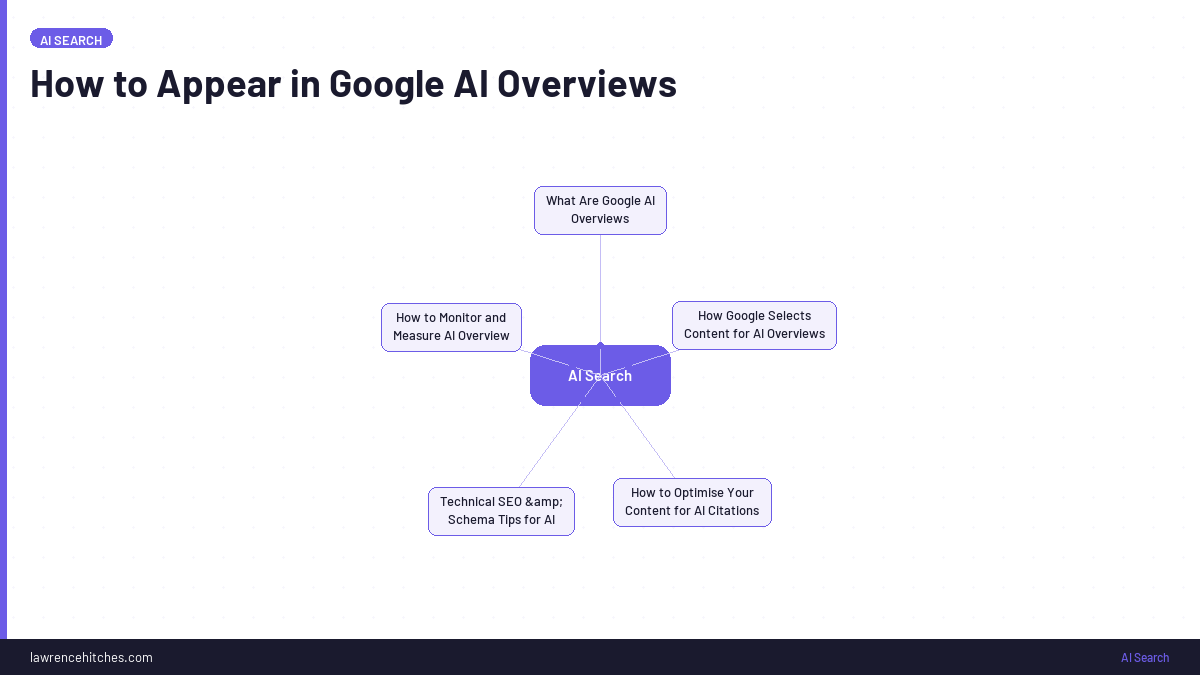
To rank in Google's AI Overviews, rank in Google's normal results first. 76% of pages cited in an AI Overview also rank in the top 10, and the median cited page sits at position 2 (Ahrefs, 1.9 million citations). The AI builds its answer from the index Google already has.
I wrote that in April 2025, before anyone had the data: if you're starting fresh, don't aim for AI Overviews, aim for rankings. The data has since caught up. What follows is the full picture, with the evidence behind each step and the parts nobody likes to say out loud.
One of them first. AI Overviews cut click-through by 34.5% in Ahrefs' study, and Seer Interactive measured drops of up to 61%. Pew found people click a normal result on 8% of visits when an AI Overview appears, against 15% when it doesn't. You get seen far more often than you get clicked. So the goal is to be the source the answer quotes.
How do you rank in Google's AI Overviews?
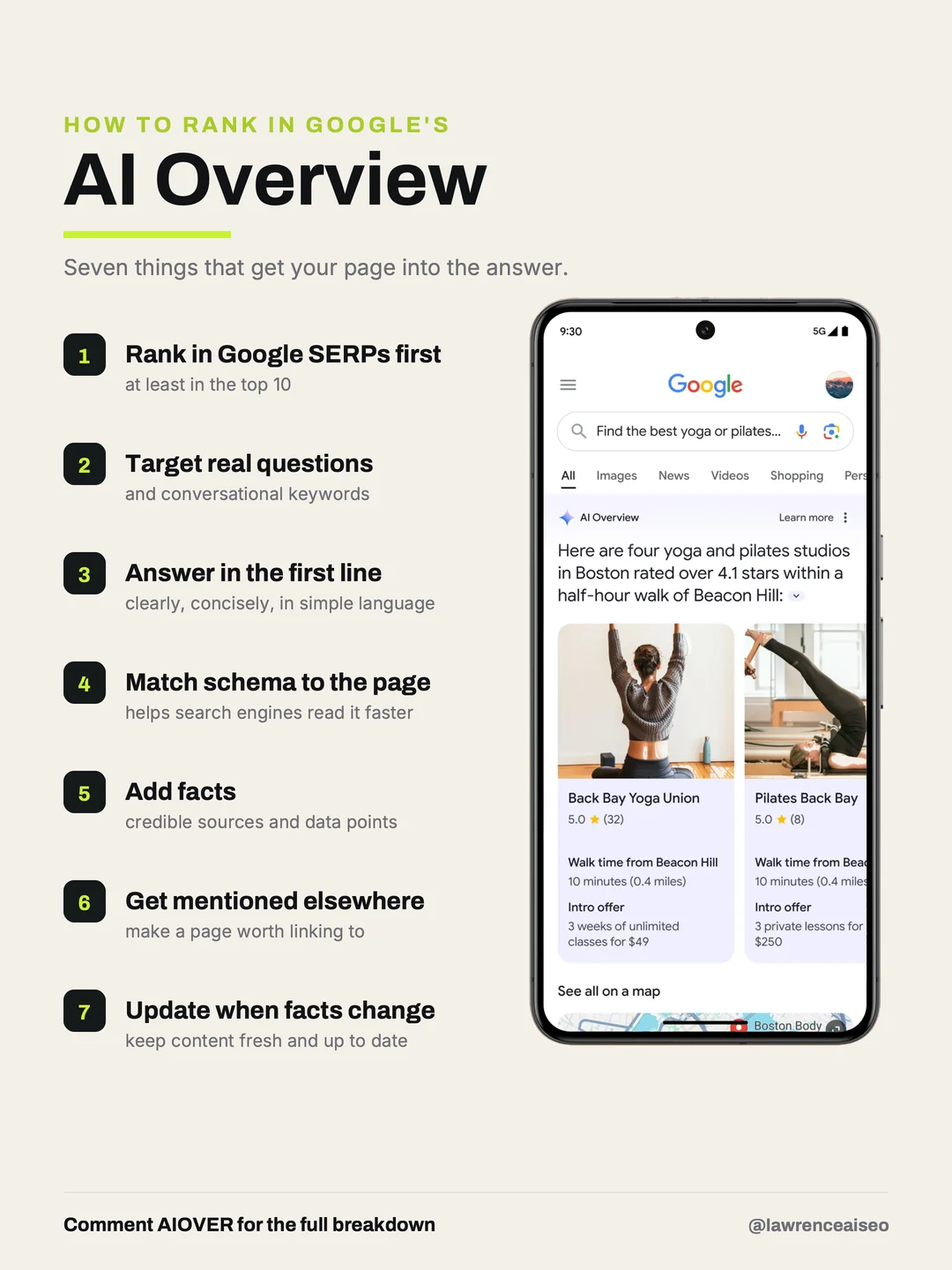
You rank in Google's AI Overviews by doing seven things well, and the first one gates the other six.
1. Rank in Google's normal results first
Get into the top 10 for the query. 76% of AI Overview citations come from there, so a page on page three rarely gets pulled in, however good it is. Position 1 carries a 33.07% chance of inclusion.
2. Target real questions
Write for the question a person actually types. AI Overviews appear on 57.9% of question searches, against 15.5% of everything else.
3. Answer in the first line
State the answer, then explain it. Declarative openings lift citation by 14%. But 53% of citations come from sentences in the middle of a passage, so the first line gets you in and the rest has to hold up.
4. Match your schema to the page
Keep your structured data honest. Google says there's no special schema to add for AI features, and its one rule is that structured data has to match what's visible on the page.
5. Add facts the other results don't have
Give the reader information they can't get from the pages already ranking. Word count correlates with being cited at 0.04, which is effectively zero. Across 150 top-three pages, median information gain was 52 out of 100, so most ranking pages leave room.
6. Get mentioned elsewhere
Build a reputation beyond your own site. Brand mentions are the single strongest factor correlated with AI Overview visibility, and 85% of high-intent AI mentions come from third parties.
7. Update when the facts change
Refresh the page when what it says stops being true. AI Overviews change with every refresh, and so do the pages they cite, so a citation you win today isn't held.
That first step matters more than the rest put together.
Do you need to rank in normal search to appear in AI Overviews?
Yes, you need to rank in normal search to appear in AI Overviews, in almost every case. The overlap is the clearest finding in the whole dataset: three quarters of cited pages already rank in the top 10.
That changes where the work goes. If a page ranks 40th, rewriting it for AI is effort in the wrong order. Fix the ranking, then the citation becomes possible.
It's also why brand strength matters so much. Pages from sites Google already trusts rank more easily, and a page that ranks gets considered. If your niche is dominated by household names, AI Overviews are hard to crack without a real budget. If nobody owns your niche yet, you have a much better shot.
Which queries trigger an AI Overview in the first place decides where that effort pays off.
What triggers an AI Overview?
An AI Overview is triggered by informational searches, especially longer questions. They appear on 21% of all keywords, and 99.9% of the keywords that trigger one are informational rather than commercial.
| Search type | Shows an AI Overview |
|---|---|
| All keywords | 21% |
| Question searches | 57.9% |
| Non-question searches | 15.5% |
| "Why" questions | 59.8% |
| One-word searches | 9.5% |
| Four-word searches | 19.5% |
| Seven words or more | 46.4% |
Source: Ahrefs analysis of 146 million SERPs, January 2026.
"Why" questions trigger them most, at 59.8%, the highest of any query type. The longer and more specific the search, the more likely Google answers it with AI.
And every search spreads further than it looks. 89.6% of queries generate two or more follow-up searches, and 95% of those follow-ups show zero monthly search volume in keyword tools. Answering the second and third question on the same page is how you show up for searches your tools never showed you.
Once an Overview fires, where your link lands inside it matters just as much.
Where can your site appear inside an AI Overview?
Your site can appear in an AI Overview in four places, and they're not equally valuable.
- The citation panel. The linked sources beside or below the answer. Only the first few are visible without a click.
- Inline links. Links attached to a specific line of the answer.
- Product or business recommendations. Named directly in the answer as the thing to buy or use.
- Follow-up suggestions. Offered as the next question or an alternative.
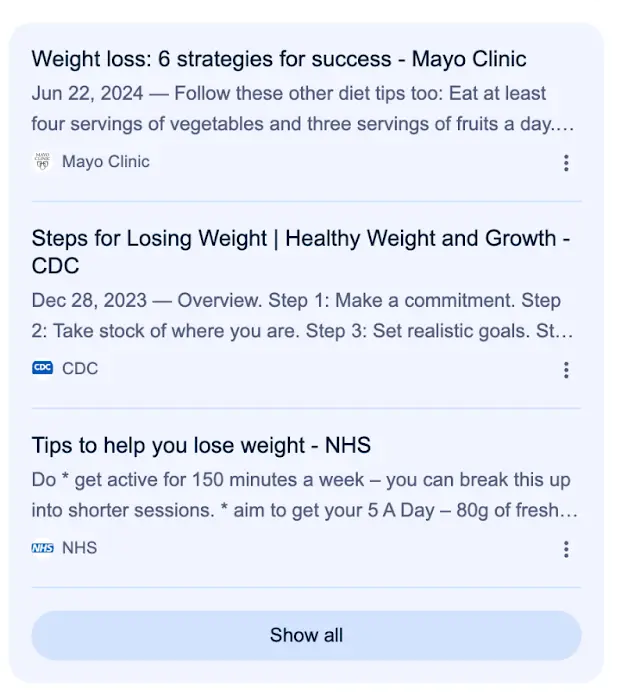
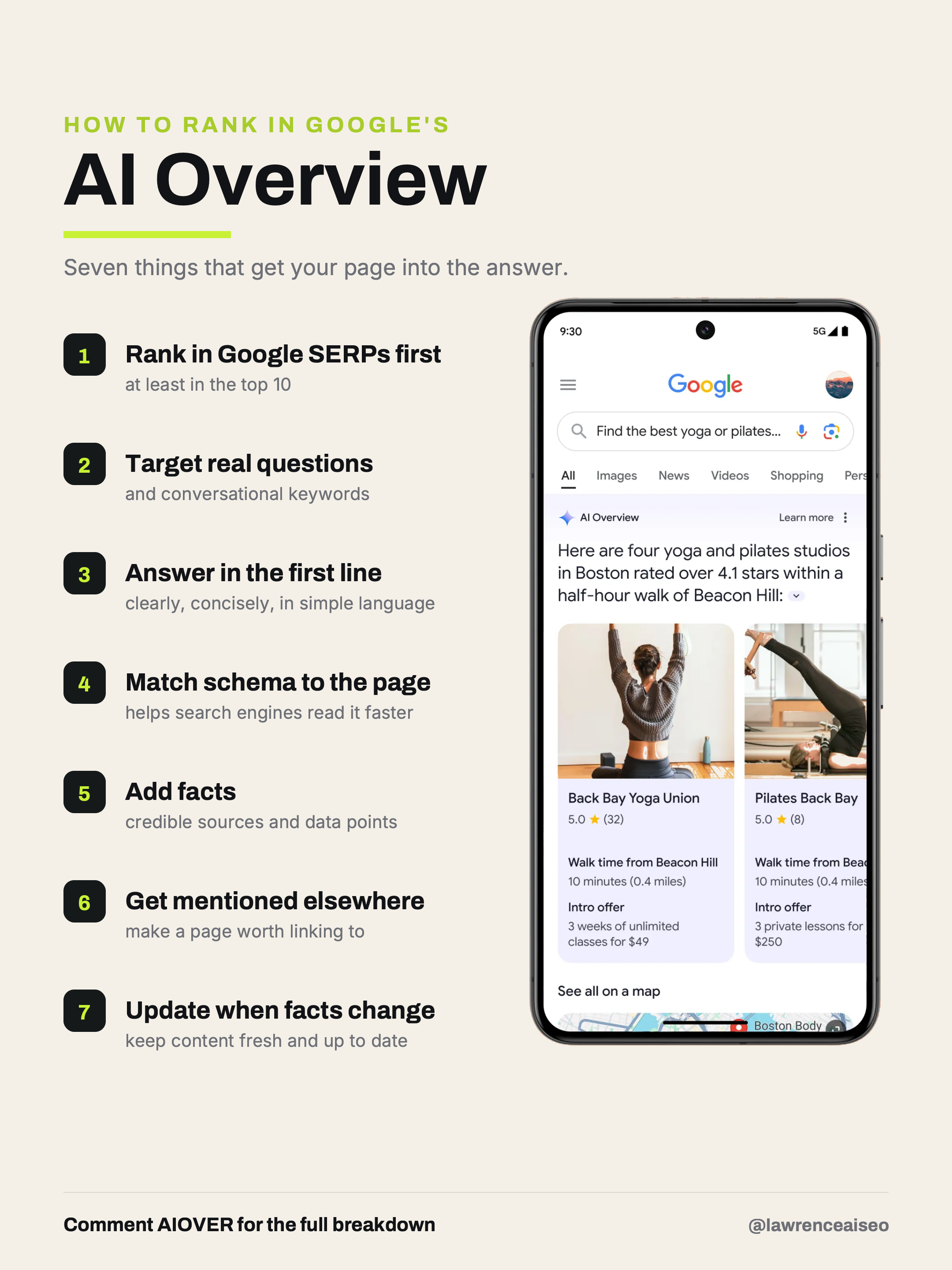
The citation panel is where most of the value sits, and it's tighter than it looks. In the example above, three sources are visible. Everything else is behind "Show all", and very few people click it.
The next question most people ask is whether schema gets them into that panel.
Does schema help you get into AI Overviews?
Schema helps Google understand your page, but there's no special schema that gets you into AI Overviews. Google says so directly: there are no new files, no AI text files and no special schema to add, because AI Overviews run on the same core systems as Search.
What Google does ask is narrower and easy to miss. Your structured data has to match the visible text on the page. Put the fact where a reader can see it, then mark it up. Schema that only exists in the code doesn't count.
Ahrefs adds a practical catch. Many AI crawlers don't run JavaScript, so schema injected client-side may never be seen at all. Keep it in the raw HTML.
You'll also see claims that pasting Google's internal tags onto your page helps. A widely shared leak described tags like Carousel and Entity that Google's AI uses internally. Those are instructions Google's own system writes to itself. Putting them on your page does nothing.
Getting the markup right still leaves the traffic question.
Do AI Overviews still send traffic?
AI Overviews still send traffic, but far less of it per impression. Click-through drops by 34.5% in Ahrefs' data and by up to 61% in Seer's, and people click a normal result on 8% of visits with an Overview against 15% without.
That doesn't make them worthless. Being the cited source puts your brand in front of the searcher at the moment they're deciding, and that shows up in branded search and direct visits later rather than as a click today. Measure it that way, or it looks like a loss.
Which brings us to tracking.
How do you track whether you appear in AI Overviews?
You track AI Overview visibility with a rank tracker that records Overview citations, plus Search Console for the clicks that do arrive.
Search Console doesn't separate AI Overview clicks from normal ones, so watch the shape instead: impressions rising while clicks stay flat on informational pages is the usual signature. Pair it with a tracker that checks whether your URL is cited for your target queries, because the citations themselves change with every refresh.
Then check the result itself. Search your own target question and see who Google quotes. If it isn't you, the seven steps above are where to start, beginning with the first.
Sources
- Louise Linehan, Ahrefs, "How to Rank in AI Overviews: What Actually Works (Based on Data, Not Speculation)", 20 January 2026. 146 million SERPs, 1.9 million AI Overview citations, 76.7 million AI Overviews.
- Seer Interactive, click-through research on AI Overviews, as reported by Ahrefs.
- Pew Research Center, click behaviour with and without AI summaries, as reported by Ahrefs.
- Google Search Central, "AI features and your website", Google's own documentation on AI Overviews and AI Mode.
- Lawrence Hitches, "How to Optimise for AI Overviews", 16 April 2025, the original prediction that rankings gate AI Overview inclusion.
Enjoying this? The 60-second versions live on Instagram.
Follow @lawrenceaiseo →Soaring Above Search
Weekly AI search insights from the front line. One newsletter. Six sections. Everything that actually moved this week, with a practitioner's take.
AI SEO consultant and AI search consultant helping brands appear in AI Overviews, AI Mode and ChatGPT. Chief of Staff at StudioHawk, Australia's largest dedicated SEO agency. Runs a measured three-channel playbook: Google, Bing and AI citations. Book a free consultation →