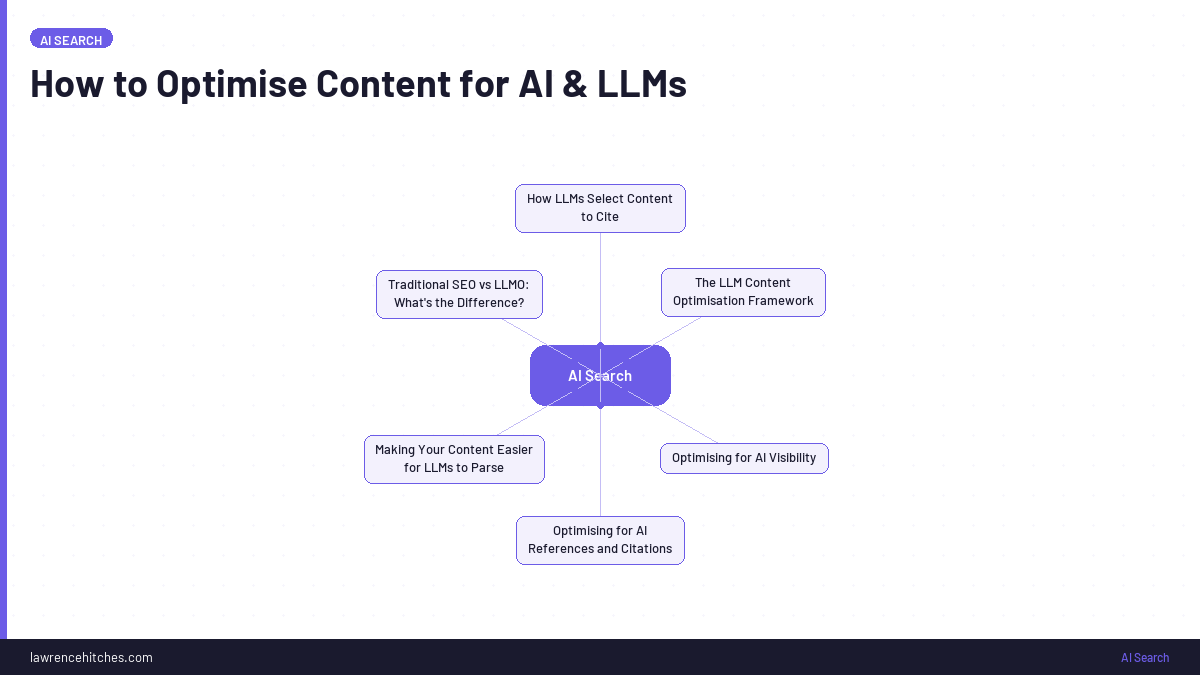
Large language models (LLMs) and generative AI systems like Google AI Overviews, ChatGPT, and Perplexity are reshaping how people find information.
If you want your brand to be enhanced through AI visibility, you need to adjust your content strategy now.
Quick answer:
Focus on well-structured, authoritative content that answers user questions directly. Build credibility through original research, and show up across multiple platforms.
Optimising for AI goes beyond traditional SEO.
This guide gives you clear, actionable strategies based on research using the LLMO (Large Language Model Optimisation) and GEO (Generative Engine Optimisation) assistant.
Optimising for AI Visibility
To show up in AI-generated responses, you need a strong online presence.
Here’s how:
- Use multiple platforms: Post content on YouTube, LinkedIn, and other trusted sites to boost branded search traffic and AI mentions.
- Create multiple contact points: Make it easy for solution-aware customers to reach you.
- Offer valuable content: Share useful resources in exchange for an email address to build trust.
- Repurpose strategically: Turn blog posts into videos (long and short) for wider reach.
- Dominate your topics: Create several content pieces around the same subject to build authority.
- Prioritise your website: Make sure your own site has strong, useful content before pushing too hard on external platforms.
- Use Google Business Profile: Collect customer reviews to boost trust and support your web presence.
Optimising for AI References
If you want AI systems to cite your content, you need to be seen as a trusted source.
- Publish unique insights: Share original research, reports, or expert analysis.
- Reference reliable sources: Link to respected materials and quote experts to show credibility.
- Rank highly in search: Content that already ranks well is more likely to be picked up by AI models.
Here’s a quick video on how to optimise for Google AI Overviews specifically:
Making Your Content Easier for LLMs to Understand
LLMs prefer clear, structured information. Here’s what to focus on:
- Use natural language: Optimise for long-tail, question-based queries.
- Structure for machines: Organise content with clear headings, short paragraphs, and logical transitions.
- Stay fresh: Update regularly based on conversations from Reddit, Quora, and forums.
- Answer clearly: Put direct answers at the start of each section.
- Enhance readability: Clear, logical structure helps both humans and machines.
Traditional SEO vs LLMO: What’s the Difference?
To make it clearer how LLMO differs from traditional SEO, here’s a simple side-by-side comparison:
| Traditional SEO Focus | LLMO Focus |
|---|---|
| Rank higher in search engine results | Get mentioned inside AI-generated answers |
| Optimise for keywords | Optimise for clarity, authority, and completeness |
| Target human readers first | Target AI systems and human readers |
| Focus on backlinks and domain authority | Focus on being a trusted, well-structured source |
| Drive traffic to website pages | Drive brand mentions and citations inside AI tools |
| Update for algorithm changes | Update for how AI systems pull and process content |
Both approaches are essential. By combining SEO and LLMO, you’ll cover both search engines and AI systems, giving your content the best chance to be seen and trusted.
FAQs About LLMO and GEO
What is LLMO/GEO?
LLMO (Large Language Model Optimisation) and GEO (Generative Engine Optimisation) are methods for making your content easier for AI systems to understand and reference.
What are the goals of LLMO/GEO?
To get your brand, product, or content mentioned or linked inside AI-generated results from tools like ChatGPT, Perplexity, or Gemini.
How is LLMO different from SEO?
SEO aims for higher rankings in search results. LLMO aims for inclusion inside the AI-generated answers themselves. It focuses more on clarity, authority, and comprehensiveness than keywords.
How long before I see results?
If you have a decent digital presence, you might notice improvements within 1-3 months.
Which is more important: SEO or LLMO?
Both matter. SEO brings visibility in search engines. LLMO gets you referenced inside AI systems. They work best together.
Final Word
Following these strategies will help you show up in AI-generated answers, improve your brand’s reach, and make your content easier for AI systems to understand.
Success today means combining traditional SEO with LLMO techniques.
As AI search keeps changing, staying sharp and updating your approach regularly is key.
Looking to apply these LLM SEO ranking factors to your own site?
I offer tailored consulting to help brands build AI-visible content, structure passages for citation, and stay ahead in the evolving search landscape.
Explore LLM SEO consulting services to get started.
Sources & Further Reading
Enjoying this? The 60-second versions live on Instagram.
Follow @lawrenceaiseo →Soaring Above Search
Weekly AI search insights from the front line. One newsletter. Six sections. Everything that actually moved this week, with a practitioner's take.
AI SEO consultant and AI search consultant helping brands appear in AI Overviews, AI Mode and ChatGPT. Chief of Staff at StudioHawk, Australia's largest dedicated SEO agency. Runs a measured three-channel playbook: Google, Bing and AI citations. Book a free consultation →