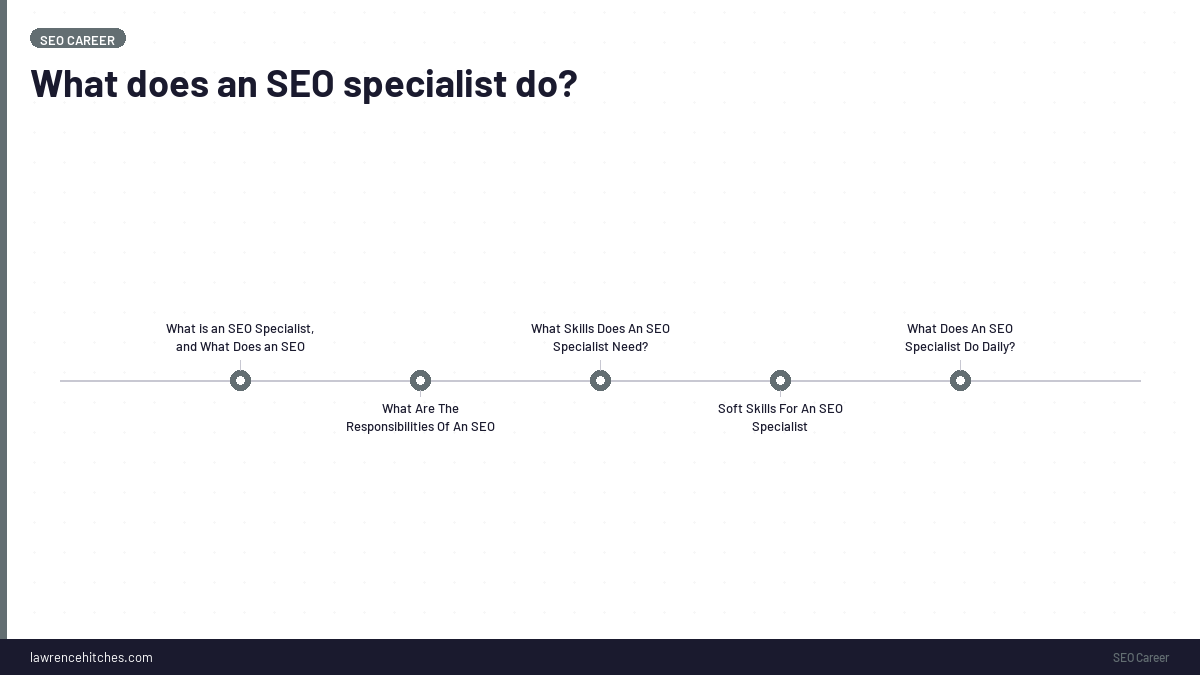
An SEO specialist is a marketing professional who improves a website's organic visibility across Google, Bing, and AI search so it earns more qualified traffic: the hands-on execution role inside an SEO team.
Also known as: SEO analyst, SEO executive, organic search specialist, search engine optimisation specialist.
I've hired over 50 SEO specialists at StudioHawk across every level. First-job juniors fresh out of university. Enterprise leads managing multi-million dollar client portfolios. Here's what that experience taught me about the role, and what most career articles get completely wrong.
An SEO specialist improves a website's visibility in Google, Bing, and AI search platforms. They research keywords, optimise on-page content, manage technical site health, and build authority through links and digital PR. The role covers strategy, content, and technical work, with growing overlap between AI-assisted production and human-led brand building.
What an SEO Specialist Actually Does
An SEO specialist's job is to make a website more visible in search engines and, increasingly, in AI-generated answers. That sounds simple. The work itself is not.
The role sits at the intersection of three disciplines that feed into each other.
Day-to-Day Responsibilities
What the job looks like in practice:
- Keyword research to identify what potential customers are actually searching for
- On-page optimisation: titles, headings, meta descriptions, internal links
- Technical audits: crawlability, site speed, indexation, Core Web Vitals
- Content strategy: deciding what to create, update, or cut
- Link acquisition: earning and building backlinks from credible sources
- Digital PR: pitching stories and data to journalists for coverage and links
- Reporting: tracking rankings, organic traffic, conversions, and campaign ROI
- Staying current with algorithm updates and AI search changes
The Three Disciplines
Not all SEO specialists do all of this equally well. The role has three main disciplines:
Technical SEO
- Site architecture
- Crawlability and indexation
- Core Web Vitals
- Structured data
Content SEO
- Keyword strategy
- On-page optimisation
- Content briefs and audits
- Internal linking
Digital PR
- Link acquisition
- Media pitching
- Data-led story angles
- Brand mentions
At smaller businesses, one person handles all three. At larger organisations, these split into separate roles with dedicated headcount.
What I Look For When Hiring SEO Specialists
There's a fundamental lack of SEO education in the market. It's not in universities. There's no certification that actually prepares you for the job. The only way you learn SEO is by doing it.
So when I'm hiring, I'm not looking for credentials. I'm looking for four things.
The Four Things That Actually Matter
- Technical capability. Can you look at a website and tell me what's broken? Can you read a crawl report? Do you understand how search engines actually work?
- Communication skills. Can you explain what you're doing to a client who doesn't know what a meta tag is? Can you write a report a CEO will actually read?
- Problem-solving attitude. SEO is uncertainty management. Algorithm updates, client pushback, technical constraints. You need someone who sees obstacles as puzzles, not roadblocks.
- Willingness to learn. SEO changes faster than almost any other marketing discipline. The person who stops learning stops being useful within 12 months.
The Wholesome Nerds Test
I jokingly say that people who love Lord of the Rings and The Matrix tend to be a good fit for our agency. It sounds ridiculous, but it's actually telling about personality.
Those people love adventure, curiosity, and the grind behind it. They're genuinely helpful but also quite nerdy and technical. At StudioHawk, we call them wholesome nerds. Whether they're assertive or more passive, those people consistently outperform and accelerate faster than anyone else we hire.
What Skills Does an SEO Specialist Need?
The technical skills are learnable. The soft skills are harder to develop and more important in the long run.
Technical Skills
- Keyword research using tools like Ahrefs, Semrush, and Google Search Console
- On-page optimisation: headings, meta tags, internal linking
- Technical auditing with Screaming Frog, Sitebulb, or similar
- Analytics: GA4, Google Search Console, click-through rate analysis
- Content strategy: writing briefs, assessing quality, identifying gaps
Soft Skills
Communication. You will constantly translate technical work into business language. If you can't explain why a 404 error matters to a CFO, you'll struggle in client-facing or leadership roles.
Adaptability. Google's algorithm changes hundreds of times a year. AI search is reshaping how content gets discovered. The best SEO specialists aren't attached to tactics, they're attached to outcomes.
Patience. SEO is measured in months, not days. You need the discipline to execute consistently before the results appear.
How Much Does an SEO Specialist Cost?
The short answer: it depends on what you actually need done. Here's a realistic framework for Australian businesses in 2026.
$1,000 to $3,000/month
Smaller businesses
An experienced specialist working part-time on your account. Covers fundamentals: keyword strategy, on-page fixes, technical health. Good for getting the foundation right.
$3,000+/month
Mid-size businesses
Full strategy execution: keyword and content planning, link building, guest post outreach. Enough budget to implement, not just advise.
$10,000+/month
Larger businesses
The full mix: strategy, technical SEO, content production, and digital PR running in parallel across multiple specialists.
The mistake most businesses make is hiring at the $1,000 tier and expecting $10,000 outcomes. Budget determines what can be executed, not just planned. An SEO specialist can identify every opportunity on your site in a $1,000 month. They can't implement the strategy, produce the content, build the links, and manage the reporting in that same budget.
In-House vs Freelance vs Agency
In-house works best for larger businesses with enough ongoing work to justify a full-time salary. You get full-time focus and deep business context, but you're limited to one person's skill set.
Freelance is flexible and cost-effective for project-based work or businesses that need a specific skill (a technical audit, a content strategy) without an ongoing retainer.
Agency suits businesses that need the full mix across technical, content, and link building without building an in-house team. The cost is higher, but the depth of capability is wider.
SEO Specialist Salaries in Australia (2026)
Before the numbers: there is no baseline title governance in SEO. No industry body, no standard, no certification controls what a role is called.
A Head of SEO at a 10-person startup might have zero direct reports and be doing keyword research daily. A Senior SEO Specialist at a large agency might be managing a team of eight. What actually shapes pay: years in the discipline, business size, marketing infrastructure, goals, vertical, and whether the role is in-house, agency, or freelance.
StudioHawk conducted a salary benchmarking exercise in April 2026, cross-referencing 36 roles against SEEK, Glassdoor, and specialist recruiter data. Here's where salaries typically land in the Australian market.
| Level | Common Title Variations | Typical AU Range (2026) |
|---|---|---|
| Entry | Junior SEO, SEO Associate, SEO Coordinator, SEO Executive | $55,000 to $70,000 |
| Developing | SEO Specialist, SEO Executive, Performance Marketing Coordinator | $75,000 to $90,000 |
| Senior | Senior SEO Specialist, SEO Strategist, Senior SEO Strategist | $95,000 to $110,000 |
| Leadership | SEO Manager, Team Lead, Enterprise SEO Manager, Head of SEO | $100,000 to $120,000 |
| Director | SEO Director, Associate Director, Head of Organic Search | $120,000 to $135,000+ |
The leadership and director bands overlap because context collapses them. A Head of SEO at a mid-size ecommerce brand might sit at $110,000 with no direct reports. The same title at a listed company with a six-person team might be $130,000+.
I've seen people with two years of experience outperform people with eight because they learned faster and adapted to how search is changing. Trajectory matters more than time served.
What to Hold Your SEO Specialist Accountable For
One of the most common complaints I hear from business owners: "Our SEO specialist sends us a rankings report every month but we have no idea if it's working."
Rankings are a lag indicator. Here's what you should actually be tracking.
The KPIs That Matter
| KPI | What to Measure |
|---|---|
| Campaign performance | Organic traffic growth, keyword position movement, conversion from organic channels |
| Account health | Client retention, satisfaction signals, whether the relationship is built on trust or just reports |
| Campaign profitability | Cost per organic lead or acquisition, compared against other channels |
Red Flags: Signs You're Being Taken For a Ride
No roadmap. A competent SEO specialist can show you a 90-day plan. If they can't tell you what they're working on and why, that's a problem.
No execution. Strategy without implementation is a waste of budget. If your specialist is full of recommendations but nothing gets built, written, or fixed month over month, you're paying for opinions, not outcomes.
Vague recommendations. "We're working on improving your authority" is not a recommendation. "We're acquiring three links this month from Australian industry publications to strengthen your /services/ cluster" is a recommendation. Specificity is a proxy for competence.
The SEO Career Path
Every career article presents a clean progression: Junior to Mid to Senior to Director. In reality, there's no standardised career ladder in SEO. The titles vary wildly between agencies and businesses.
How the Ladder Actually Works
At StudioHawk, our structure looks roughly like this:
- Junior (SEO Executive, SEO Associate): Learning the fundamentals, running audits, executing tasks under supervision.
- Mid-level (SEO Specialist, SEO Executive): Managing campaigns independently, client-facing, making strategic recommendations.
- Senior (Senior SEO Specialist, SEO Strategist): Leading complex campaigns, mentoring juniors, driving strategy.
- Leadership (SEO Manager, Enterprise Manager, Head of SEO): Cross-client or cross-team strategy, business development, team leadership.
- Director (SEO Director, Head of Organic): Setting the strategic direction for a function, reporting to executive level.
The titles matter less than the trajectory. Are you taking on more complex problems? Being trusted with bigger clients? Teaching others? That's how you know you're progressing, not by what it says on your LinkedIn profile.
How to Get Into SEO With No Experience
There's no degree or certification that fully prepares you for the job. The only way to learn SEO is by doing it.
Start with your own website or a practice project. Use Google Search Console and Ahrefs Webmaster Tools (both free). Work through the basics: keyword research, on-page optimisation, technical audits. Then apply for junior roles or internships at agencies where you'll have access to real client data.
The fastest path into the industry is showing up with something you've built and evidence of results, even small ones. A blog that grew from 0 to 500 organic visitors is more convincing than any certification.
Will AI Replace SEO Specialists?
No. But it will replace the ones who don't adapt.
The entry point for SEO is getting lower every year. Anyone can open Claude, Gemini, or ChatGPT and generate a keyword list, write a meta description, or fix a title tag. That's the commodity layer of the job, and it was always commodity work. As the floor drops, the value moves upward.
The hard part of SEO, the part AI consistently gets wrong, is connecting a business goal to a search term to an executable strategy. Knowing which keyword to target, why it connects to the business objective, and how to sequence that across a 12-month roadmap requires context and judgment that AI doesn't reliably have. It can produce a plan that looks right and is fundamentally wrong for that specific business.
Two adjacent disciplines reinforce this point.
Digital PR is increasingly central to SEO because it drives links, but the editorial angle, the hook that makes a journalist care, has to come from a human perspective. You can't automate genuine insight.
Technical SEO ties directly into website design and user experience, which is driven by human behaviour. Someone needs to interpret what users are doing and direct the response. That steering is not something AI handles well.
All of Google's recommendations point toward the same thing: create content that's genuinely helpful, not just content that exists. That's inherently a human brief.
The SEO specialist of the future designs the strategy and executes it with AI. They don't get replaced by it.
Related concepts
The SEO specialist role connects to a wider set of ideas worth knowing. Start with what an AI SEO consultant is for the strategic sibling role, topical authority for the concept specialists build toward, and AI SEO for where the discipline is heading.
Frequently Asked Questions
What's the difference between an SEO specialist and an SEO consultant?
An SEO specialist typically works in-house or at an agency, executing strategy across a portfolio of clients or a single business. An SEO consultant is usually independent, brought in for audits, strategy, or advisory work on a project or retainer basis. The distinction is as much about engagement model as skill set.
How long before SEO shows results?
Most businesses see meaningful movement in three to six months for competitive keywords, and six to twelve months for significant organic traffic growth. The timeline depends on the site's existing authority, the competitiveness of the target keywords, and how consistently the strategy is executed.
Do SEO specialists write content?
Some do, some don't. Most SEO specialists will brief content, identify topics, and assess quality, but writing output is often handled by a dedicated content writer or copywriter working alongside the SEO. At smaller agencies and in-house roles, the lines blur.
What's the difference between SEO and SEM?
SEO is organic search: unpaid rankings earned through content, links, and technical site health. SEM (search engine marketing) typically refers to paid search advertising, including Google Ads. Most SEO specialists focus on organic and don't manage paid campaigns, though generalist digital marketing roles sometimes cover both.
Is hiring an SEO specialist worth it?
For most businesses with a website that's supposed to generate leads or revenue, yes. The question is whether the budget matches the scope. A $1,000 per month engagement produces different outcomes than a $5,000 engagement. Set realistic expectations based on the investment, not on what competitors appear to be doing.
Sources & Further Reading
Watch: What Does An SEO Specialist Do? [Insights, Skills, FAQs]
Soaring Above Search
Weekly AI search insights from the front line. One newsletter. Six sections. Everything that actually moved this week, with a practitioner's take.
Chief of Staff at StudioHawk, Australia's largest dedicated SEO agency. Specialising in AI search visibility, technical SEO, and organic growth strategy. Leading a team of 120+ across Melbourne, Sydney, London, and the US. Book a free consultation →