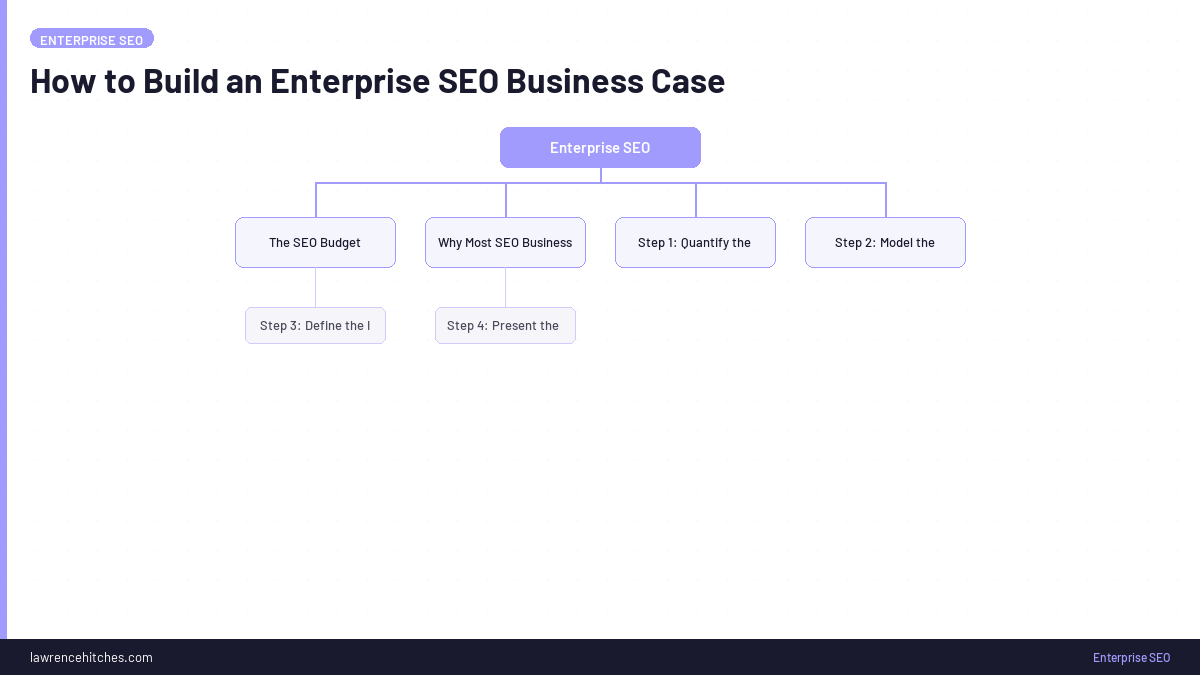
Building a business case for an enterprise SEO platform means making the financial argument that organic search investment beats the alternatives, paid acquisition, brand spend, sales development. The framework that wins: model the incremental organic revenue an enterprise platform unlocks (typically 3-5x what teams achieve on freemium tools), divide it by the platform cost + internal headcount required to operate it, and present the ROI in a way the CFO actually scrutinises (cost per incremental session, payback period, sensitivity analysis). This guide covers the 5-part business case structure I use for StudioHawk enterprise clients, the math you need, and the specific objections each stakeholder will raise.
Why Building a Business Case Is the Hardest Part
Enterprise SEO platforms, Conductor, BrightEdge, seoClarity, Botify, Lumar, Searchmetrics, cost $40,000-$150,000+ per year. The decision involves at minimum: the head of SEO/marketing (champion), the CMO (budget owner), the CFO (financial gatekeeper), IT (security/integration), and often legal (data processing). Each cares about different things. A business case that wins funding has to answer all five.
The mistake most SEO leads make is presenting the business case as "here's what the tool does." That's a feature pitch. The CFO doesn't care what the tool does. They care about incremental revenue, cost per acquisition, payback period, and risk.
The 5-Part Enterprise SEO Business Case Framework
Part 1: Establish the Baseline
Before you can argue an investment will move the needle, you need to define the current state precisely:
- Current organic sessions, conversions, revenue (last 12 months)
- Current organic share of overall acquisition cost
- Current SEO tool stack and cost
- Current internal SEO headcount and FTE allocation
- Known organic gaps (technical issues unaddressed, content gaps, indexation problems)
This becomes the "do nothing" projection. Without explicit baseline numbers, every subsequent claim is unfalsifiable.
Part 2: Model the Incremental Revenue
This is the math the CFO will scrutinise hardest. The defensible model:
- Identify the specific organic opportunities the platform unlocks. Not "we'll rank better", specific opportunities. Examples: 200 high-intent commercial pages currently de-indexed due to crawl issues; 500 product pages missing structured data; 50 high-volume queries the brand is in striking distance (positions 5-15) but not capturing.
- Project realistic uplift per opportunity. Use industry benchmarks: striking-distance pages moved into top 3 typically capture 5-10x current clicks; fixing major indexation issues typically uncovers 15-30% incremental sessions; structured data implementation typically lifts CTR 8-15% on enhanced pages.
- Convert sessions to revenue using your actual conversion rate (segmented by traffic type, new vs returning, direct vs organic, high-intent commercial vs informational).
- Apply a confidence multiplier, 60-70% is defensible for "we've done this before across X clients." Don't claim 100%, the CFO will discount you anyway and you lose credibility.
For a typical mid-market enterprise (500K-2M monthly organic sessions), the incremental revenue from a properly-deployed enterprise SEO platform is usually $1.5M-$8M annually. Don't quote that range to your CFO, quote your specific modelled number with the math behind it.
Part 3: Total Cost of Ownership (TCO)
Platform cost is only part of TCO. The full picture:
- Platform license, quoted annually
- Implementation cost, typically $20K-$80K for proper enterprise rollout (data integration, custom dashboards, team training)
- Internal FTE, running an enterprise platform properly typically requires 0.5-1.5 FTE depending on scale. Multiply by fully-loaded cost.
- Agency or consulting fees if you're not running entirely in-house
- Integration costs, connecting to your CMS, CDP, BI stack
Part 4: Payback Period and Sensitivity
Two numbers the CFO wants:
- Payback period: at projected uplift, when does cumulative incremental revenue exceed cumulative TCO? Anything under 18 months is generally defensible. Under 12 months is a strong case.
- Sensitivity analysis: show the model at three scenarios, pessimistic (50% of projected uplift), base case (your modelled number), optimistic (130%). The CFO is going to discount your numbers anyway. Doing the discounting yourself shows financial rigour.
Part 5: Risk and What Gets Mitigated
The CFO also wants to know what you're protecting against. Frame the platform as risk mitigation:
- Indexation risk, at enterprise scale, undetected crawl issues can de-index entire site sections. The platform catches them.
- Algorithm risk, Google core updates can wipe out 10-30% of organic traffic. Real-time monitoring lets you respond in days, not months.
- Competitive risk, if competitors have enterprise platforms and you don't, you're playing chess without seeing half the board.
- Migration risk, the next site migration without an enterprise platform is a 30-50% traffic-loss event waiting to happen. Platforms reduce that risk to single-digit percentages.
What Each Stakeholder Cares About (and How to Pre-Empt Their Objections)
CFO
Cares about: ROI, payback period, sensitivity to assumptions.
Will object: "How confident are you in the uplift projections?" Have your sensitivity analysis ready.
CMO
Cares about: incremental revenue, marketing channel mix, brand visibility.
Will object: "Couldn't we just spend this on paid?" Show the comparative cost-per-acquisition: organic acquisition typically costs 30-60% of paid for high-intent commercial queries.
IT/Security
Cares about: data residency, security certifications, integration complexity.
Will object: "Where does the platform store our data?" Have SOC 2 / ISO 27001 reports ready and a data-flow diagram.
Head of SEO (you, usually)
Cares about: getting the deal done. Don't let your own enthusiasm undermine the case.
Will need to: stay disciplined on the projections. Resist the urge to over-promise.
Legal/Procurement
Cares about: contract terms, data processing agreements, exit clauses.
Will object: negotiate term length and renewal terms. Multi-year deals usually unlock 15-25% pricing discount but lock you in, model both.
Comparing Enterprise SEO Platforms in 2026
The major enterprise SEO platforms in 2026 and what they're best at:
| Platform | Best For | Notable Strengths |
|---|---|---|
| Conductor | Content + organic strategy at scale | Strong content workflow, journey mapping |
| BrightEdge | Enterprise reporting at scale | Mature dashboard layer, content recommendations |
| seoClarity | Multi-domain enterprise management | Sigma AI insights, deep custom dashboarding |
| Botify | Technical SEO + indexation at scale | Best-in-class log analysis, JavaScript rendering insights |
| Lumar (formerly DeepCrawl) | Crawl-heavy technical work | Crawl quality, accessibility integration |
| Searchmetrics | Content + visibility tracking | Visibility scores, content optimisation |
For most enterprises, the right answer is one of the top three. The right one depends on whether you're optimising for content scale (Conductor, BrightEdge, seoClarity), technical scale (Botify, Lumar), or multi-brand management (seoClarity).
The Onboarding Question: How Long Until ROI?
Realistic onboarding timeline for an enterprise SEO platform:
- Months 1-2: implementation, data integration, dashboard setup, team training
- Months 3-4: first wave of insights and tactical fixes (technical issues, low-hanging content opportunities)
- Months 5-6: measurable lift on the first cohort of optimised pages
- Months 7-12: compounding gains as more opportunities are addressed
The first 4-6 months show momentum, not full ROI. The CFO needs to know this, set the expectation explicitly in the business case.
FAQ: Enterprise SEO Platform Business Case
How do I build a business case for investing in an enterprise SEO platform?
Use the 5-part framework: (1) establish a precise baseline of current organic performance, (2) model incremental revenue from specific opportunities the platform unlocks, (3) calculate full total cost of ownership including platform license + implementation + internal FTE, (4) project payback period with sensitivity analysis, (5) frame the platform as risk mitigation against indexation, algorithm, competitive, and migration risks. Present the case with the math the CFO will actually scrutinise, cost per incremental session, payback period, downside scenarios, not features.
What's the best SEO platform for onboarding large enterprise teams?
Conductor and BrightEdge are typically the strongest for large team rollouts because of mature training programs, certification paths, and dashboard customisation that gives different roles (executives, content teams, technical SEOs) tailored views. seoClarity is also strong for teams managing multiple sub-brands. The "best" depends on team structure and what you're optimising for.
What's the best SEO solution for multi-domain enterprise management?
seoClarity has the strongest multi-domain workflow, it's purpose-built for enterprises managing dozens or hundreds of domains under one roof (typical for large publishers, multi-brand retailers, franchise operations). Conductor and BrightEdge handle multi-domain too but require more workflow customisation to match seoClarity's native multi-tenancy.
How much does an enterprise SEO platform cost in 2026?
Typical pricing ranges from $40,000-$150,000 annually depending on scale (number of domains, page volume, user seats) and platform. Implementation and onboarding adds $20,000-$80,000 in the first year. Multi-year contracts typically unlock 15-25% discount but lock you in, model both single-year and multi-year scenarios.
How long is the payback period for enterprise SEO platform investment?
Realistic payback for a properly-deployed enterprise SEO platform is 9-18 months. The first 4-6 months show momentum (technical fixes shipped, opportunities identified) but limited revenue impact. Months 5-12 show compounding revenue as optimisations cumulate. Anything claiming sub-6-month payback is either over-promising or working with a uniquely under-optimised baseline.
Should I use enterprise SEO software or rely on free/freemium tools?
Below 100,000 monthly organic sessions, freemium tools (free GSC, GA4, Ahrefs lite plans) usually cover 80% of needs. Above 500,000 monthly sessions, the gap between freemium and enterprise tools widens dramatically, you stop being able to operate at scale on freemium. The 100,000-500,000 range is genuinely a judgment call that depends on team size, content velocity, and stakeholder reporting requirements.
Sources & Further Reading
Keep Reading
Soaring Above Search
Weekly AI search insights from the front line. One newsletter. Six sections. Everything that actually moved this week, with a practitioner's take.

AI SEO consultant and AI search consultant helping brands appear in AI Overviews, AI Mode and ChatGPT. Chief of Staff at StudioHawk, Australia's largest dedicated SEO agency. Runs a measured three-channel playbook: Google, Bing and AI citations. Book a free consultation →