AI visibility optimisation means structuring your content so ChatGPT, Google AI Overviews, Perplexity, and Microsoft Copilot cite your brand when answering queries in your category. Brands appearing in AI-generated answers earn a 35% CTR boost on organic results, and answer-first page structure is the single highest-leverage change for improving citation rates.
AI visibility is your brand's presence inside AI-generated answers - when someone asks ChatGPT, Perplexity, Google AI Overviews, or Microsoft Copilot a question, does your brand get mentioned or cited?
This is different from traditional SEO. Ranking #1 on Google means your blue link appears first. AI visibility means an AI system references your brand, quotes your content, or recommends your product in its generated response.
In 2026, an estimated 40% of informational queries now involve some form of AI-generated answer. If your brand isn't part of those answers, you're invisible to a growing segment of search users.
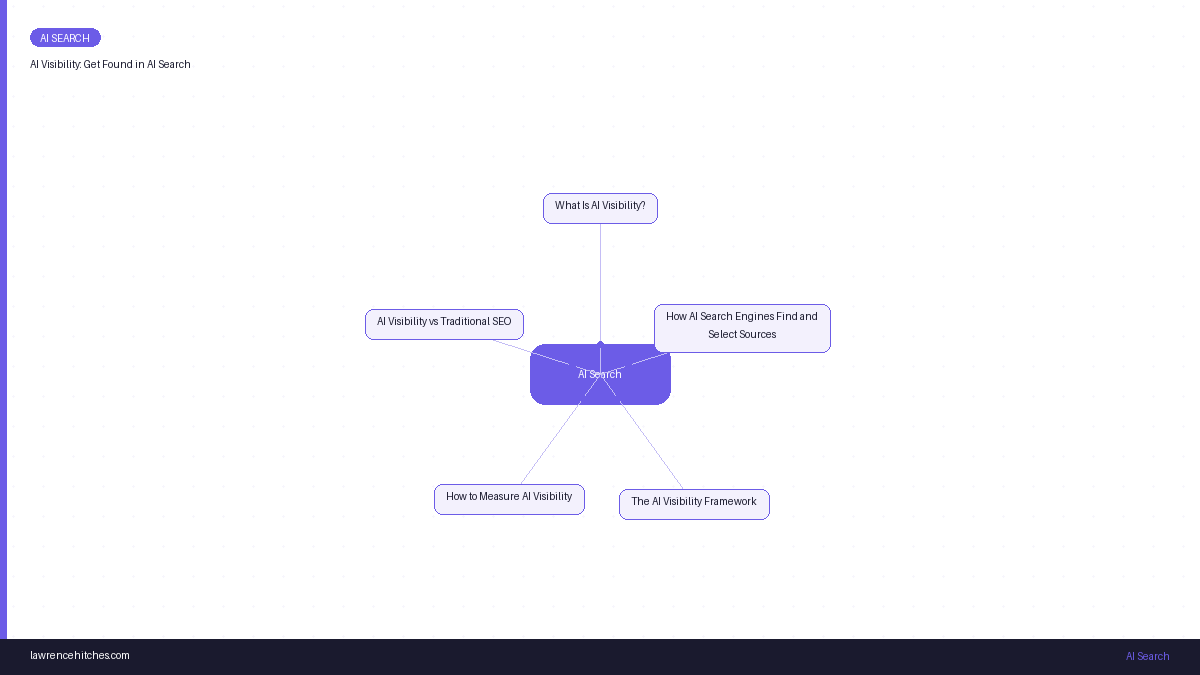
What Is AI Visibility?
AI visibility is the measure of how often and how prominently your brand or content appears in AI-generated search responses across ChatGPT, Google AI Overviews, Perplexity, and Copilot. Unlike traditional search visibility (which measures ranking positions), AI visibility measures citation frequency, whether AI platforms select your content as a source when answering user queries. The Ahrefs 75,000-brand study found that brand web mentions correlate at 0.664 with AI visibility, making it the strongest individual predictor. Traditional backlinks correlate at only 0.218 for AI visibility.
AI visibility refers to how often and how prominently your brand, content, or products appear in responses generated by AI search platforms. This includes:
- Direct citations: The AI links to your page as a source (ChatGPT Search, Perplexity)
- Brand mentions: The AI names your brand in its answer without linking
- Content extraction: The AI quotes or paraphrases your content as part of its response
- Recommendation: The AI recommends your product or service when asked for options
Each AI platform handles this differently. Understanding the mechanics of each is key to an effective AI SEO strategy.
How AI Search Engines Find and Select Sources
AI search engines select sources through a three-step process: retrieval (finding candidate pages via search index or training data), relevance ranking (scoring candidates against the user's query using semantic similarity), and grounding (selecting the most authoritative and relevant passages to cite in the response). Each platform does this differently. ChatGPT uses Bing's index plus its training data, Perplexity maintains its own crawler, Google AI Overviews draws from Google's organic index, and Copilot uses Bing exclusively. The common factor across all platforms is that clear, structured, factually specific content outperforms vague or generic content.
ChatGPT Search
ChatGPT uses real-time web browsing via GPTBot to find current information. It tends to cite pages that provide clear, direct answers with authoritative sourcing. Content structure matters - ChatGPT extracts from well-formatted pages more reliably than from walls of text.
Google AI Overviews
AI Overviews primarily cite pages already ranking in Google's top 10 organic results. Getting into AI Overviews starts with traditional Google SEO. The additional factor is content format - Google's AI favours list-based content, direct definitions, and comparison tables.
Microsoft Copilot
Copilot draws from Bing's index. Bing SEO is the foundation, with social signals playing a larger role than in Google. Schema markup and structured data significantly increase Copilot citation rates.
Perplexity AI
Perplexity uses its own index plus third-party search APIs. It cites sources inline with every claim, making it the most citation-heavy AI search platform. Well-structured, factual content with clear data points performs well.
The AI Visibility Framework
A practical AI visibility framework has four pillars: citability (is your content structured for LLM extraction with direct answers in the first 50-150 words of each section?), crawlability (can AI crawlers access your content. GPTBot, PerplexityBot, ClaudeBot allowed in robots.txt?), authority (do you have strong brand mentions, author entities, and E-E-A-T signals?), and freshness (is your content updated within the last 30 days for time-sensitive topics?). Weakness in any single pillar can exclude you from the citation pool entirely.
AI visibility optimisation has three layers, each building on the one below:
Layer 1: Technical Foundation
Before AI can cite you, it needs to be able to find and crawl your content.
- Allow AI crawlers in your robots.txt: GPTBot, ChatGPT-User, ClaudeBot, PerplexityBot, Bingbot, Googlebot
- Publish an llms.txt file - a machine-readable directory of your site's content organised by topic
- Implement schema markup: Article, FAQ, HowTo, Organization, and Person schema help AI understand your content structure
- Ensure fast, clean pages: AI crawlers have timeouts. Slow or JavaScript-heavy pages may not get fully indexed
Layer 2: Content Strategy
AI systems cite content that's structured for extraction and demonstrates authority.
- Direct answers first: Start every section with a clear, quotable answer before elaborating. AI systems extract the first sentence after a heading.
- Question-format headings: Use H2s that match how people ask questions. "What is AI visibility?" is more extractable than "Overview of the concept."
- Data and specifics: Include numbers, percentages, dates, and named sources. AI systems prefer citing content with concrete data points over vague claims.
- Comparison tables: Tables that compare options, features, or approaches are frequently extracted by AI systems.
- Build topical authority: AI systems assess overall site expertise. A cluster of 10+ articles on AI SEO signals more authority than a single post.
Layer 3: Authority and Trust
E-E-A-T signals influence which sources AI systems choose to cite.
- Named authors with credentials: Content attributed to identifiable experts gets cited more than anonymous content
- First-hand experience: Original data, case studies, and practitioner insights outperform rehashed information
- Cited sources: Linking to authoritative references (studies, official documentation, industry reports) increases your own perceived authority
- Brand presence: Being mentioned on other authoritative sites reinforces your entity in AI training data. Digital PR directly supports AI visibility.
How to Measure AI Visibility
Measuring AI visibility requires three data sources: GA4 referral traffic from AI platforms (filter for chatgpt.com, perplexity.ai, bing.com/copilot), manual prompt testing across platforms (run 20-30 relevant queries every two weeks and record which sources get cited), and branded search volume in Google Search Console (AI mentions drive branded search, making it a proxy metric for AI visibility). At StudioHawk, we track AI referral traffic as a dedicated channel, our 100-brand dataset shows ChatGPT sessions growing 19x year-over-year.
Measuring AI visibility is harder than tracking Google rankings, but several approaches work:
| Method | What It Tracks | Tools |
| UTM tracking | Direct traffic from AI sources to your site | Google Analytics 4 (utm_source=chatgpt) |
| LLM page reports | Which AI crawlers visit your pages | SEOtesting.com, server logs |
| Manual testing | Whether AI cites you for target queries | ChatGPT, Perplexity, Copilot |
| Brand monitoring | How AI describes your brand | AI SEO audit tools |
| Referral analytics | Traffic from AI domains | GA4 referral reports |
AI Visibility vs Traditional SEO
AI visibility and traditional SEO overlap but diverge on key signals. Both reward content quality, topical authority, and technical accessibility. But AI visibility weights brand mentions 3x more than backlinks (0.664 vs 0.218 correlation), prioritises freshness more aggressively (76.4% of top-cited pages updated within 30 days), and rewards content structured for passage extraction over content optimised for keyword matching. Pages ranking well in Google organic are 86% likely to appear in AI Overviews, but the reverse isn't true. You can be cited by ChatGPT while ranking on page 3 of Google.
| Factor | Traditional SEO | AI Visibility |
| Goal | Rank in search results | Get cited in AI answers |
| Success metric | Position, clicks, CTR | Citations, mentions, referral traffic |
| Content format | SEO-optimised pages | Structured, extractable, quotable content |
| Authority signals | Backlinks, domain rating | E-E-A-T, entity recognition, brand presence |
| Technical needs | Googlebot access, speed, mobile | AI crawler access, schema, llms.txt |
| Timeline | 3-6 months for results | Variable - depends on training data cycles |
The good news: most AI visibility tactics are additive to traditional SEO. Structured content, schema markup, and authority signals help both.
AI Visibility for B2B SaaS Products
B2B SaaS companies have a structural advantage in AI search visibility because their content tends to be highly specific, data-rich, and written by domain experts, exactly what LLMs prioritise when selecting citation sources. The key challenge is that B2B queries are longer and more contextual than B2C queries (averaging 8-12 words vs 3-4 for consumer searches). To capture these, structure your content around the specific workflows, integration questions, and ROI calculations that enterprise buyers ask about. Product comparison pages, integration guides, and ROI calculators are the highest-performing content types for B2B AI citation.
B2B-specific tactics:
- Create detailed integration guides for each tool in your stack (e.g., "How [Product] integrates with Salesforce for SEO reporting")
- Publish ROI calculators and benchmarking data. AI systems cite specific numbers over generic claims
- Build comparison pages against competitors with honest evaluation criteria
- Document your methodology in public-facing content. LLMs preferentially cite transparently documented processes
- Leverage customer case studies with specific metrics . "increased organic revenue by 340%" gets cited, "improved performance" doesn't
AI Visibility for Small Teams and Limited Budgets
Small businesses and solo practitioners can build AI search visibility without enterprise budgets by focusing on depth over breadth. Instead of trying to rank for broad terms, own one narrow topic comprehensively. A freelance SEO consultant who publishes the definitive guide to "local SEO for dentists" with original survey data will get cited by AI systems over a large agency's generic "local SEO guide", because the niche content has higher topical authority and information gain per page. The three highest-ROI free tactics: FAQ schema on every page (takes 30 minutes), llms.txt file at your domain root (takes 5 minutes), and monthly content updates on your top 5 pages (takes 2 hours).
Zero-budget AI visibility checklist:
- Pick one niche topic and cover it more thoroughly than anyone else
- Add FAQ schema to every article, free and takes minutes with JSON-LD generators
- Deploy llms.txt at your domain root to help AI crawlers understand your site
- Ensure GPTBot, PerplexityBot, and ClaudeBot are allowed in robots.txt
- Update your top 5 pages monthly with new data or examples
- Answer questions in Reddit and Quora where your expertise applies, these feed AI training data
- Submit to Bing Webmaster Tools and enable IndexNow (most small sites ignore Bing entirely)
Troubleshooting: Why Your Content Isn't Getting Cited
If your content ranks well in Google but never appears as an AI citation, the problem is usually one of three things: technical blocking (GPTBot or PerplexityBot blocked in robots.txt, check this first, 30% of sites have accidental blocks), content structure (your content answers questions eventually but not in the first 150 words of each section. LLMs extract 50-150 word chunks and skip pages that bury the answer), or freshness (your content is older than 30 days on a time-sensitive topic and AI systems deprioritise stale sources). Fix these three in order, each takes under an hour.
Diagnostic checklist:
- Check robots.txt, visit yourdomain.com/robots.txt and search for GPTBot, PerplexityBot, ClaudeBot. If any are blocked, that's your answer.
- Test in ChatGPT/Perplexity, search for your topic. If competitors are cited but you're not, compare their content structure to yours.
- Check GA4 for AI referral traffic, filter Traffic Acquisition for chatgpt.com, perplexity.ai. If you see zero, your content isn't in the citation pool.
- Audit your first paragraphs, does each H2 section open with a direct answer? Or does it start with context and preamble?
- Check content freshness, when was the page last meaningfully updated? If over 30 days on a fast-moving topic, update it.
- Verify schema markup, run your URL through Google's Rich Results Test. Missing Article or FAQPage schema reduces your chances.
FAQ
How do I check if my brand appears in AI search results?
Ask ChatGPT, Perplexity, and Copilot questions your target audience would ask. Note whether your brand is mentioned, cited, or recommended. Do this regularly - AI responses change as models update and re-crawl the web.
Does blocking AI crawlers hurt my Google rankings?
No. Blocking GPTBot or ClaudeBot does not affect Google rankings. However, it prevents your content from appearing in ChatGPT and Claude's answers. Unless you have a specific reason to block AI crawlers, allowing them expands your visibility at no cost.
Is AI visibility the same as GEO (Generative Engine Optimisation)?
They're closely related. GEO specifically refers to optimising for generative AI search engines. AI visibility is the broader concept - it includes GEO tactics plus brand presence in AI training data, entity recognition, and multi-platform visibility strategy.
Which AI search platform should I prioritise?
Start with Google AI Overviews (largest audience) and ChatGPT Search (fastest growing). Copilot matters if your audience uses Microsoft products. Perplexity is smaller but growing among researchers and professionals. Optimising for one generally helps with all - the fundamentals are shared.
How long does it take to improve AI visibility?
Technical changes (allowing crawlers, adding schema, publishing llms.txt) can have impact within weeks. Content and authority improvements take 2-6 months as AI systems re-crawl and re-index your site. Consistent effort compounds - sites that maintain quality content and strong E-E-A-T signals gain AI visibility over time.
Final Word
AI visibility is not a replacement for traditional SEO - it's an extension of it. The brands winning in AI search are the ones already doing great SEO: creating authoritative content, building genuine expertise, and making their sites technically sound. The additional layer is formatting that content for AI extraction and ensuring AI crawlers can access it.
Start with the technical foundation (crawlers, schema, llms.txt), build with structured content, and reinforce with authority signals. The sooner you start, the more compounding advantage you build as AI search adoption continues to grow.
Sources & Further Reading
Soaring Above Search
Weekly AI search insights from the front line. One newsletter. Six sections. Everything that actually moved this week, with a practitioner's take.
Chief of Staff at StudioHawk, Australia's largest dedicated SEO agency. Specialising in AI search visibility, technical SEO, and organic growth strategy. Leading a team of 115+ across Melbourne, Sydney, London, and the US. Book a free consultation →