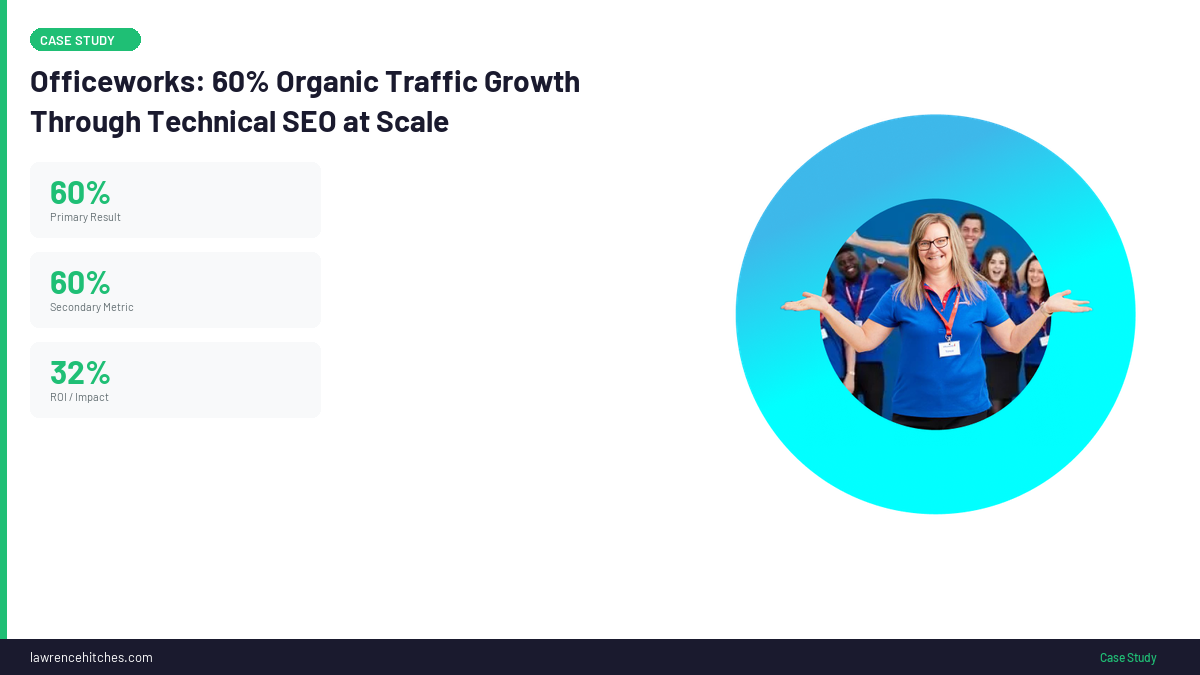
Officeworks is one of Australia's largest retailers. Over 160 stores, billions in annual revenue, and a product catalogue that runs into the hundreds of thousands of SKUs. When I took on the GM role at StudioHawk, this was one of the accounts that tested every system I'd built. Because at this scale, you can't just 'do SEO'. You need infrastructure.
This case study covers how we turned a technically broken enterprise site into a machine that delivered 60% organic traffic growth and 32% organic revenue uplift. Across a domain with hundreds of thousands of pages.
The Challenge
Officeworks had migrated to a React-based frontend. On paper, great for UX. In practice, catastrophic for SEO.
Search engines couldn't render critical pages. Googlebot was hitting JavaScript walls and walking away empty-handed. The result: thousands of high-value category and product pages sitting in a black hole. Technically live, functionally invisible.
But the rendering issue was only the surface problem. Underneath, we found:
- Orphaned category pages. High-value pages with zero internal links pointing to them, completely disconnected from the site's link equity flow
- Legacy redirect chains. Some running 4-5 hops deep, bleeding crawl budget across thousands of URLs
- Thin product content. Manufacturer descriptions copy-pasted across hundreds of pages, creating near-duplicate content at scale
- Crawl budget waste. Googlebot spending its budget on faceted navigation URLs, parameter variations, and dead-end pages instead of the pages that actually drive revenue
This wasn't a content problem or a technical problem. It was both, compounding at enterprise scale. And the longer it went unfixed, the more market share leaked to competitors who had their technical house in order.
The internal team knew something was wrong. They could see traffic flatline despite strong brand demand. But diagnosing and fixing issues across a site this large requires a different kind of SEO operation. That's where we came in.
The Strategy
I structured the team around three pillars for this account. Each one addressed a different failure mode, and all three had to work in parallel.
1. Technical Remediation. Fix What Google Can't See
The rendering problem was priority one. If Google can't process your pages, nothing else matters. Your content strategy is irrelevant, your link building is pointless.
We worked directly with Officeworks' dev team to implement server-side rendering (SSR) solutions across critical page templates. This meant Google could finally access the content that had been locked behind JavaScript execution.
Simultaneously, we ran a comprehensive crawlability audit across the entire domain. We mapped every redirect chain, identified every orphaned page, and built a prioritised remediation roadmap based on revenue potential. Not just technical severity.
2. Content Optimisation at Scale
With hundreds of category and product pages needing attention, the traditional approach of one strategist writing bespoke content for each page would have taken years. We needed a system.
We built keyword mapping templates and content frameworks that the team could apply across pages without bottlenecking on a single person. Each template included:
- Category-specific keyword clusters mapped to search intent
- Content structure guidelines (H2s, product groupings, buying guides)
- Internal linking rules connecting related categories and product pages
- Meta title and description formulas optimised for CTR in competitive SERPs
The goal was to make good SEO content the path of least resistance for anyone touching a page.
3. Client Enablement. Build Systems, Not Dependencies
This is the part I'm most proud of. We created SEO playbooks and training resources so the Officeworks internal team could scale what we'd started. Hawk Academy-style training sessions. Documentation that lived beyond our engagement.
Because here's the thing: an enterprise client shouldn't need an agency forever. They should need an agency to build the machine, train the operators, and then step back into an advisory role. That's the infrastructure mindset, and it's what separates agencies that deliver lasting value from agencies that create dependency.
We ran Hawk Academy-style workshops for their marketing team covering keyword research methodology, on-page optimisation fundamentals, and how to brief developers on technical SEO requirements. The documentation we created wasn't just a handover deck. It was an operational manual their team could reference independently for months and years after our engagement scaled back.
The Execution
We ran this as a phased campaign over 12+ months:
Phase 1 (Months 1-3): Technical triage. SSR implementation on the highest-revenue page templates. Redirect chain cleanup. We consolidated thousands of multi-hop redirects into clean 301s. Robots.txt and meta robots overhaul to stop Googlebot wasting budget on faceted URLs.
Phase 2 (Months 3-6): Content infrastructure. Deployed the keyword mapping templates across top 200 category pages by revenue. Rewrote meta titles and descriptions using CTR-optimised formulas. Built internal linking architecture connecting product pages to their parent categories and related buying guides.
Phase 3 (Months 6-9): Scale and enablement. Rolled templates out to the long tail of category pages. Trained the internal content team on SEO fundamentals. Keyword research, intent mapping, on-page optimisation. Handed over the playbooks.
Phase 4 (Months 9-12+): Optimisation and monitoring. Ongoing crawl monitoring to catch new technical issues before they compounded. Content performance reviews. Iterating on what was working and pruning what wasn't.
The key decision that made this work: we prioritised pages by revenue potential, not by volume. The top 200 category pages drove the majority of organic revenue. Fixing those first meant results showed up fast, which bought us the time and trust to fix everything else.
The Results
- 60% increase in organic traffic
- 32% increase in organic revenue
- Thousands of previously unindexed pages successfully crawled and ranked
- Significant drop in crawl errors across the entire domain
- Reduced crawl waste. Googlebot efficiency improved as budget was redirected to revenue-generating pages
- Internal team capability. Officeworks' team could independently execute SEO optimisation using the frameworks we built
What those numbers meant in practice: Officeworks was capturing search demand it had been invisibly losing for months. Categories that had flatlined started growing. Products that Google literally couldn't see were now ranking and driving purchases. And the 32% organic revenue increase wasn't driven by more branded searches. It came from non-brand category and product queries where Officeworks was finally competing with the likes of Amazon, Catch, and eBay in the SERPs.
The enablement piece had its own long-tail impact. Months after the core engagement wound down, the Officeworks team was still using the frameworks to optimise new product launches and seasonal campaigns. Exactly as designed.
"I honestly can't put into words how awesome the experience has been with StudioHawk.". Madhu Malhotra, Head of SEO at Officeworks
Key Takeaway
Enterprise SEO isn't about doing more SEO. It's about building the systems that let SEO happen at scale without breaking. Officeworks proved that the infrastructure I built at StudioHawk. The team structure, the QA processes, the templated workflows, the client enablement playbooks. Could operate at genuine enterprise scale. This wasn't one person doing great SEO. It was an infrastructure delivering it. If your site has more than 10,000 pages and you're still running SEO like a small business. One strategist, one page at a time. You're leaving money on the table. Build the system first. The results follow.