Enterprise SEO Strategy: A Framework That Scales
Most enterprise SEO strategies fail because they're built like small-business strategies with bigger budgets. That doesn't work. A strategy that scales needs cross-team alignment, ruthless prioritisation, and governance that survives team turnover.
This is the framework I've refined across 50+ enterprise engagements at StudioHawk. It works whether you're managing a 50,000-page SaaS site or a 2-million-page ecommerce catalogue.
Why Enterprise SEO Strategy Is Different
Small-business SEO strategy fits on a single page: fix technical issues, publish content, build links. Enterprise strategy requires a fundamentally different approach because:
- Implementation takes months, not days. Every recommendation competes for engineering resources.
- Multiple teams have conflicting priorities. Product wants speed. Brand wants consistency. SEO wants crawlability.
- The cost of mistakes is enormous. A bad robots.txt push on a 5-million-page site can wipe $10M in annual organic revenue overnight.
- You can't do everything. Prioritisation isn't optional. It's the entire game.
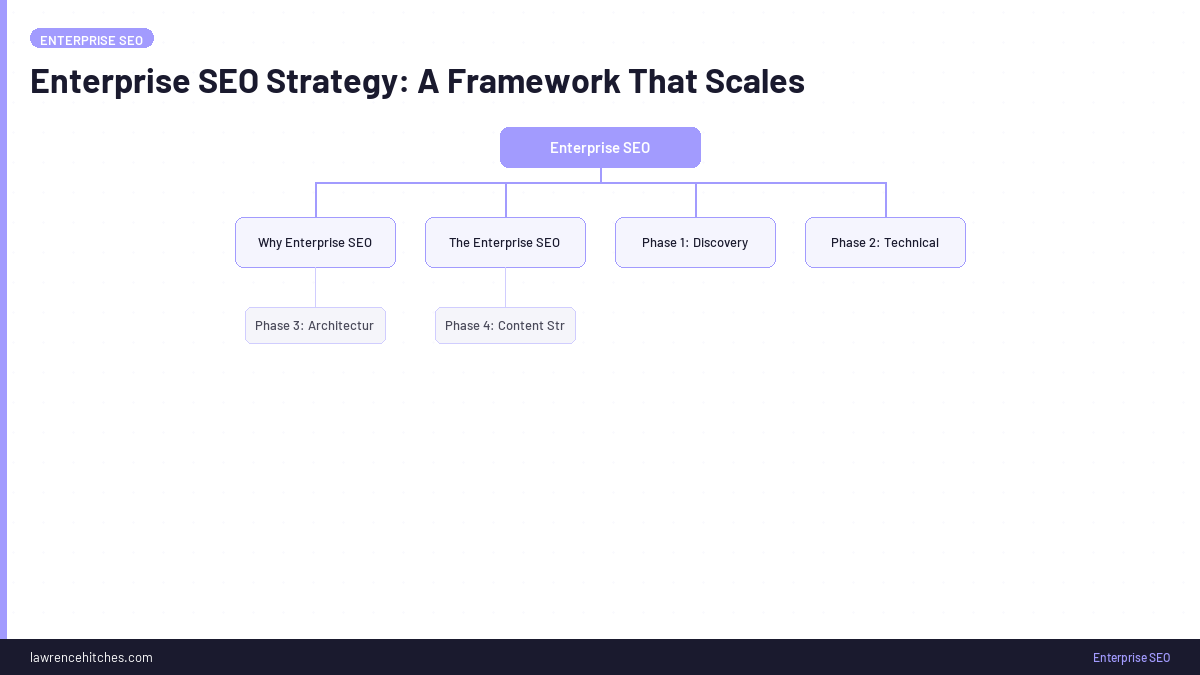
The Enterprise SEO Strategy Framework
Lawrence Hitches, AI SEO consultant, developed this framework managing enterprise accounts where a single recommendation could take three months to implement. Every phase has a clear objective, deliverable, and success metric.
| Phase | Objective | Duration | Key Deliverable |
|---|---|---|---|
| 1. Discovery | Understand the business, competitive landscape, and current state | 2–4 weeks | Situation analysis document |
| 2. Technical Foundation | Fix crawl, indexation, and rendering issues | 4–8 weeks | Prioritised technical roadmap |
| 3. Architecture & Taxonomy | Align site structure with search intent | 4–6 weeks | Site architecture blueprint |
| 4. Content Strategy | Build topical authority at scale | Ongoing | Content governance framework |
| 5. Authority & PR | Earn links and brand mentions | Ongoing | Digital PR campaign calendar |
| 6. Measurement | Prove ROI and iterate | Ongoing | Executive dashboard with revenue attribution |
Phase 1: Discovery
You can't build a strategy without understanding the terrain. Discovery covers four areas.
Business Context
What drives revenue? Which products or services are highest margin? Where is the business expanding? These questions determine where SEO effort should concentrate.
Competitive Landscape
Map your top 5–10 organic competitors. Identify where they outperform you. Not just rankings, but content depth, technical execution, and topical coverage. Use share of voice as the primary competitive metric.
Technical Baseline
Run a full SEO audit covering crawlability, indexation, rendering, Core Web Vitals, and structured data. At enterprise scale, this audit alone generates 200+ action items.
Stakeholder Mapping
Identify every person and team that touches the website. Build a RACI matrix for SEO decisions. This step gets skipped constantly and it's the reason most enterprise SEO strategies die on arrival.
Phase 2: Technical Foundation
Technical SEO is the foundation. Without it, content and links won't compound. At enterprise scale, the priority list typically looks like this:
- Crawl budget optimisation. Eliminate parameter URLs, fix redirect chains, manage faceted navigation
- Rendering. Ensure JavaScript content is accessible to Google (SSR or dynamic rendering)
- Indexation hygiene. Clean up duplicate content, canonical tags, and index bloat
- Core Web Vitals. LCP, INP, CLS at the template level, not page level
- Structured data. Organisation, Product, FAQ, Article schema at scale
I've seen enterprise sites recover 30–40% of lost organic traffic purely from technical fixes. No new content. No links. Just letting Google crawl and render the pages that already existed.
Phase 3: Architecture and Taxonomy
Site architecture determines how authority flows through your domain. Get it wrong and your most important pages starve while low-value pages absorb all the equity.
Key principles for enterprise site architecture:
- Flat hierarchy. No important page should be more than 3 clicks from the homepage
- Hub-and-spoke model. Category pages link to subcategory pages link to individual pages
- Consistent URL taxonomy. /category/subcategory/page across the entire site
- Internal linking at scale. Automated contextual links between related content using internal linking rules
Phase 4: Content Strategy at Scale
Enterprise content strategy isn't about publishing more. It's about publishing the right things with governance that maintains quality.
Read the full breakdown in Enterprise SEO Content Strategy at Scale.
The essentials:
- Keyword universe. Map every target keyword to a specific URL. No overlaps.
- Content briefs. Standardised briefs for every piece of content, including target keywords, internal links, competitive benchmarks, and word count ranges.
- Editorial workflow. Writer → SEO review → editor → legal (if needed) → publish → monitor
- Content audits. Quarterly audits to identify underperforming content for refresh, consolidation, or removal
Phase 5: Authority Building
At enterprise scale, link building shifts from outreach to digital PR and brand authority. The tactics that move the needle:
- Data-driven PR. Proprietary research, surveys, and data studies that earn media coverage
- Product-led link earning. Free tools, calculators, and resources that attract natural links
- Strategic partnerships. Co-marketing with complementary brands
- Competitor link gap analysis. Identify publications linking to competitors but not you
Phase 6: Measurement and Reporting
Enterprise stakeholders don't care about rankings. They care about revenue. Your reporting framework needs to answer one question: what is SEO contributing to the business?
Build dashboards that show:
- Revenue attribution from organic search (first-touch and multi-touch)
- Non-brand organic traffic growth (the truest measure of SEO effectiveness)
- Share of voice vs competitors for priority keyword sets
- Technical health score trending over time
- Content velocity. Pieces published vs target
Read the full guide to enterprise SEO KPIs for dashboard templates.
International Enterprise SEO
Global enterprises face additional complexity. Hreflang implementation alone can derail a quarter if done wrong.
The critical decisions:
- Domain strategy. CcTLDs, subdomains, or subfolders? Subfolders consolidate authority. ccTLDs offer geo-targeting precision. There's no universal answer.
- Content localisation. Translation is not localisation. Each market needs content adapted to local search behaviour.
- Hreflang. Implement via XML sitemap, not HTML head, at enterprise scale. See the international SEO checklist.
Getting Stakeholder Buy-In
The most technically perfect strategy is worthless if you can't get it implemented. Stakeholder buy-in requires:
- Speak in business outcomes, not SEO jargon. "We're leaving $4.2M in annual revenue on the table" beats "our crawl efficiency ratio is suboptimal."
- Show competitor evidence. Nothing motivates executives like seeing a competitor winning.
- Start with quick wins. Deliver measurable results within 30 days to build trust for larger initiatives.
- Quantify the cost of inaction. Show declining organic share of voice and the paid media cost to replace lost organic traffic.
What makes a good enterprise SEO strategy?
A good enterprise SEO strategy prioritises ruthlessly, aligns cross-functional teams, and ties every initiative to measurable business outcomes. It includes a technical foundation, content governance, authority building, and measurement framework, with clear ownership and timelines for each.
How do you prioritise enterprise SEO tasks?
Use an impact vs effort matrix. Score each task on potential organic traffic impact (based on keyword volume and current ranking position) against implementation effort (engineering hours, stakeholder approvals needed). High impact, low effort goes first. Always.
How long does an enterprise SEO strategy take to develop?
Expect 6–10 weeks from kickoff to a fully documented strategy, including discovery, technical audit, competitive analysis, and roadmap creation. Implementation then runs on a rolling basis, typically in quarterly planning cycles aligned with the business.
Do you need an agency or in-house team for enterprise SEO?
Both work. The best model is usually a hybrid: an in-house SEO lead who understands the business deeply, supported by an agency (like StudioHawk) that brings specialist expertise, tooling, and bandwidth. Pure agency models struggle without an internal champion.
Sources & Further Reading
Watch: Enterprise SEO Strategies For Maximum Growth
Soaring Above Search
Weekly AI search insights from the front line. One newsletter. Six sections. Everything that actually moved this week, with a practitioner's take.

Chief of Staff at StudioHawk, Australia's largest dedicated SEO agency. Specialising in AI search visibility, technical SEO, and organic growth strategy. Leading a team of 115+ across Melbourne, Sydney, London, and the US. Book a free consultation →