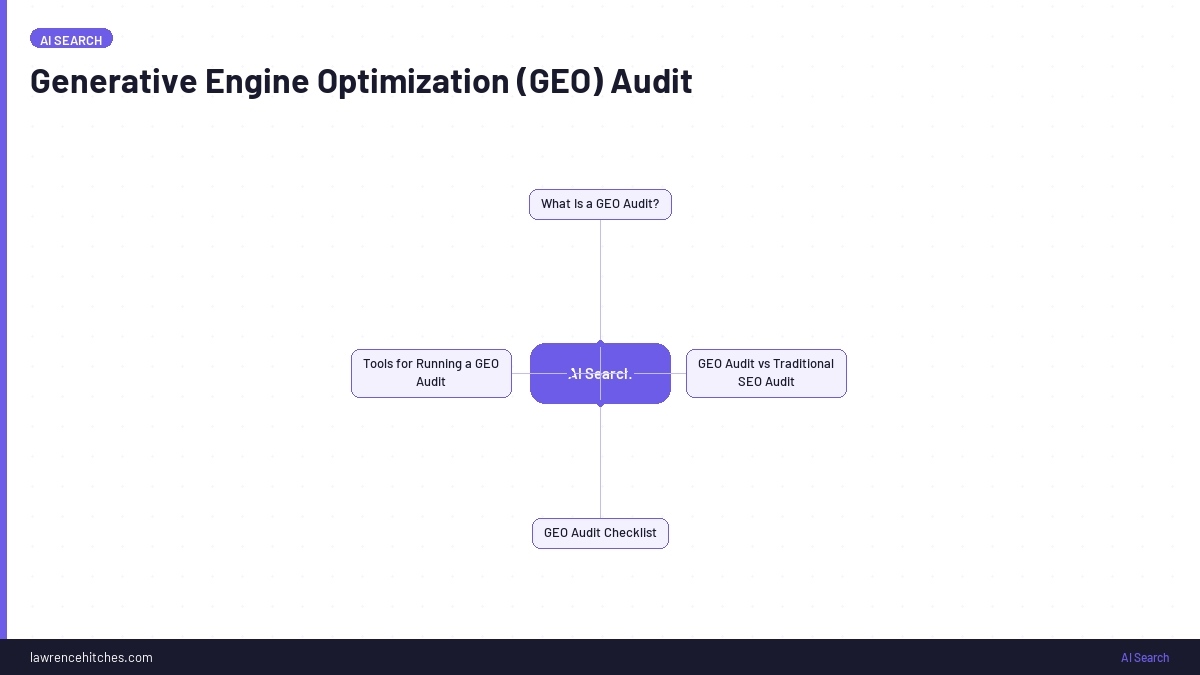
A GEO audit (Generative Engine Optimisation audit) evaluates how visible your content is across AI search engines. ChatGPT, Google AI Overviews, Perplexity, and Microsoft Copilot. Unlike a traditional SEO audit that checks rankings and technical health, a GEO audit answers one question: when someone asks an AI about your topic, does the AI cite your content?
This guide walks through the exact process we use at StudioHawk to audit AI search visibility for clients. No theory, just the steps, what to look for, and how to fix what you find.
Google's official position (May 2026): Google's AI optimization guide says you "don't need to create new machine readable files, AI text files, markup, or Markdown to appear in generative AI search," which includes llms.txt. My take: Google is right that it is not a ranking lever. But it takes seconds to generate, does zero harm, and is quietly becoming a de facto standard. Shopify rolled out native llms.txt files to every store in early 2026. Treat it as low-cost insurance, not a growth tactic.
What a GEO Audit Actually Measures
A GEO audit measures four things: citation presence (whether AI platforms cite your content when answering relevant queries), citation quality (how your content is summarised and attributed), competitive gap (which competitors are being cited instead of you), and structural readiness (whether your content is formatted for LLM extraction). Traditional SEO audits miss all four because they only measure Google rankings and technical health, they don't test whether AI systems can find, parse, and cite your content.
The distinction matters because a page can rank #1 in Google and still never be cited by ChatGPT. The ranking factors for AI citation are different: brand mentions (0.664 correlation), content structure for extraction, freshness, and topical authority matter more than backlink profiles and keyword density.
At StudioHawk, we've audited AI visibility for over 50 brands. The most common finding: pages that rank well in traditional search are structurally unprepared for AI citation. They answer questions eventually, but not in the first 150 words. They have data, but it's buried in paragraphs instead of structured in tables. They have authority, but no author entity or E-E-A-T signals that LLMs can parse.
Step 1: Prompt Testing Across Platforms
The first step in a GEO audit is testing 20-30 relevant queries across ChatGPT, Perplexity, Google AI Mode, and Copilot to see which sources get cited. For each query, record whether your content appears, which competitors appear instead, how the AI summarises the topic, and what specific passages are quoted. This creates a citation baseline, without it, you're optimising blind. Run each query in a fresh session (no conversation history) to avoid personalisation bias.
Start with your top 10 target keywords, then expand to conversational variations. AI users don't search the way Google users do, the average AI prompt is roughly 60 words, compared to 3-4 words for a typical Google search. Your prompt testing should reflect this:
- Short queries: "best enterprise SEO tools", "what is GEO"
- Conversational queries: "I'm an ecommerce manager and need to understand how to track ChatGPT referral traffic in GA4"
- Comparative queries: "Compare the top AI search optimisation approaches for B2B SaaS companies"
- Follow-up queries: "Which specific schema types help with AI search visibility?"
Record results in a spreadsheet with columns for: query, platform, cited sources (URLs), your position (cited/not cited), and the competitor cited instead.
Step 2: Content Structure Analysis
LLMs extract content in 50-150 word chunks that directly answer questions. A content structure analysis checks whether your pages are formatted for this extraction pattern. The test is simple: can you pull a self-contained, factually complete answer from the first paragraph after each H2? If the answer requires reading three paragraphs of context before reaching the point, the content isn't structured for AI citation. Pages with direct-answer lead paragraphs are cited 52% more frequently than pages using narrative formats.
For each page in your audit, check:
- H2 headings in question format, do they match natural language queries? "How to Track ChatGPT Traffic" works. "Tracking Methodology" doesn't.
- Direct-answer first paragraphs, does each section open with a 50-150 word standalone answer? This is the two-layer architecture: LLM-citable lead, then depth for Google organic.
- Specific data points, does each section include at least one specific number, statistic, or fact? Vague claims ("many companies find that...") don't get cited.
- Tables and lists, comparison tables, feature lists, and structured data are extracted more reliably than paragraphs.
- FAQ schema. FAQPage markup makes question-answer pairs explicitly available to AI systems.
Step 3: Technical Accessibility Check
If AI crawlers can't access your content, nothing else in the audit matters. Check robots.txt for GPTBot (ChatGPT), PerplexityBot, ClaudeBot, and Bingbot (Copilot). As of April 2026, roughly 30% of top websites block at least one AI crawler without realising it, often through overly broad robots.txt rules inherited from legacy configurations. Also check whether you have an llms.txt file providing AI-friendly site structure, and whether your pages render server-side (JavaScript-heavy pages may not be processable by AI crawlers).
Technical checklist:
- robots.txt: Verify GPTBot, PerplexityBot, ClaudeBot, and Bingbot are allowed on all content pages
- llms.txt: Create an llms.txt file at your domain root with site structure information for AI crawlers
- IndexNow: Implement for Bing/Copilot to ensure new content is discoverable immediately
- Server-side rendering: Test pages with JavaScript disabled, if key content disappears, AI crawlers may not see it
- Page speed: Target TTFB under 800ms, slow pages get deprioritised by AI crawl systems
- XML sitemap: Ensure it's submitted to both Google Search Console and Bing Webmaster Tools
Step 4: Entity and Authority Signals
AI search engines assess source credibility through author entities, brand mentions, and E-E-A-T signals. An entity audit checks whether your author has Person schema with verifiable credentials, whether your brand is mentioned across the web (the Ahrefs 75K-brand study found brand mentions correlate at 0.664 with AI visibility), and whether your content demonstrates first-hand experience through original data, case studies, and practitioner insights. Pages by named practitioners with verifiable credentials are cited more frequently than anonymous or generic content.
What to audit:
- Author entity: Does every article have a named author with bio, credentials, headshot, and links to professional profiles?
- Person schema: Is there JSON-LD Person schema with sameAs links to LinkedIn, YouTube, and professional directories?
- Brand mentions: Search your brand name across Reddit, YouTube, industry publications, and forums. How often are you mentioned?
- Original data: Does your content include proprietary data, original research, or case study results that aren't available elsewhere?
- Third-party profiles: Are your mentions on Wikipedia (via company page), industry directories, and speaker bio pages accurate and current?
Step 5: Competitive Citation Analysis
The most actionable part of a GEO audit is identifying which competitors are being cited instead of you and why. For each query where you're not cited, examine the cited source's content structure, word count, data specificity, author authority, and freshness. The gap between your content and the cited content reveals exactly what you need to add or change. In our experience, the most common citation gap is specificity, competitors win with concrete numbers and data points while your content has general advice.
For each competitive gap, categorise the fix:
- Structure gap: Competitor has better heading structure, direct answers, or FAQ schema
- Data gap: Competitor includes specific statistics, benchmarks, or case study data you don't have
- Freshness gap: Competitor's content is more recently updated with current platform information
- Authority gap: Competitor has stronger author credentials, more brand mentions, or more third-party citations
- Coverage gap: Competitor covers sub-queries and follow-up questions you haven't addressed
Step 6: Action Plan and Prioritisation
A GEO audit without a prioritised action plan is just a report. Prioritise fixes by impact and effort: technical accessibility fixes (robots.txt, llms.txt) come first because they gate everything else. Content structure retrofits on your top 10 pages come second. Entity and authority improvements run in parallel. New content to fill coverage gaps comes last. The goal is to move from "not cited" to "consistently cited" on your core topic queries within 60-90 days.
Typical action plan structure:
- Week 1: Technical fixes, robots.txt, llms.txt, IndexNow, schema validation
- Weeks 2-3: Content structure retrofit, add snippet leads to top 10 pages, restructure H2s as questions, add FAQ schema
- Weeks 3-4: Entity improvements, author bios, Person schema, brand mention strategy
- Weeks 4-8: Content gaps, new articles targeting uncovered sub-queries, comparison pages, data-backed analysis
- Ongoing: Monthly freshness cycle on top 10 pages, bi-weekly prompt testing, citation tracking in GA4
GEO Audit Template
Here's the checklist we use at StudioHawk for client GEO audits:
| Audit Area | Check | Status |
|---|---|---|
| Prompt Testing | 20+ queries tested across 4 AI platforms | |
| Citation baseline documented | ||
| Competitor citations mapped | ||
| Content Structure | H2s in question format | |
| 50-150 word lead paragraphs after each H2 | ||
| Specific data points in each section | ||
| FAQ schema on key pages | ||
| Technical | GPTBot, PerplexityBot, ClaudeBot allowed | |
| llms.txt deployed | ||
| IndexNow for Bing/Copilot | ||
| Server-side rendering verified | ||
| TTFB under 800ms | ||
| Entity | Author bios with credentials on all articles | |
| Person schema with sameAs links | ||
| Brand mention volume tracked | ||
| Third-party profiles accurate | ||
| Competitive | Top 5 competitors audited for each core query | |
| Citation gaps categorised | ||
| Action plan prioritised by impact |
FAQ
How is a GEO audit different from a traditional SEO audit?
A traditional SEO audit checks Google rankings, technical health, and on-page optimisation. A GEO audit checks whether AI search engines can find, extract, and cite your content. The two overlap on technical accessibility but diverge on content structure (LLM extraction vs keyword targeting), authority signals (brand mentions vs backlinks), and measurement (citation frequency vs ranking position).
How often should I run a GEO audit?
Run a comprehensive GEO audit quarterly. Between audits, run bi-weekly prompt tests across ChatGPT, Perplexity, and Google AI Mode to track citation changes. AI search platforms update their citation logic frequently, quarterly audits catch structural shifts while bi-weekly testing catches content-level changes.
What tools do I need for a GEO audit?
You need access to ChatGPT, Perplexity, Google AI Mode (or AI Overviews), and Microsoft Copilot for prompt testing. Google Search Console and GA4 for tracking AI referral traffic (utm_source=chatgpt.com). A crawling tool like Screaming Frog for technical checks. And a spreadsheet for documenting results. No specialised GEO audit tool is required, most of the work is manual prompt testing and content analysis.
Can I do a GEO audit myself or do I need an expert?
You can run a basic GEO audit using this guide. The prompt testing, technical checks, and content structure analysis are all straightforward. Where expert help adds value is in the competitive analysis (knowing what "good" looks like across different industries), content strategy (deciding what to create or restructure), and ongoing optimisation (building the monthly freshness and testing cycles that compound over time).
How long does it take to see results from a GEO audit?
Technical fixes (robots.txt accessibility, clean crawlable structure) can show impact within 1-2 weeks as AI crawlers re-process your site. Content structure retrofits typically take 4-6 weeks to reflect in changed citation patterns. Full competitive gap closure, including new content and entity building, takes 60-90 days for measurable improvement in citation frequency and AI referral traffic.
Sources & Further Reading
Enjoying this? The 60-second versions live on Instagram.
Follow @lawrenceaiseo →Soaring Above Search
Weekly AI search insights from the front line. One newsletter. Six sections. Everything that actually moved this week, with a practitioner's take.
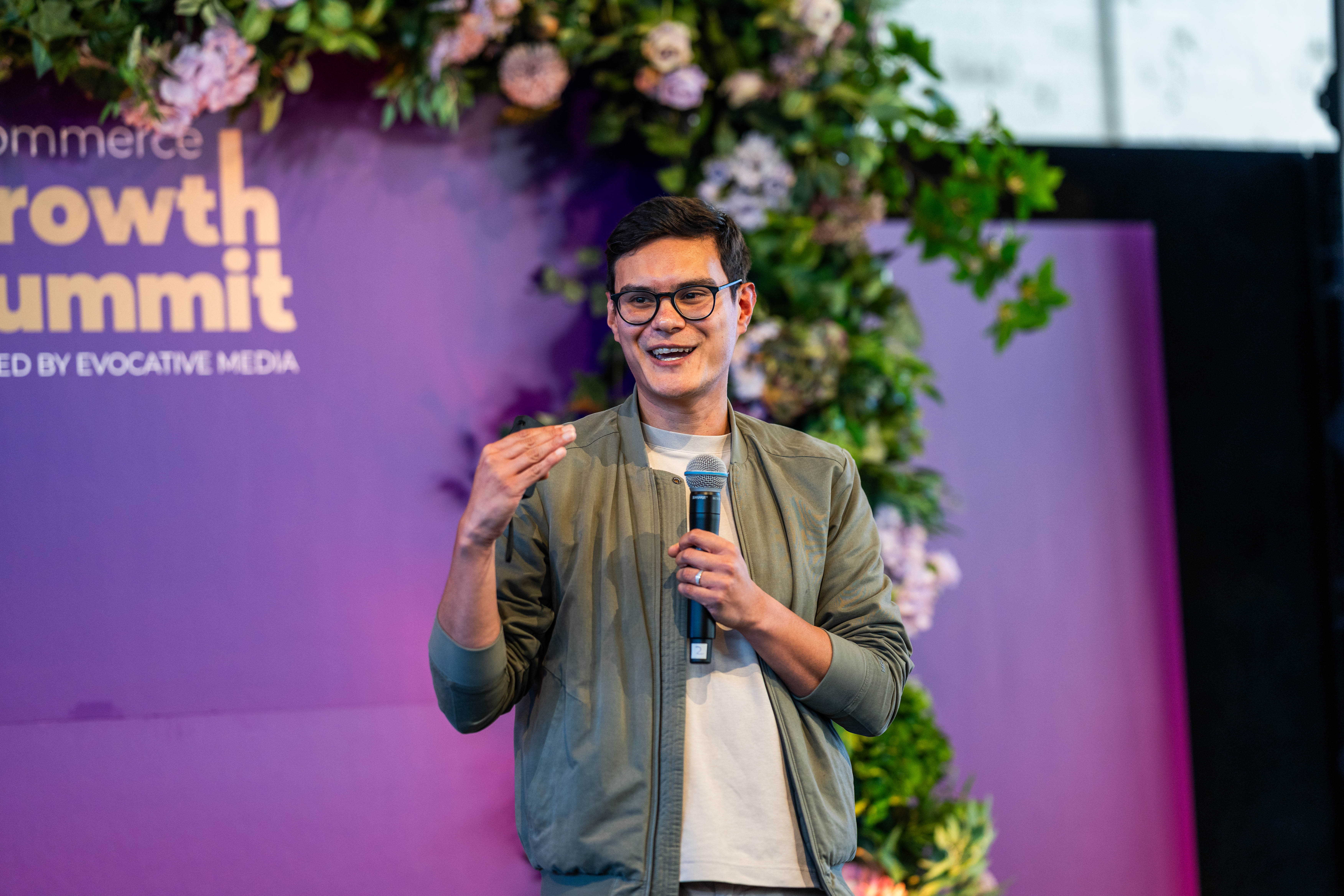
AI SEO consultant and AI search consultant helping brands appear in AI Overviews, AI Mode and ChatGPT. Chief of Staff at StudioHawk, Australia's largest dedicated SEO agency. Runs a measured three-channel playbook: Google, Bing and AI citations. Book a free consultation →