Bondi Sands is Australia's #1 self-tanning brand. Dominant at home. Stocked in every Priceline and Chemist Warehouse in the country. But search dominance in Australia means nothing when you're trying to crack the UK and US beauty markets, where the competitive landscape, the search behaviour, and the entire product discovery journey are completely different.
This was one of the international SEO accounts I oversaw at StudioHawk that required the most nuanced approach. Three markets. Three distinct search landscapes. One brand that needed to feel native in all of them.
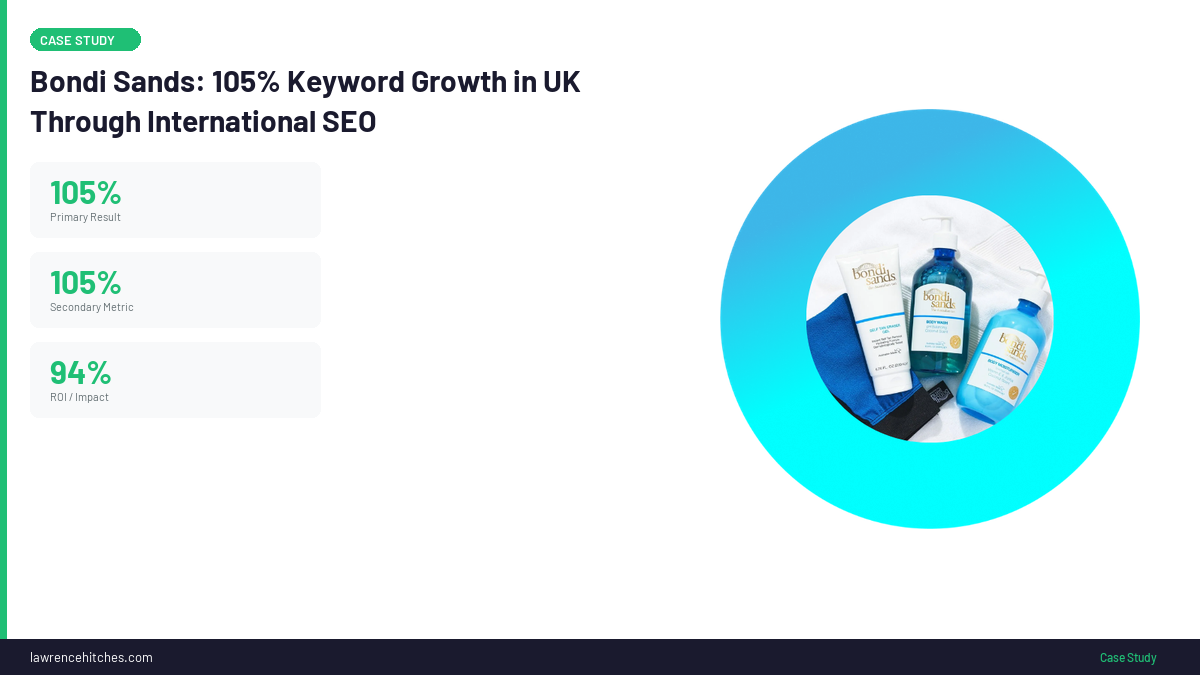
The result: 105% keyword growth in the UK, 94% in Australia, and 54% in the US. Across all three markets simultaneously.
The Challenge
Bondi Sands had already won Australia. They owned the self-tan category domestically. But international expansion through search presented a completely different set of problems.
The technical foundation was broken:
- Legacy URL duplication across international versions of the site. The same content existing on multiple regional URLs, cannibalising itself
- JavaScript redirects routing users between regions instead of proper server-side redirects, which meant Googlebot couldn't follow the redirect chain and was indexing the wrong version of pages
- Broken hreflang configuration. Search engines couldn't determine which page served which market, so UK users were seeing Australian pages and vice versa
But the deeper problem was strategic. Bondi Sands was approaching international SEO as if it were an extension of their Australian strategy. It's not.
In Australia, people search for "fake tan" and "self tanning." In the UK, they search for "fake tan" but also "gradual tanner" and "tan drops". Products and categories that barely register in Australian search. In the US, the entire category is framed differently: "sunless tanner," "self bronzer," "at home tanning."
Bondi Sands had category pages built for Australian search intent being served to UK and US users. The content didn't match what those users were actually looking for. And the site was almost entirely dependent on branded traffic. People who already knew Bondi Sands. Zero visibility for the non-branded discovery queries that drive new customer acquisition in unfamiliar markets.
The Strategy
We built a three-market strategy that treated each region as its own campaign while sharing production infrastructure across all three.
1. Technical Architecture Repair
Before any content work could begin, the technical foundation had to be rebuilt. You can't rank content that Google can't properly crawl and attribute to the right market.
We audited every URL across all three regional versions of the site. Identified and consolidated duplicates. Replaced JavaScript redirects with proper server-side 301s. Rebuilt the hreflang implementation so that every page correctly signalled its target market and language variant.
This alone had a measurable impact. Once Google could correctly attribute pages to markets, the cannibalisation stopped and existing pages started performing better immediately. We saw indexing improvements within the first crawl cycle after deployment. Google was finally understanding which pages belonged to which market, and the duplicate content signals cleared.
2. Market-Specific Content Architecture
This was the strategic core of the campaign. We conducted keyword research independently for each market. Not translating Australian keyword lists, but starting from scratch with native search behaviour data.
For each market, we:
- Mapped the full category taxonomy against actual search intent in that region
- Identified category pages that needed to be created (the UK needed "gradual tan" and "tan drops" categories that didn't exist)
- Renamed existing categories to match local search language ("self tan" vs "sunless tanner")
- Built content briefs for each new and existing page with market-specific keyword targets, competitor analysis, and content structure guidelines
We deployed 20 high-traffic pages targeting optimised search intent across AU, UK, and US regions. Each page was purpose-built for its market, not a regional clone of an Australian template.
3. Market-Specific Link Building
Link profiles need to be regionally relevant. A backlink from an Australian beauty blogger does nothing for UK rankings.
We built separate outreach campaigns for each market, targeting:
- UK: Health, beauty, and wellness publishers with .co.uk domains and UK editorial audiences
- US: Beauty and lifestyle publications with US-focused readership
- Australia: Maintained and grew the existing domestic link profile
Critically, we targeted links to inner pages. Category and product pages. Not just the homepage. Inner page link building is harder but dramatically more effective for eCommerce SEO because it puts authority exactly where the revenue-generating pages need it.
The Execution
The campaign ran in three overlapping phases:
Phase 1 (Months 1-3): Technical cleanup. Hreflang rebuild. URL consolidation. JavaScript redirect replacement. Crawl error resolution. By the end of month 3, Google was correctly crawling and attributing pages across all three markets for the first time.
Phase 2 (Months 2-6): Content architecture. New category pages deployed for each market. Existing pages rewritten with market-specific keyword targeting. Product page content updated to match local search language. Internal linking rebuilt to support the new category structure.
Phase 3 (Months 3-9): Link building and authority. Regional outreach campaigns launched. Beauty and wellness publisher relationships built in each market. Inner page link equity distributed to the highest-priority category pages.
The key insight during execution: the UK market responded fastest. Once we gave Google properly attributed, locally relevant content with regional link signals, keyword visibility climbed rapidly. The UK beauty market was actively looking for self-tan content. Bondi Sands just hadn't been showing up for it. The US market, being the most competitive and having the weakest starting position, was the slowest to respond, but even there, 54% keyword growth in a market dominated by established American beauty brands is a strong result from a standing start.
The Results
- Australia: 94% increase in ranking keywords
- UK: 105% increase in ranking keywords
- US: 54% increase in ranking keywords
- Cross-market visibility for non-branded discovery queries for the first time
- Eliminated regional cannibalisation through correct hreflang and URL structure
- Inner page authority built through targeted regional link acquisition
The UK result is the standout: 105% keyword growth in a market where Bondi Sands was virtually invisible before. That's not incremental improvement. That's going from having no seat at the table to being a genuine competitor in UK beauty search.
But the Australian numbers are equally telling. Even in their home market, the technical and content improvements drove a 94% keyword increase. Fixing your international SEO infrastructure doesn't just help new markets. It lifts everything.
"Throughout this period, our collaboration has yielded numerous successes in both our SEO, content and technical strategies.". Tyler Velasquez, Global eCommerce Manager
Key Takeaway
International eCommerce SEO is not localisation-as-translation. Every market has its own search language, its own category structure, its own competitive landscape, and its own link authority requirements. Bondi Sands proved that treating each region as its own campaign, with its own keyword research, its own content architecture, its own link building strategy. Delivers results that a one-size-fits-all translation approach never will. The infrastructure I built at StudioHawk let us run three distinct strategies under one account without dropping quality. If you're expanding internationally and your approach is "translate the Australian site," you're leaving enormous amounts of organic traffic on the table.