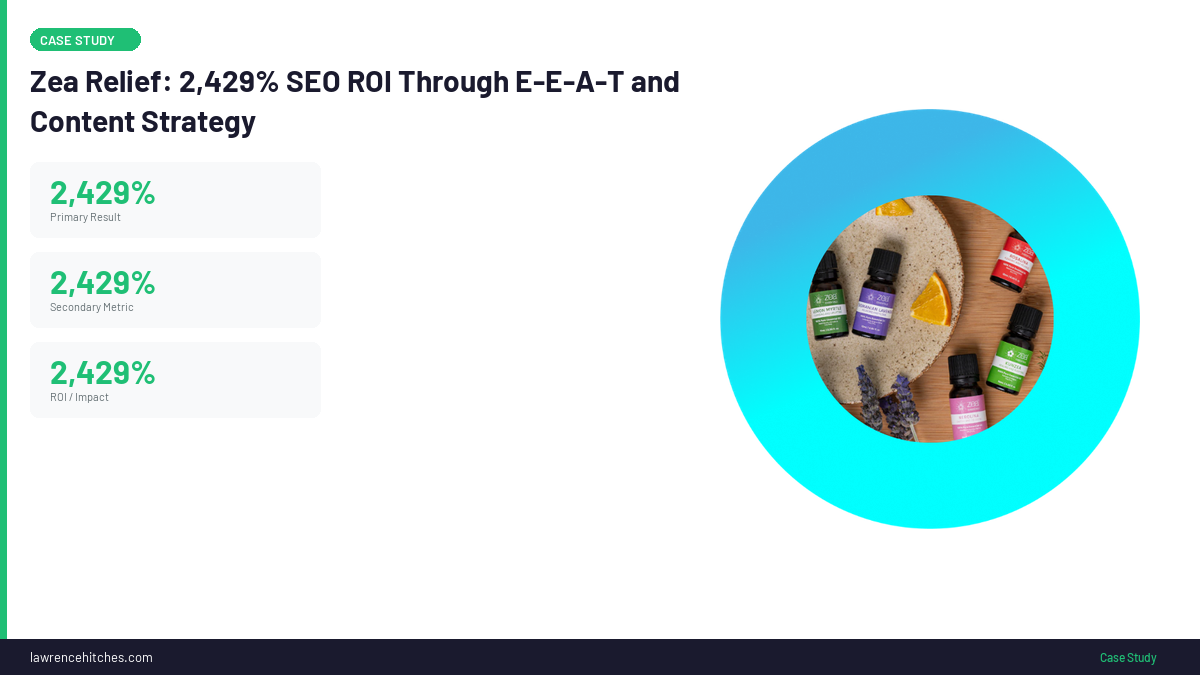
Zea Relief sells natural pain relief products. Ointments, essential oils, and aromatherapy blends made from Australian native botanicals. Solid products with genuine customer loyalty. But here's the problem: health and wellness is one of the most E-E-A-T-sensitive verticals in search. Google doesn't just want good content in this space. It demands proof that you have the authority to make the claims you're making.
This account pushed us to build frameworks for demonstrating expertise that I later applied across every YMYL client at StudioHawk. The result: 2,429% ROI from their SEO investment.
The Challenge
Zea Relief had three overlapping problems that all needed solving simultaneously.
The E-E-A-T barrier. Google's Quality Evaluator Guidelines are explicit: content about health, wellness, and anything that could affect someone's physical wellbeing is held to the highest standard. This is YMYL. Your Money or Your Life. Google wants to see demonstrated expertise, verifiable credentials, and properly sourced claims before it'll rank health content. Zea Relief had none of this infrastructure in place. No author pages. No credential signals. No citations or sourcing on health-related claims. Their content could be medically accurate and genuinely helpful, but without the trust signals Google looks for, it was effectively invisible.
The migration risk. On top of the E-E-A-T challenge, Zea Relief was planning a site migration. New platform, new URL structure, new design. In normal circumstances, a migration is high-risk for SEO. For a site that already had limited organic visibility, a poorly managed migration could wipe out what little they had, and in a YMYL vertical, recovering from a traffic drop takes significantly longer than in less scrutinised industries.
The discovery problem. Even if we solved E-E-A-T and managed the migration perfectly, Zea Relief had a fundamental visibility issue. Their product pages were optimised for product names, not for how people actually search for pain relief solutions. Nobody searches for "Zea Relief kunzea ointment" unless they already know the brand. They search for "natural pain relief cream," "essential oils for back pain," "Australian native plant remedies." The site wasn't showing up for any of these discovery queries.
The Strategy
I built the strategy around a principle I've come back to on every YMYL account since: in health and wellness, trust signals aren't a nice-to-have. They're the prerequisite. Without them, your technical SEO and content strategy are irrelevant because Google won't rank you regardless.
1. E-E-A-T Signal Architecture
This was the foundation everything else built on. We created a comprehensive trust signal framework:
Author pages with verifiable credentials. Every piece of content on the site needed to be attributed to a real person with demonstrable expertise. We built dedicated author bio pages that included qualifications, professional affiliations, and links to external profiles that could be independently verified. This wasn't about creating fake authority. Zea Relief's team and advisors genuinely had relevant expertise. We just needed to make that expertise visible to both users and search engines.
Content sourcing standards. Every health claim on the site was reviewed and linked to legitimate sources. Peer-reviewed research, government health resources, established medical references. We created a content sourcing checklist that the team could apply to every new piece of content going forward.
Schema markup for expertise signals. We implemented author schema, organisation schema, and medical-relevant structured data across the site. This made it easier for Google to understand the relationship between the content, the authors, and the organisation's credentials.
2. Site Migration Management
We managed the migration as a parallel workstream to the E-E-A-T build. The approach was straightforward but rigorous:
- Pre-migration crawl baseline capturing every URL, its ranking position, and its traffic contribution
- Comprehensive redirect mapping. Every old URL to its new equivalent
- Post-migration crawl monitoring for the first 30 days, checking for broken redirects, indexing issues, and crawl errors
- Cross-domain tracking setup so analytics continuity wasn't lost during the transition
The migration went clean. Zero authority loss. This is one of those things that doesn't get celebrated because the win is that nothing bad happened, but in SEO, a clean migration is a genuine achievement.
3. Educational Content Strategy
With the E-E-A-T foundation in place and the migration complete, we built a content strategy designed to capture the discovery queries Zea Relief was missing.
The content targeted three query clusters:
- Condition-based queries: "natural remedies for arthritis," "essential oils for muscle pain," "plant-based pain relief". These are the queries people search when they're looking for solutions, not brands
- Ingredient-based queries: "kunzea oil benefits," "Australian native essential oils," "eucalyptus oil for pain". These queries indicate someone researching the active ingredients Zea Relief uses
- Comparison and buying queries: "best natural pain relief cream Australia," "essential oil brands Australia". Commercial intent queries where a purchase decision is imminent
Every piece of content followed the E-E-A-T standards we'd built: attributed to a credentialed author, properly sourced, with appropriate disclaimers where needed. This wasn't about gaming the system. It was about meeting the genuine quality bar that Google requires in health content.
4. Technical SEO Overhaul
Alongside the content and E-E-A-T work, we ran a comprehensive technical cleanup:
- Broken link audit and repair across the entire domain
- Schema implementation. Product schema, FAQ schema, how-to schema on relevant pages
- Site speed optimisation. Image compression, render-blocking resource cleanup
- Internal linking restructure connecting educational content to product pages, creating a natural pathway from research to purchase
5. Product Page Repositioning
We rewrote product page content to align with how people actually search for pain relief solutions. Instead of leading with product names and brand features, we restructured pages around:
- The problem the product solves (back pain, joint stiffness, muscle recovery)
- The active ingredients and their evidence base
- How to use the product (application guidance, dosage, frequency)
- Who the product is suitable for
This repositioning meant product pages could capture search demand from people looking for solutions, not just people who already knew the brand name.
The Execution
Months 1-2: Migration and technical foundation. Managed the site migration. Ran the technical SEO audit. Began the E-E-A-T signal build. Author pages, sourcing standards, schema markup.
Months 2-4: E-E-A-T deployment and content launch. Author pages live. Content sourcing standards applied retrospectively to existing pages. First wave of educational content published targeting condition-based and ingredient-based queries.
Months 4-6: Product repositioning and internal linking. Product pages rewritten with solution-focused copy. Internal linking structure deployed connecting educational content to product pages. Second wave of blog content published.
Months 6-9: Scale and optimisation. Expanded the content calendar. Monitored which content clusters were driving the most traffic and conversions. Doubled down on the highest-performing query categories. Ongoing technical monitoring and link building.
The Results
- 2,429% ROI from SEO investment
- 68% increase in organic users
- 283% increase in top 3 keyword rankings
- Featured snippet for Australian native essential oils
- Zero authority loss during site migration
- Established E-E-A-T framework that became standard operating procedure for all YMYL clients at StudioHawk
The 2,429% ROI speaks for itself. But the featured snippet result is worth highlighting separately. Winning a featured snippet in a health and wellness vertical, where Google is most cautious about what it surfaces. Is direct validation that the E-E-A-T framework we built was working. Google trusted the content enough to put it in position zero.
The 283% increase in top 3 rankings tells the same story. Zea Relief wasn't just appearing in search. They were appearing at the top. For a brand that was virtually invisible before we started, that shift represents an entirely new customer acquisition channel.
Key Takeaway
In YMYL verticals, E-E-A-T isn't a nice-to-have. It's the barrier to entry. If you sell health products, financial services, legal advice, or anything else that falls under Google's heightened quality standards, your SEO strategy needs to start with trust signals. Not keywords, not links, not technical fixes. Build the author pages. Source your claims. Make your expertise verifiable. The author page framework and content sourcing standards we built for Zea Relief became standard operating procedure across every YMYL client at StudioHawk, and the pattern repeats: once Google trusts you, everything else compounds. Without that trust, nothing else matters.