Low Quality & Thin Content Checker
Paste your content or a page URL and get an instant quality score with the exact issues holding it back. Free, no signup to see your score. It is a thin content checker, a keyword-stuffing detector and an E-E-A-T gap finder in one pass.
Optimising for a keyword? Add a target keyword, title and meta (optional)
Nothing you paste leaves your browser. The analysis runs entirely on your device.
Get the full fix guide for every issue above
Your score and flags are above. Enter your email and I'll unlock the step-by-step fix for each flagged issue, plus my full content quality checklist. No spam, unsubscribe anytime.
What this checks: the signals Google's helpful content systems actually weigh. Thin word count, keyword stuffing, AI filler phrases, hard-to-read sentences, weak specificity, missing first-hand experience, and poor structure.
Tip: pasting HTML or Markdown also checks your heading structure, and the optional target keyword, title and meta description fields add keyword-placement checks and a Google preview. The full fix guide for each issue is one email away.
Got a whole site of thin content?
This tool checks one page at a time. If you have hundreds of pages and need to know which to fix, merge, or cut, that is exactly the kind of content audit I run.
Book a free consultation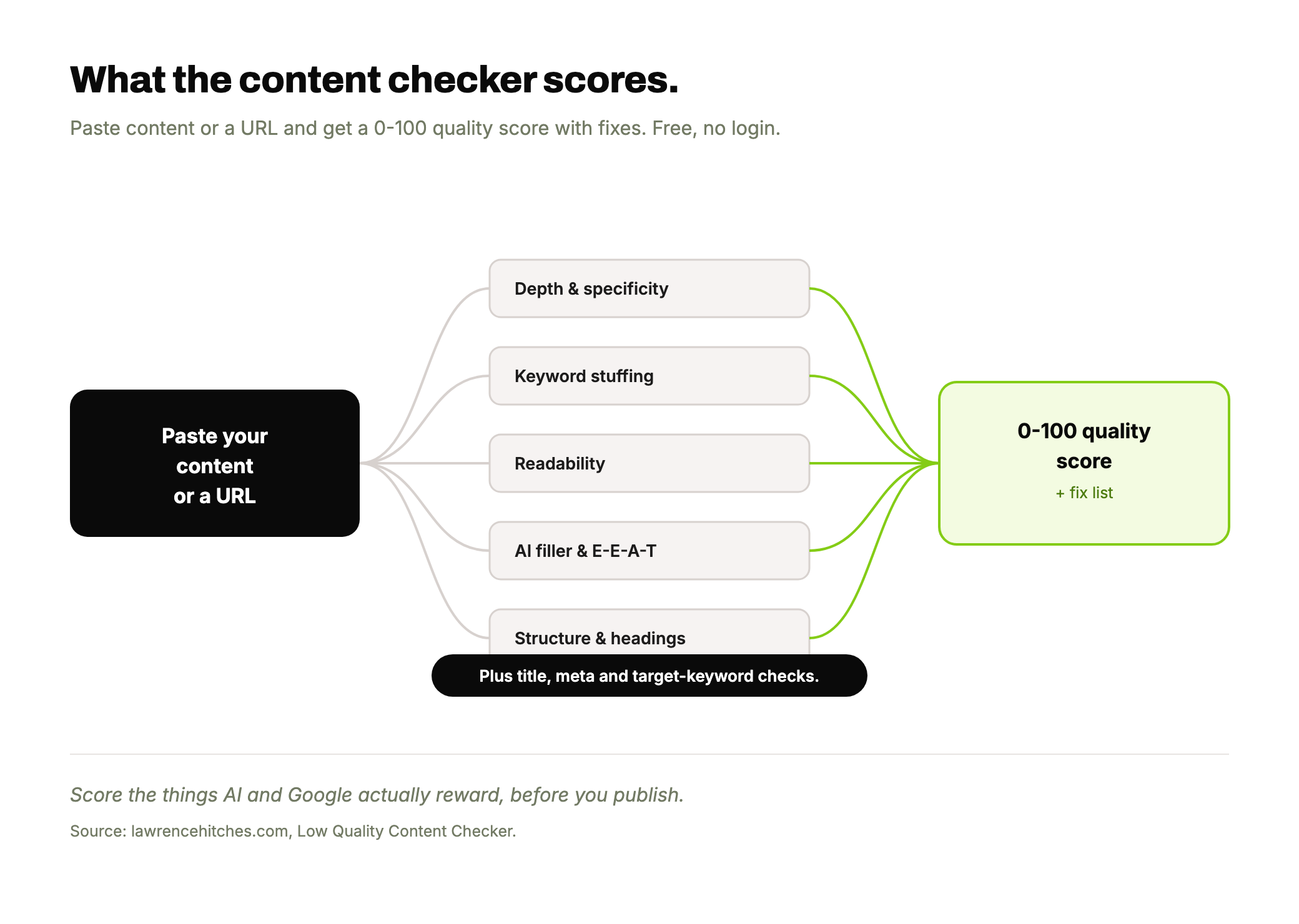
What are the signs of low quality content?
The signs of low quality content are thin coverage, keyword stuffing, AI filler phrases, hard-to-read sentences, no specificity, no first-hand experience and weak structure. It is not about grammar or spelling. It is content that fails to help the person who searched for it, content that repeats what every other page already says, with nothing original added. You will also see it called low value content or thin content; this checker flags all of it. Google's helpful content systems are built to find exactly this, and AI search engines like ChatGPT and Perplexity simply skip past it when choosing what to cite.
After auditing thousands of pages, the same signals show up on the content that gets demoted or ignored. This checker scores your content against the most reliable of them:
- Thin content. Too few words to genuinely cover the topic. Length is not a ranking factor, but coverage is, and very short pages rarely cover anything fully. See the full breakdown in my guide to thin content and how to fix it.
- Keyword stuffing. The same term repeated far above natural density. A 2026 relic that still actively hurts pages.
- AI filler. Phrases like "in today's digital landscape" and "it is important to note" that signal generic, mass-produced writing.
- Poor readability. Long, dense sentences that bury the point. Both human scanners and AI extractors prefer short, clear passages.
- No specificity. No numbers, examples, or data. Commodity content that could have been written about any brand in the category.
- No first-hand experience. The "E" in E-E-A-T. Content with no sign anyone actually did the thing they are writing about.
- Weak structure. Walls of text with no scannable chunks, headings, or lists.
How to fix low quality content
Once you know which signals are firing, the fix is rarely a full rewrite. Most low quality pages need information gain, a few real examples, a data point or two, tighter sentences, and a clearer structure. I walk through the full process, including when to merge or redirect a page instead of fixing it, in the thin content guide and the E-E-A-T guide.
Frequently asked questions
What counts as low quality content?
Low quality content is thin, generic, or unhelpful content that adds nothing a reader cannot get elsewhere. The common signals are very short word counts, keyword stuffing, AI filler phrases, hard-to-read sentences, and no first-hand experience or original data.
Is this low quality content checker free?
Yes. Paste your content and get an instant quality score and flagged issues for free. The detailed fix guide for each issue is emailed to you at no cost.
Does this detect AI-generated content?
It is not an AI detector and does not claim to be. It flags the patterns that make AI-written content low quality, filler phrases, low specificity, and missing first-hand experience, which is what Google's helpful content systems actually assess. Plenty of AI-assisted content scores well here once a human adds real substance.
Is this a thin content checker?
Yes. Thin content is one of the main signals this checker scores. It flags word counts too low to cover the topic, plus the signals that usually travel with thin pages: no examples, no data, and no first-hand experience. For the full find-and-fix process across a whole site, see the thin content guide.
What is the difference between thin content and low quality content?
Thin content is one type of low quality content: too little substance to help the searcher. Low quality is the broader bucket and includes stuffed, generic, unreadable, or inexperienced content at any length. A 3,000 word page can still be low quality; a 200 word page is almost always thin.
Built by Lawrence Hitches, AI SEO Consultant. Related: Thin content guide · E-E-A-T guide · SEO audit.