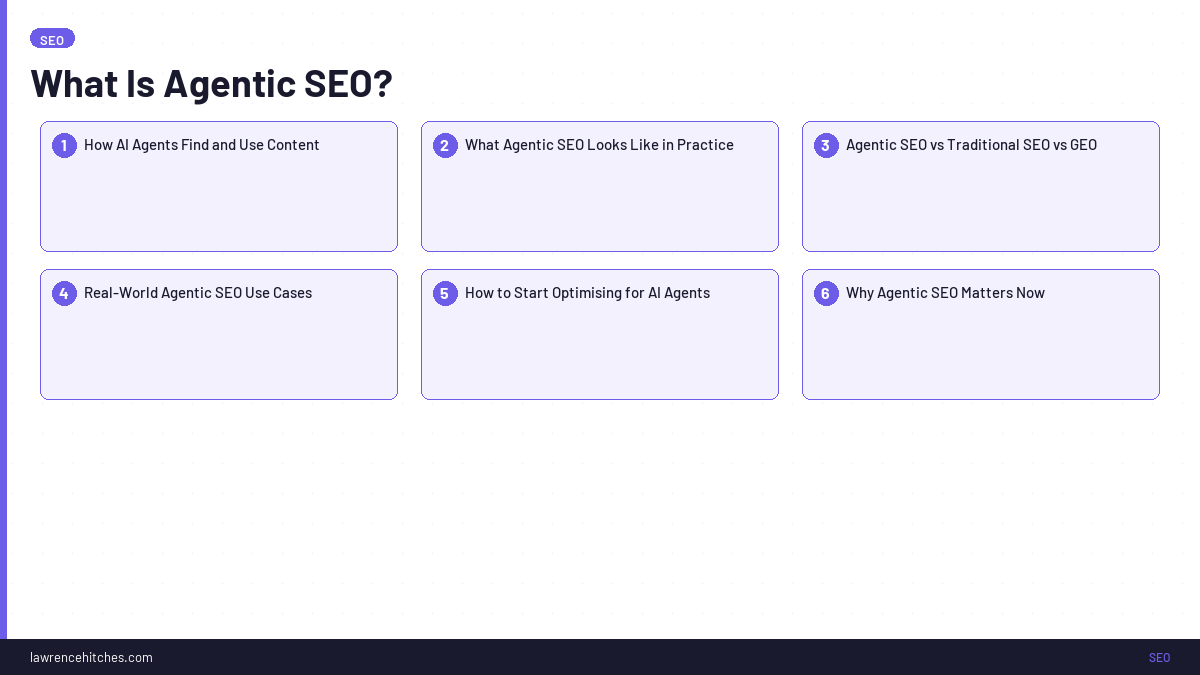
Agentic SEO is optimising your content so AI agents can discover, understand, and act on it: the practice of being usable by autonomous systems that browse, research, and complete tasks for users.
Agentic SEO is the practice of optimising your content to be discovered, understood, and acted on by AI agents, autonomous AI systems that browse, research, and complete tasks on behalf of users.
Not chatbots. Not AI Overviews. Agents.
These are systems that book flights, compare vendors, research products, and make purchasing decisions without a human clicking through a single search result. As these agents become mainstream, being agent-readable becomes a new form of search visibility, and most businesses are nowhere near ready for it.
It's the next evolution of AI SEO, moving beyond "will ChatGPT mention me" to "will AI agents act on my content".
How AI Agents Find and Use Content
AI agents typically operate in one of two modes. Understanding both is critical because your optimisation strategy differs depending on which mode the agent uses.
RAG (Retrieval-Augmented Generation)
The agent queries a search index, retrieves relevant pages, and synthesises an answer. Your content needs to rank in that index and be clearly structured for extraction. This is how most current agents work, they pull from Bing, Google, or proprietary indexes, then feed those results into an LLM for synthesis.
The practical implication: if your content doesn't rank in Bing's index, many agents will never see it. I've seen businesses obsess over Google rankings while completely ignoring Bing, and then wonder why they're invisible to AI tools built on Microsoft's infrastructure.
Direct Browsing
The agent navigates directly to URLs, reads page content, and extracts specific information. Your page structure, load speed, and content clarity matter enormously here. OpenAI's Operator literally opens a browser and reads your site like a human would, except it's faster, less patient, and has zero tolerance for ambiguity.
In both cases, the agent is looking for specific, factual, well-structured information, not persuasive marketing copy. Agents don't get emotionally convinced. They extract data points.
What Agentic SEO Looks Like in Practice
Five things that directly affect whether AI agents can use your content:
- llms.txt file, a new web standard (similar to robots.txt) that tells AI agents what your site contains and how to navigate it. Think of it as a site map designed specifically for language models. Early adopters are already implementing it, and I'd argue it's going to be as standard as robots.txt within 18 months.
- Structured data . schema markup helps agents understand entity relationships, pricing, availability, credentials, and other facts that go beyond plain text. For agents completing transactions, Product schema with accurate pricing and availability isn't optional, it's the difference between being recommended and being skipped.
- Direct answer formatting, agents extract answers from the first 1-2 sentences of sections. Put the answer before the explanation, not after. I call this "answer-first architecture" and it's the single highest-impact change most sites can make.
- Crawlability, agents can't use content they can't access. No JavaScript-only rendering, no login walls on indexable content, clean sitemap. If your site requires JS to render core content, you're invisible to most agents right now.
- Factual accuracy and consistency, agents cross-reference sources. If your pricing page says one thing and your Google Business Profile says another, you become an unreliable source. Contradictory information across your site tanks your citation reliability.
Agentic SEO vs Traditional SEO vs GEO
People keep conflating these three. They're related but distinct, and the distinction matters for how you allocate effort.
Traditional SEO optimises for humans clicking through search results. You rank pages, earn clicks, convert visitors.
GEO (Generative Engine Optimisation) optimises for being cited in AI-generated answers. Think AI Overviews, ChatGPT responses, Perplexity answers. The goal is brand mention and citation.
Agentic SEO optimises for AI systems that take actions. Not just citing you, actually using your content to complete tasks on behalf of users. Booking, comparing, purchasing, recommending with actionable next steps.
The overlap is significant. Good structured content helps across all three. But the emphasis shifts. In agentic SEO, machine-readability and data precision matter more than narrative quality. An agent doesn't care if your prose is compelling, it cares if your pricing is accurate and your availability data is current.
Real-World Agentic SEO Use Cases
Here's where this gets concrete. These aren't hypothetical, they're happening now.
Travel booking: AI agents comparing flight prices and hotel availability are reading structured data from travel sites. If your hotel's schema doesn't include accurate room types, pricing, and availability, the agent skips you entirely. Booking.com and Expedia are already optimising for this.
Vendor research: When a procurement agent is asked to "find the top three project management tools for a 50-person team," it's pulling from product pages, comparison articles, and review aggregators. If your product page doesn't clearly state team size limits, pricing tiers, and key differentiators in the first few paragraphs, you don't make the shortlist.
Local services: Agents helping users find service providers pull from Google Business Profiles, review platforms, and service pages. Consistent NAP data, clear service descriptions, and structured pricing are what get you recommended.
E-commerce: ChatGPT's Shopify integration means agents will soon be comparing and recommending products with a buy button attached. Your product data feed accuracy directly impacts whether an agent recommends you or your competitor.
How to Start Optimising for AI Agents
If you're running SEO for a business right now, here's the priority order I'd recommend:
- Audit your Bing index status. Most AI agents use Bing's index. If you're not indexed there, fix it immediately via Bing Webmaster Tools.
- Implement llms.txt. It takes an hour to set up and signals to agents that your site is agent-friendly.
- Restructure key pages for answer-first formatting. Start with your highest-value pages, product pages, service pages, key informational content.
- Verify structured data accuracy. Not just that schema exists, but that it's accurate and current. Outdated pricing or wrong availability data is worse than no schema at all.
- Test agent accessibility. Can a tool like Operator actually navigate your site and extract the information it needs? Try it. The gaps will surprise you.
Why Agentic SEO Matters Now
AI agents are moving from novelty to mainstream faster than most SEOs expected. OpenAI's Operator, Google's agent features in AI Mode, and Perplexity's Comet browser are all building agent-first experiences.
The businesses that are agent-readable now will have a compounding advantage as these tools scale. This is exactly what happened with mobile optimisation in 2015, the early movers gained ground they never gave back.
I run SEO strategy across dozens of client sites, and I can tell you: the gap between agent-ready sites and everyone else is going to widen fast. The technical bar isn't high. The strategic shift is what matters. Start treating AI agents as a primary audience, not an afterthought.
For the broader context, see the guide to ranking in Google AI Mode and how to optimise content for LLMs.
Related concepts
Agentic SEO builds on the broader discipline. Start with what AI SEO is, then how to appear in AI Overviews for a concrete surface it targets.
Frequently Asked Questions
Is agentic SEO different from GEO?
Related but distinct. GEO (Generative Engine Optimisation) focuses on appearing in AI-generated answers. Agentic SEO focuses specifically on being usable by autonomous AI agents that take actions, booking, comparing, transacting, on behalf of users. GEO is about citations. Agentic SEO is about being actionable.
What is llms.txt and do I need it?
llms.txt is a proposed standard file (placed at yourdomain.com/llms.txt) that gives AI systems a structured overview of your site's content, similar to a sitemap but designed for language models. It's not yet universal but adoption is growing. Worth implementing now for forward-compatibility.
Does agentic SEO require technical changes?
Some, yes. The llms.txt file, schema markup, and ensuring your content is accessible without JavaScript rendering are the main technical requirements. The content strategy changes (direct answers, factual structure) are editorial, not technical.
Sources & Further Reading
Soaring Above Search
Weekly AI search insights from the front line. One newsletter. Six sections. Everything that actually moved this week, with a practitioner's take.

AI SEO consultant and AI search consultant helping brands appear in AI Overviews, AI Mode and ChatGPT. Chief of Staff at StudioHawk, Australia's largest dedicated SEO agency. Runs a measured three-channel playbook: Google, Bing and AI citations. Book a free consultation →