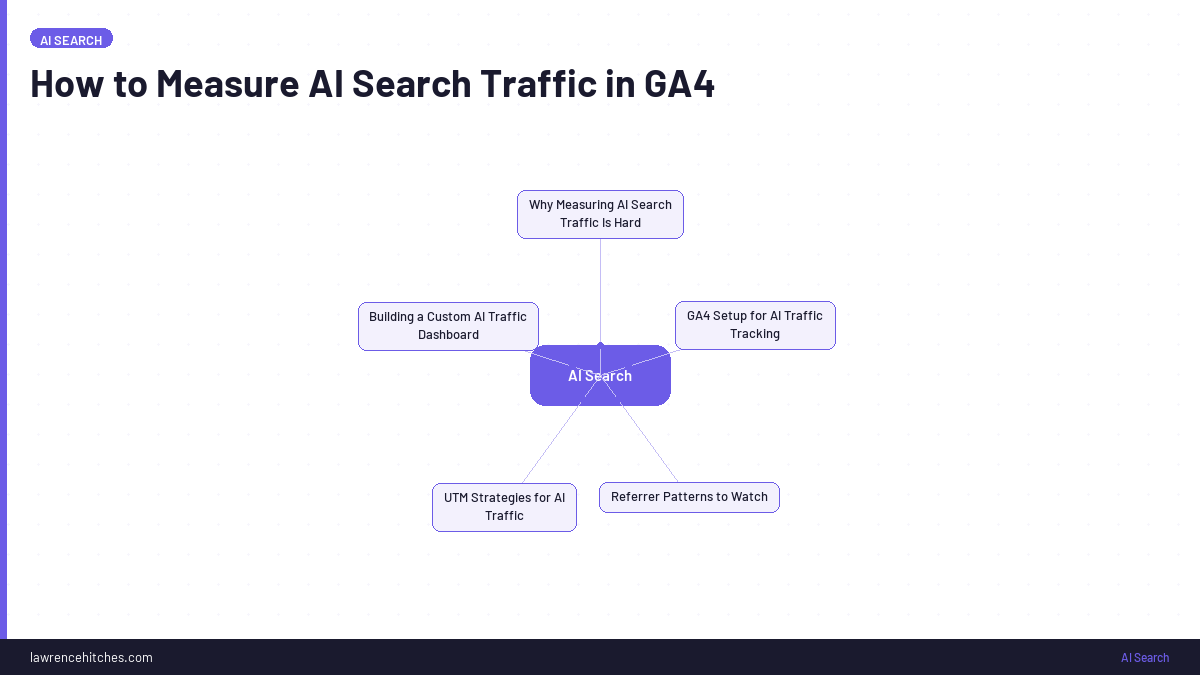
You measure AI search traffic in Google Analytics 4 by filtering for known AI referral parameters, primarily utm_source=chatgpt.com, perplexity.ai, bing.com (Copilot), and you.com. These appear as referral traffic in GA4 and tell you exactly which AI platforms are sending users to your site.
This isn't theoretical . ChatGPT is actively sending referral traffic to well-cited sites right now. Here's how to track it properly.
AI Referral Sources in GA4: The 2026 Reference Table
Each AI platform shows up differently in GA4. ChatGPT appears as chatgpt.com / referral (sometimes with utm_source=chatgpt.com), Claude as claude.ai / referral, Perplexity as perplexity.ai / referral, Microsoft Copilot blends into bing.com / referral, and Google Gemini as gemini.google.com / referral. Google AI Overviews send no referral string at all and can only be tracked in Search Console. Match on Session source, not User source, to capture every session.
Before you build a single segment, here is exactly what each platform looks like in your analytics, and what the traffic is actually worth based on our 100-brand ecommerce dataset:
| AI Platform | GA4 Session source | What it means | Conversion signal (100-brand data) | Full guide |
|---|---|---|---|---|
| ChatGPT | chatgpt.com / referral(or utm_source=chatgpt.com) | OpenAI cited your page in an answer | ~98% of AI referral volume; the dominant source | utm_source=chatgpt.com explained |
| Claude | claude.ai / referral | Anthropic's Claude cited your page | 1.2% conversion, highest AOV; enterprise/dev audience | claude.ai/referral in GA4 |
| Perplexity | perplexity.ai / referral | Perplexity cited your page | ~10-20% of ChatGPT's volume; research intent | Perplexity referral traffic |
| Microsoft Copilot | bing.com / referral (blends in) | Copilot cited you (runs on Bing's index) | 2.3% conversion, the highest of any AI source | Copilot search optimisation |
| Google Gemini | gemini.google.com / referral | Gemini cited your page | Newer, smaller; growing with Gemini 3 rollout | Gemini referral traffic |
| Google AI Overviews | No referral string | AIO cited you inside Google results | Track in GSC only (no GA4 referrer) | Google AI Mode traffic in GA4 |
The one regex to capture all of them. Most guides give you a half-complete or out-of-date pattern (still matching bard.google.com, deprecated in 2024). This is the current 2026 Session-source regex, copy-paste ready:
chatgpt\.com|chat\.openai\.com|perplexity\.ai|claude\.ai|copilot\.microsoft\.com|gemini\.google\.com|grok\.com|deepseek\.com|you\.comUse it in the custom channel group below (Step 2 onward) so every AI platform rolls into a single "AI Search" channel. Review it quarterly, the platform list changes faster than any other channel you track.
Step 1: Check Your Referral Sources in GA4
If your GA4 data is messy and you need a second pair of eyes, you can talk to an AI SEO expert who's tracked this for 100+ ecommerce brands.
To find AI search traffic in GA4, go to Reports > Acquisition > Traffic Acquisition and search for the AI platform domains: chatgpt.com, perplexity.ai, and bing.com. ChatGPT traffic appears as chatgpt.com / referral, Perplexity as perplexity.ai / referral, and Copilot traffic blends into bing.com referrals. Use the Session source dimension (not User source) to see all sessions, not just first-touch. If you don't see any AI traffic, your content may not be getting cited, or the volume may be below GA4's sampling threshold.
In GA4, go to Reports → Acquisition → Traffic Acquisition. Set the primary dimension to Session source/medium and look for:
chatgpt.com / referralperplexity.ai / referralclaude.ai / referralyou.com / referralbing.com / referral(Copilot traffic often appears here)
Even small numbers matter early, they tell you AI systems are finding and citing your content.
Step 2: Create a Custom AI Traffic Segment
Create a GA4 segment that captures all AI search traffic in one view by using a regex filter on Session source matching: chatgpt|perplexity|claude|copilot|openai. This gives you a single number for total AI referral traffic across all platforms. At StudioHawk, we set this up as a permanent segment on every client property, it's the baseline metric for measuring AI search optimisation impact. Save it as a comparison segment so you can overlay it against organic traffic trends.
Build a reusable segment in GA4 to isolate all AI referral traffic at once:
- Go to Explore → create a new exploration
- Under Segments, create a new segment: Session source contains chatgpt.com OR perplexity.ai OR claude.ai OR you.com
- Save it as "AI Search Traffic" for ongoing monitoring
Step 3: Track Which Pages AI Platforms Are Sending Traffic To
In GA4, create an Exploration report with Session source (filtered to AI platforms) and Landing page dimensions. This shows exactly which pages on your site are being cited by AI search engines. The pages receiving AI referral traffic are your current citation winners, study their content structure, heading format, and data specificity to understand what's working. Pages with zero AI traffic despite high Google organic traffic are candidates for content structure retrofit.
Once you have the segment, apply it to a page-level report. This tells you which content is being cited, and therefore which topics you have authority on in AI search. Pages getting AI referrals are your strongest citation assets.
Step 4: Monitor Google AI Overview Traffic in Search Console
Google Search Console shows impressions and clicks from AI Overviews in the Performance report under Search Appearance > AI Overviews (where available). This data tells you which queries trigger AI Overviews that cite your content, and your CTR within those AI-generated results. As of mid-2026, AI Overviews appear on roughly 99.9% of informational queries (Position.digital, 100k-query study), and content cited in AI Overviews earns roughly 35% more clicks than standard organic positions while uncited pages see CTR drops of up to 61%.
Google Search Console now shows when clicks come through AI Overview citations. Under Search Results, look for the "Search Appearance" filter and select AI Overviews. This shows impressions and clicks specifically from AI Overview appearances, separate from standard organic.
What Does claude.ai/referral Mean in GA4?
claude.ai/referral appearing in your GA4 data means someone clicked a link to your site from within a Claude conversation. This is Anthropic's equivalent of ChatGPT's utm_source=chatgpt.com, it's AI referral traffic from Claude specifically. This is a newer signal (first appearing in GSC data in March-April 2026) and indicates your content is being cited by Claude's web search feature. Track it alongside ChatGPT and Perplexity referrals as part of your total AI search traffic metric.
When you see claude.ai / referral in your GA4 traffic acquisition report, it means someone clicked a link inside a Claude AI response and landed on your site. Anthropic's Claude started including web search citations in 2025, and this referral source is growing.
In our 100-brand ecommerce dataset, Claude sends the smallest AI traffic volume (~160 sessions over 21 months) but serves an enterprise and developer user base with a 1.2% conversion rate. To track it alongside other AI sources, include claude.ai in your custom channel grouping regex: chatgpt|openai|copilot|gemini|perplexity|claude|grok.
How to Track All AI Search Sources in One View
The simplest way to track all AI search traffic is a GA4 custom channel group that routes chatgpt.com, perplexity.ai, claude.ai, bing.com/copilot, and any other AI platform referrals into a single 'AI Search' channel. This lets you see AI search as a channel alongside Organic, Direct, and Referral in standard reports. Set the channel rules to match Session source containing: chatgpt, perplexity, claude, copilot, openai, anthropic. Review and update quarterly as new AI platforms emerge.
Don't track each AI platform separately. Create a single "AI Search" custom channel grouping in GA4 that captures everything:
- Go to Admin > Data display > Channel groups
- Create a new channel called "AI Search"
- Set condition: Session source matches regex:
chatgpt\.com|chat\.openai\.com|copilot\.microsoft\.com|gemini\.google\.com|perplexity\.ai|claude\.ai|grok\.com
This gives you "AI Search" as its own channel in every standard GA4 report. ChatGPT accounts for 98% of AI traffic, but Copilot's 2.3% conversion rate is the highest of any AI source. Track them all.
What Numbers to Expect
For most websites, AI search traffic currently represents 0.1-0.5% of total organic traffic. Our 100-brand ecommerce dataset shows the median site receives 50-200 ChatGPT sessions per month, while top performers in content-rich niches see 2,000+ monthly sessions. Perplexity drives roughly 10-20% of what ChatGPT sends. Claude referral traffic is newer and smaller, typically 5-15 sessions per month for sites that are cited. The volume is growing 40-60% year-over-year across all platforms, so today's small numbers are tomorrow's meaningful channel.
AI referral traffic is still a small fraction of total organic for most sites, typically 1-5% today. But it's growing fast, and the sites building authority now will compound that advantage. Track month-over-month growth rather than absolute numbers.
For the full context on why this traffic appears and what the utm parameters mean, see utm_source=chatgpt.com explained.
Want to size the opportunity before you start? The AI search revenue calculator estimates what AI search could be worth to your business, using the same 100-brand benchmarks.
How This Connects to AI Agent UX (May 2026 Update)
The Lily Ray AWIN 2026 keynote evidence pack pinpoints two stats that frame the strategic importance of this topic in 2026: "Pages ranking #1 on Google are 3.5x more likely to be cited by ChatGPT" (AirOps) and "81% of AIOs cite a top-10 result" (Writesonic). Strong Google ranking is the precondition; AI citation engineering layers on top.
Per the SparkToro/Gumshoe Jan 2026 study (2,961 prompts, 100 runs each), AI ranking position is statistically meaningless: same brand list at same position less than 1% of the time. Visibility frequency is the metric: does your brand appear at all across 60-100 runs? This is why you should track AI search rankings as a funnel, not a fixed position.
The work covered on this page is the citation-ready content layer. The companion engineering layer (how AI agents read pages, what schema declares actions to them, how to score your own site against Google's 2026 agent-friendly guidelines) is covered in the AI Agent UX cluster:
- Agent-Friendly Websites: Google's 2026 Guide
- Free Agent-Friendliness Audit Tool
- Schema.org Action Types for AI Agents
- WebMCP Explained: The Web Standard for AI Agents
- Claude Computer Use for Marketers
- OpenAI Operator for Marketers
- Microsoft Copilot Vision for SEO
Want to run this without the manual work? The free Claude SEO skills the StudioHawk team uses on live client work package it up inside Claude Desktop.
Frequently Asked Questions
How do I track AI-driven traffic and measure ROI from generative engine optimisation?
Track AI traffic in GA4 by filtering referral sources for chatgpt.com, perplexity.ai, claude.ai and copilot, grouped into one AI channel. Measure ROI by tying those sessions to conversions and revenue. GEO ROI is referral revenue plus the brand lift from being cited, which converts even when there is no click.
Why does some ChatGPT traffic not show utm parameters?
ChatGPT doesn't always append utm parameters, it depends on whether the user clicked a cited link in ChatGPT's browsing mode. Direct navigation (users typing your URL after seeing it mentioned) won't show any referral data at all. Your actual AI-driven traffic is likely higher than what GA4 shows.
Is there a dedicated tool for tracking AI search visibility?
Yes, tools like SEOtesting, Semrush, and dedicated AI monitoring tools like Profound or Otterly are building AI visibility tracking features. GA4 remains the most reliable source for actual referral traffic data right now.
How do I track AI traffic that doesn't pass a referrer?
A lot of AI-influenced traffic never shows a referral string: someone reads your brand in a ChatGPT answer, then types your URL directly, or the platform strips the referrer. That lands in GA4 as Direct. Three ways to catch the shortfall: (1) watch for unexplained Direct-traffic growth that tracks with your AI citation wins, (2) monitor branded search volume in Search Console (AI mentions drive branded queries), and (3) add a one-question "How did you hear about us?" field at conversion. Your real AI-driven traffic is almost always higher than the referral data alone shows.
Should I set up a separate GA4 property for AI traffic?
No, keep it in your main property but use segments and custom reports to isolate it. Separating it would lose the ability to compare AI traffic behaviour against your overall audience benchmarks.
Sources & Further Reading
Enjoying this? The 60-second versions live on Instagram.
Follow @lawrenceaiseo →Soaring Above Search
Weekly AI search insights from the front line. One newsletter. Six sections. Everything that actually moved this week, with a practitioner's take.
AI SEO consultant and AI search consultant helping brands appear in AI Overviews, AI Mode and ChatGPT. Chief of Staff at StudioHawk, Australia's largest dedicated SEO agency. Runs a measured three-channel playbook: Google, Bing and AI citations. Book a free consultation →