AI citation mechanics describes how AI search engines select and attribute sources when generating answers. The key factors are content authority, answer-first paragraph structure, entity clarity, and retrieval index presence -- with BLUF-formatted pages earning up to 52% more citations in controlled experiments than those that bury their answers in later paragraphs.
Traditional search showed ten blue links. AI search shows one synthesised answer with two or three cited sources. If your content earns a citation, you get the traffic. If it doesn't, the answer was served without you.
AI citation mechanics describe how systems like Google AI Overviews, ChatGPT Search, Perplexity, and Microsoft Copilot select, retrieve, and attribute sources when generating those answers. Understanding the mechanics is the first step to engineering your way into them.
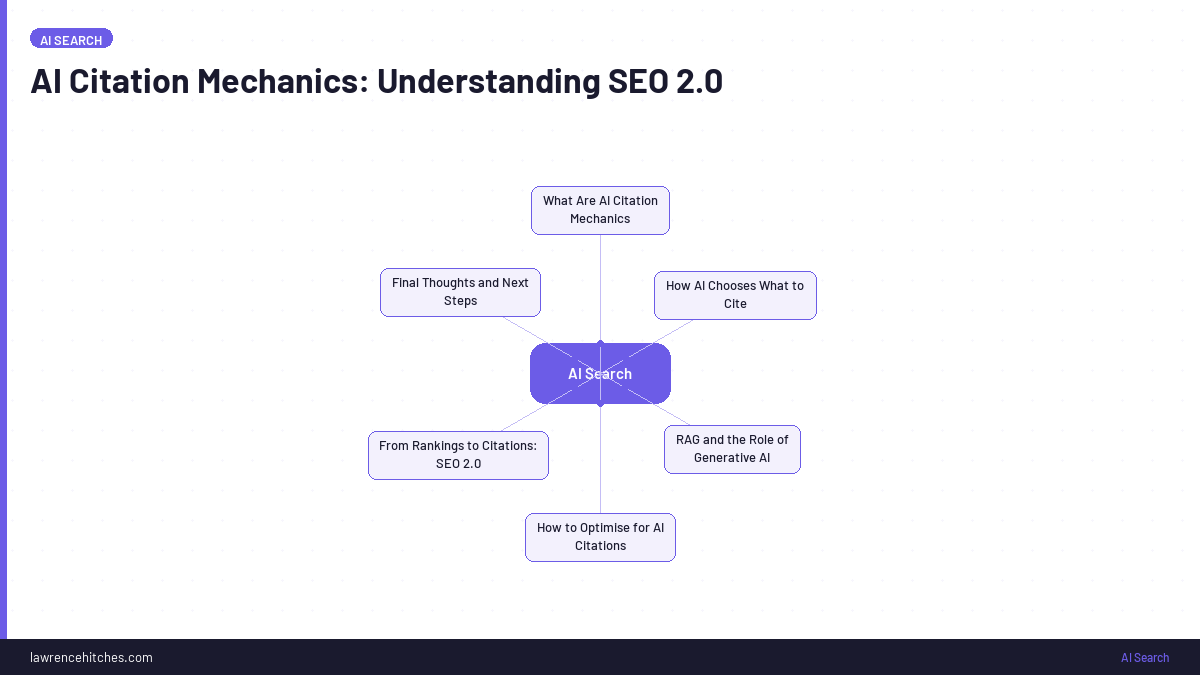
What Are AI Citation Mechanics?
AI citation mechanics refer to how AI search engines retrieve, evaluate, and attribute sources when synthesising answers. Unlike traditional SEO where Google ranks an entire page, AI systems evaluate content at the passage level. A single well-structured paragraph can earn a citation even if the surrounding page isn't ranking well in traditional search.
The core process: an AI receives a query, retrieves candidate content from its index or knowledge base, scores each passage for relevance and reliability, and cites the sources it draws from in its generated response.
Backlinks vs AI Citations
| Aspect | Backlinks | AI Citations |
| What They Are | Links from other sites that pass PageRank. | AI search engines referencing your content in generated answers. |
| Visibility | Mostly hidden; users don't see them. | Front-facing; users see the cited source. |
| Selection Factors | Link quality, quantity, topical relevance, anchor text. | Content authority, answer-first structure, entity clarity, passage relevance. |
| Key Metric | Domain Rating / NSR (Normalised Site Rank). | Brand mention frequency; unlinked mentions correlate at 0.664 vs backlinks at 0.218. |
| Effect on Traffic | Improves organic ranking position over time. | Cited pages earn 35% more clicks than non-cited competitors at the same position. |
How AI Chooses What to Cite
AI search engines don't rank pages the same way Google does. Instead of scoring a URL holistically, they chunk content into passages and score each chunk for relevance to the incoming query. The intro paragraph is processed first. If it's evasive -- building to an answer rather than opening with one -- the model assigns a low relevance score and moves on.
Hostinger ran a three-month experiment across 100 pages using answer-first introductions as one of five structural changes. Citation share jumped from 3.1% to 4.7%, a 52% increase. Structure drove the gain, not additional authority or new links.
Factors That Determine Whether AI Cites You
- Passage-level relevance: AI retrieves at the paragraph level. A single self-contained passage that directly answers the query can earn a citation regardless of where the overall page ranks.
- BLUF structure: Bottom Line Up Front. Sentence one of your intro should be extractable on its own and still answer the query. Most pages bury the answer. AI systems skip to the first H2 when they do.
- Entity density: The key entities (topic, brand, specifics) need to appear within the first 50 words. AI uses entity presence to confirm the passage is actually about the query.
- Authoritative citations within the content: Pages that cite primary sources, studies, and named experts get cited more. The Georgia Tech / IIT Delhi / Princeton GEO study found authoritative citations increased citation rates significantly.
- Structural clarity: Correct use of heading hierarchy, schema markup, and semantic HTML makes content machine-readable. AI crawlers that don't execute JavaScript can't see content that loads dynamically.
Content Types That Get Cited Most
XFunnel analysed over 768,000 AI citations across a 12-week study and found product-related content dominated: "best of" articles, comparisons, and product pages accounted for 46-70% of all cited sources. News and research content followed at 5-16%, affiliate content at single digits to 20%, and blog posts at just 3-6%.
The pattern is clear: AI systems preferentially cite content that is specific, data-rich, and structured for comparison. Generic explainers and thin opinion pieces get passed over.
RAG: How AI Retrieval Actually Works
Most AI search engines use a technique called Retrieval-Augmented Generation (RAG). The system retrieves relevant passages from its index, feeds them into the LLM as context, and the LLM synthesises an answer using that retrieved material as grounding.
Your content's role is to be the retrieved material. For that to happen, your page needs to be in the AI's retrieval index (accessible to crawlers, not blocked by JavaScript or robots.txt), and the relevant passages need to score high enough on the retrieval step to make it into the context window.
This is why AI search ranking factors diverge from traditional SEO. The retrieval step rewards answer-first formatting and entity clarity. The LLM step rewards authoritative, specific, and non-generic content that actually grounds the answer.
How to Optimise for AI Citations
1. Lead with the answer (BLUF)
The single highest-leverage structural change. Sentence one of every informational page should be a self-contained factual claim that directly answers the primary query. Everything that follows -- context, examples, depth -- supports that opening claim.
Test it: paste your intro into ChatGPT and ask "does this answer [your target query]?" If the answer is no, it's not BLUF yet.
2. Use specific schema markup
Schema markup helps AI systems parse your content more efficiently than raw HTML. Use the most specific type for your content: FAQPage, HowTo, Article, Product. Populate 3+ properties beyond the minimum. Validate with Google's Rich Results Test.
In 2026, schema's primary job is still rich results in traditional Search. Its role in AI citation is contested, and Google now states it is not required for AI features. It remains worth implementing because it is cheap, helps every search engine parse your content, and does no harm.
Google's official position (May 2026): Google's AI optimization guide states structured data "isn't required for generative AI search, and there's no special schema.org markup you need to add." My take: that is true for AI features specifically, but schema still earns rich results in traditional Search, helps every current and future search engine understand your entities, takes seconds to generate now with ChatGPT, Claude, or Gemini, and ships built into most modern CMS platforms. It costs almost nothing and still does real work. Keep it.
3. Build brand mentions, not just backlinks
Ahrefs' 75,000-brand study found unlinked brand mentions correlate at 0.664 with AI visibility -- three times stronger than backlinks at 0.218. YouTube mentions correlate at 0.737. Brands cited frequently across the web are 6.5x more likely to appear in AI-generated responses.
Digital PR that generates brand mentions (not just links) is now directly measurable as an AI citation strategy. Invest in expert commentary, speaking appearances, and platform presence that gets your brand name into content other sites publish.
4. Build topical authority through internal linking
AI systems evaluate topical authority at the site level, not just the page level. A site with deep coverage of a topic -- pillar pages, supporting articles, strong internal links between related content -- signals that it is a reliable source on that topic.
Google's leaked siteFocusScore confirms this. Sites tightly clustered around specific topics outperform generalist sites even with fewer backlinks.
5. Make content accessible to AI crawlers
Non-Google AI crawlers (ChatGPT-User, PerplexityBot, ClaudeBot) generally don't execute JavaScript. If your content loads dynamically, AI crawlers see a blank page. Check your robots.txt to confirm GPTBot, PerplexityBot, and ClaudeBot access is allowed, then test key pages with JavaScript disabled to confirm content renders in plain HTML.
Measuring Your AI Citation Performance
AI citation rate isn't directly reported anywhere yet, but you can approximate it. Track AI referral traffic in GA4 using a regex segment that captures chatgpt.com, perplexity.ai, claude.ai, and bard.google.com. Here's the full tracking setup.
For brand mention monitoring, run 20-30 prompt variations on your core topics in ChatGPT and Perplexity each month. Record which URLs get cited. Pages appearing in more than 5% of runs are earning consistent citation presence.
How This Connects to AI Agent UX (May 2026 Update)
The Lily Ray AWIN 2026 keynote evidence pack pinpoints two stats that frame the strategic importance of this topic in 2026: "Pages ranking #1 on Google are 3.5x more likely to be cited by ChatGPT" (AirOps) and "81% of AIOs cite a top-10 result" (Writesonic). Strong Google ranking is the precondition; AI citation engineering layers on top.
Per the SparkToro/Gumshoe Jan 2026 study (2,961 prompts, 100 runs each), AI ranking position is statistically meaningless: same brand list at same position less than 1% of the time. Visibility frequency is the metric: does your brand appear at all across 60-100 runs?
The work covered on this page is the citation-ready content layer. The companion engineering layer (how AI agents read pages, what schema declares actions to them, how to score your own site against Google's 2026 agent-friendly guidelines) is covered in the AI Agent UX cluster:
- Agent-Friendly Websites: Google's 2026 Guide
- Free Agent-Friendliness Audit Tool
- Schema.org Action Types for AI Agents
- WebMCP Explained: The Web Standard for AI Agents
- Claude Computer Use for Marketers
- OpenAI Operator for Marketers
- Microsoft Copilot Vision for SEO
Frequently Asked Questions
What is the difference between a backlink and an AI citation?
A backlink is a hyperlink from another site pointing to yours, passing PageRank through the link graph. An AI citation is an AI search engine referencing your content as a source in a generated answer. Backlinks influence traditional search ranking. AI citations influence whether your brand appears in AI-generated responses. The two correlate weakly: Ahrefs found backlinks correlate at 0.218 with AI visibility, while brand mentions (most unlinked) correlate at 0.664.
Does ranking #1 on Google guarantee AI citations?
No, but it helps. Pages ranking in the top 10 on Google are 86% more likely to appear in AI Overviews than pages that don't rank. But AI citation mechanics also reward answer-first structure and content format independently of ranking position. A page ranking at position 8 with a strong BLUF intro can earn citations over a position 2 page that buries its answer.
How do I know if my content is being cited by AI?
Track AI referral traffic in GA4 using a custom segment filtering for chatgpt.com, perplexity.ai, claude.ai/referral, and bard.google.com as traffic sources. For organic AI citations (where no click occurs), manually run 20-30 relevant queries in ChatGPT, Perplexity, and Google AI Mode monthly, and record which of your URLs appear as cited sources.
Does schema markup directly increase AI citations?
Schema markup doesn't guarantee citations, but it significantly improves the probability that AI systems can correctly parse and extract your content. JSON-LD structured data with the correct @type and 3+ properties makes content more machine-readable for both Google's AI Overviews and third-party AI search engines like ChatGPT and Perplexity.
Google's 2026 Guidance on Agent-Friendly Websites
In April 2026, Google's Chrome team published official guidance on building websites that AI agents can actually use. The 8 rules they recommend, semantic HTML, stable layout, proper form labels, no hover-only interactions, no ghost overlays, minimum 8-square-pixel hit targets, role/tabindex on non-semantic elements, and cursor:pointer on actionable elements, overlap almost entirely with accessibility best practice. The implication: every accessibility improvement now also improves AI search citation reliability and agentic browsing performance.
Full breakdown + a 10-step audit you can run on your own site at our agent-friendly websites guide.
See the free Claude SEO skills for ready-to-run versions of these workflows, open source and free.
Sources & Further Reading
Enjoying this? The 60-second versions live on Instagram.
Follow @lawrenceaiseo →Soaring Above Search
Weekly AI search insights from the front line. One newsletter. Six sections. Everything that actually moved this week, with a practitioner's take.
AI SEO consultant and AI search consultant helping brands appear in AI Overviews, AI Mode and ChatGPT. Chief of Staff at StudioHawk, Australia's largest dedicated SEO agency. Runs a measured three-channel playbook: Google, Bing and AI citations. Book a free consultation →