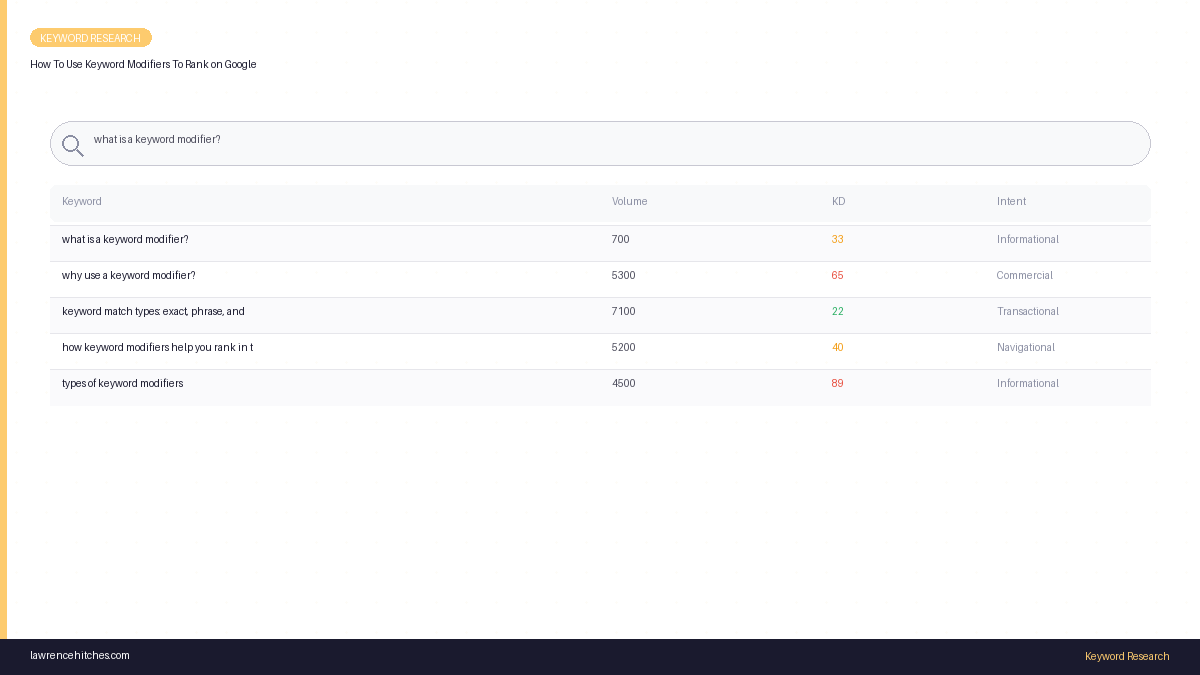
Keyword modifiers are words or short phrases added to a base keyword to make the search query more specific. They are how a generic head term like "hammock" becomes a targetable long-tail like "best hammock for camping under $100". Modifiers split into 6 main categories (intent, comparative, geographic, audience, attribute, action), each signalling different buyer-journey stages and SERP intent.
Modifiers are the smallest unit of keyword research. Get them right and a low-volume term with clear commercial intent beats a high-volume head term with diluted intent. Get them wrong and you spend months ranking a page nobody clicks because the modifier mismatched what the user actually wanted.
Below is the practitioner workflow: how to taxonomise modifiers, how to map them to buyer-journey stages, how AI Overviews are now collapsing modifier variants, and a worked hammock example showing the full chain from seed to ranked URL.
What Is a Keyword Modifier?
A keyword modifier is a word or short phrase that combines with a base keyword (also called a "seed" or "head term") to create a more specific search query. The base keyword represents the broad topic. The modifier narrows it.
Example chain:
- Base keyword: "hammock"
- + attribute modifier: "portable hammock"
- + audience modifier: "portable hammock for camping"
- + comparative modifier: "best portable hammock for camping"
- + price modifier: "best portable hammock for camping under $100"
Each modifier added makes the keyword more specific, lower volume, and (usually) easier to rank for. The trade-off is volume for intent clarity. A single-word base keyword has thousands of searches but mixed intent. A 6-word modified keyword has a handful of searches but the user knows exactly what they want.
The 6 Modifier Types (and What They Signal)
Most lists of keyword modifiers I've seen are 50+ words dumped into a single category. That isn't useful. Modifiers cluster into 6 distinct types, and each signals a different intent stage. Knowing the type tells you which page format to build, where in the buyer journey the user is, and whether the keyword is worth chasing.
1. Intent Modifiers
Words that signal what the user wants to do, not what the product is. Examples: how to, what is, guide to, tutorial, learn, step by step, tips for, why does. These signal informational intent and are increasingly being eaten by AI Overviews. Build these as long-form educational content with clear answers in the first paragraph.
2. Comparative Modifiers
Words that signal the user is shortlisting or evaluating. Examples: best, top, leading, vs, alternative to, review of, comparison, which is better, ranked. These are the highest commercial-intent modifiers in 2026 and the hardest to rank for because every brand wants them. Build these as listicles or comparison tables with specific evaluation criteria.
3. Geographic Modifiers
Words that signal location-bound intent. Examples: near me, in [city], local, [region], Australia-wide, online, [postcode]. These trigger local-pack SERP features and are essential for local businesses. Build these as location-targeted landing pages with NAP, schema, and locally-relevant signals.
4. Audience Modifiers
Words that signal who the user is or who the product is for. Examples: for beginners, for professionals, for women, for small business, for ecommerce, for SaaS, for students, for seniors. These let you create persona-targeted pages without competing for the broad head term. Build these as use-case pages with audience-specific examples.
5. Attribute Modifiers
Words that describe a feature, quality, or characteristic. Examples: portable, lightweight, premium, eco-friendly, durable, automated, fast, organic, custom, electric. These segment the product space. Build these as filtered category pages or feature-led product pages.
6. Action Modifiers
Words that signal the user wants to take a specific action right now. Examples: buy, hire, book, download, get quote, sign up, free trial, demo, contact, request. Highest commercial intent of any modifier type. Build these as conversion-optimised landing pages with low friction to the CTA.
The 4-Step Modifier Workflow
The mistake most people make with modifiers is treating them as a brainstorm. They're not. Modifier strategy is a structured process:
- Seed: identify the broad head term that defines the topic. One seed per page.
- Branch: layer each of the 6 modifier types onto the seed. Generate 5-10 candidate keywords per type. You'll end up with 30-60 candidates per seed.
- Cluster by intent stage: group the candidates by buyer-journey stage (Awareness, Consideration, Decision). Most informational and intent modifiers map to Awareness; comparative and attribute modifiers map to Consideration; action and geographic modifiers map to Decision.
- Map to URL: each cluster gets its own URL. Don't try to rank a single page for all three stages of intent. The page format that wins Awareness intent is wrong for Decision intent and vice versa.
This workflow turns a vague "let's go after long-tail keywords" into a concrete site architecture: one URL per modifier cluster, each optimised for the right format and intent.
Worked Example: Hammock Seed Modifier Chain
Let's walk through one seed end to end. Seed keyword: hammock. KD on Ahrefs: 67. Volume: 120,000/month. Position 1 dominated by major retailers (Wayfair, Amazon, Bunnings). New site has zero chance.
Modifier branching:
- Intent: how to hang a hammock, what is a hammock chair, hammock setup guide, how to wash a hammock
- Comparative: best hammock for camping, top rated hammocks 2026, hammock vs hammock chair, ENO vs Kammok hammocks
- Geographic: hammocks Melbourne, hammock store near me, online hammock Australia, hammocks in Sydney
- Audience: hammock for two people, hammock for kids, hammock for camping, hammock for backyard
- Attribute: portable hammock, lightweight hammock, double hammock, waterproof hammock
- Action: buy hammock online, hammock with free shipping, hammock free delivery Melbourne
Cluster by intent stage:
- Awareness URLs (intent + some attribute): /how-to-hang-a-hammock/, /hammock-setup-guide/
- Consideration URLs (comparative + audience): /best-hammock-for-camping/, /hammock-for-two-people/
- Decision URLs (action + geographic): /buy-hammock-melbourne/, /hammock-free-delivery/
Six URLs from one seed, each targeting a coherent cluster of modifier-modified queries with the same intent. KD on each individual modifier cluster is in the 20-40 range, far easier than ranking the head term. Combined volume across the 6 URLs typically captures 8-15% of the head-term volume but with much higher conversion intent.
How AI Overviews Handle Modifier Variants in 2026
Something that has changed dramatically since 2024: AI Overviews and AI search engines (ChatGPT, Perplexity) now collapse most modifier variants into a single response. If you search "best portable hammock" or "top portable hammock" or "leading portable hammocks 2026", the AI Overview will often return the same answer with the same cited sources.
What this means for modifier strategy:
- Comparative modifiers (best/top/leading) are no longer 3 separate ranking opportunities. They're one. Pick the dominant variant (usually "best [keyword]") and let the page rank for the cluster.
- Intent modifiers (how to/what is/guide to) are increasingly answered by AI Overviews directly. Building a page for these is still worthwhile because AI engines need to cite sources, but the click-through is degraded. Build for citation, not just rank.
- Action and geographic modifiers are still position-driven. AI Overviews don't replace the local pack or the buy-now intent. These remain the highest-ROI modifier types.
- Attribute and audience modifiers split the difference. Useful for category page differentiation, but harder to rank standalone because AI engines collapse minor attribute variants.
The 2026 modifier reality is fewer pages, each ranking for tighter clusters, with stronger intent signals. The era of building 50 modifier-variant pages and hoping each ranks individually is over.
Common Keyword Modifier Mistakes
- Stuffing multiple modifier types onto one page. "Best cheap portable hammock for kids in Melbourne" reads like SEO spam. Pick one modifier cluster per page.
- Ranking for modifiers that don't match the page format. If your page is a comparison post, don't bait it with action modifiers like "buy". Match modifier intent to page format.
- Ignoring zero-click modifiers. Some modifier-modified queries (e.g. "what is a hammock") are 100% answered in AI Overviews now. Don't waste content effort on these.
- Treating modifier lists as a brainstorm. The 6-type taxonomy + intent stage clustering is the difference between random keyword targeting and structured site architecture.
FAQ
What is a keyword modifier in SEO?
A keyword modifier is a word or short phrase added to a base keyword to make a search query more specific. Modifiers split into 6 types: intent, comparative, geographic, audience, attribute, and action. Each signals different buyer-journey intent and maps to a different page format.
How do I find keyword modifiers for my niche?
Start with a single seed keyword (your head term). Layer each of the 6 modifier types onto the seed using a keyword tool like Ahrefs Keyword Explorer, Semrush Keyword Magic Tool, or Google's autosuggest. Generate 5-10 candidates per modifier type. You'll end up with 30-60 candidate keywords per seed.
Are keyword modifiers the same as long-tail keywords?
Related but not identical. A long-tail keyword is any low-volume specific query (typically 3+ words). A keyword modifier is the specific word that creates the long-tail. So "best portable hammock for camping" is a long-tail keyword; "best", "portable", "for camping" are the modifiers that built it.
Do AI Overviews still reward keyword modifiers?
Partially. AI Overviews collapse minor modifier variants (best/top/leading often return the same response) but still differentiate by intent type. Action modifiers (buy/hire/book) and geographic modifiers (near me, in [city]) remain position-driven. Intent and informational modifiers are increasingly displaced by AI Overview answers.
How many modifier types should I target on one page?
One. Each page should target a single modifier cluster with consistent intent. Mixing modifier types dilutes the page's intent signal and confuses both Google's ranking algorithms and the user.
Related Reading
- Keyword Research for SEO in 2026: The Practitioner Workflow
- How to Win Low-Hanging Fruit Keywords
- Keyword Difficulty: What It Is and How to Use It
- Chunky Middle Keywords for SEO
- Fat Head Keywords: Definition, Examples, and Strategy
- Head Terms vs Long-Tail Keywords
Sources & Further Reading
Watch: How to Use Keyword Modifiers to Enhance Your SEO
Soaring Above Search
Weekly AI search insights from the front line. One newsletter. Six sections. Everything that actually moved this week, with a practitioner's take.

Chief of Staff at StudioHawk, Australia's largest dedicated SEO agency. Specialising in AI search visibility, technical SEO, and organic growth strategy. Leading a team of 120+ across Melbourne, Sydney, London, and the US. Book a free consultation →