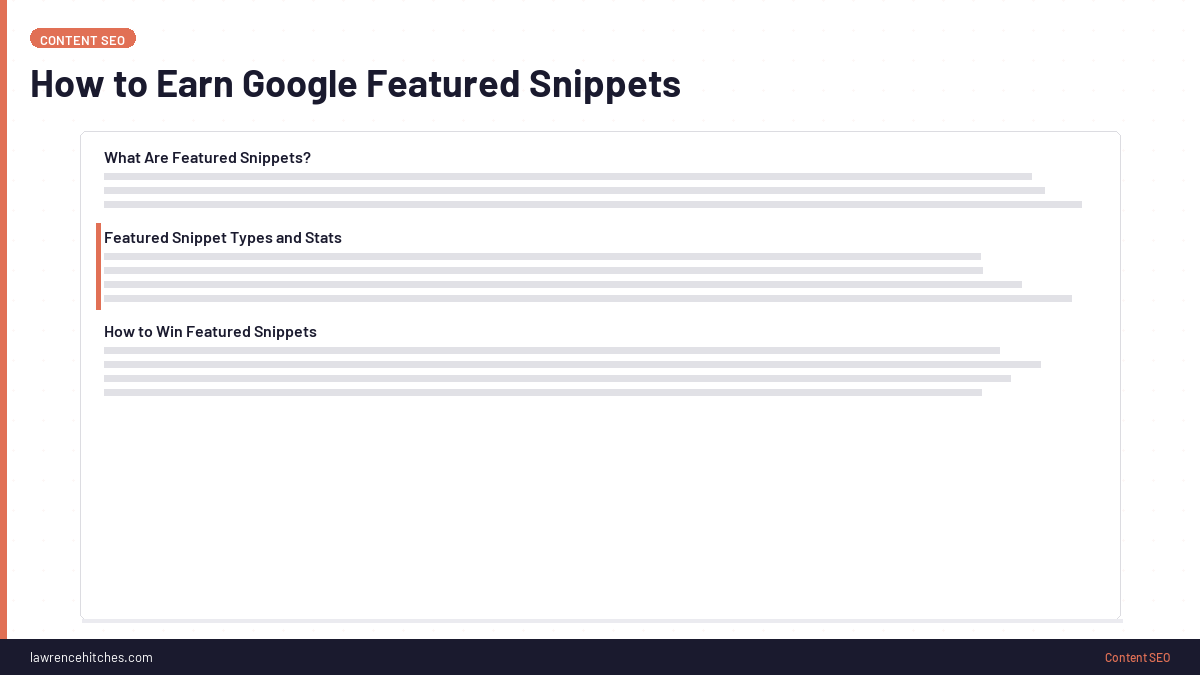
A featured snippet is the answer box at the top of Google's results that directly answers a query, pulled from a ranking page. You win one by structuring content to answer a specific question cleanly: a direct 40 to 60 word answer immediately under a question-shaped heading, followed by supporting detail. You do not need to rank number one, most featured snippets come from pages ranking in positions 2 to 8. In 2026 this matters beyond Google's classic results: the same answer-first structure that wins featured snippets is what wins citations in AI Overviews and AI search.
What Are Featured Snippets?
Featured snippets are selected results Google displays in a box at the top of the SERP, above the regular links, directly answering the searcher's question. Google extracts them from a page it already ranks, so a snippet is a promotion of existing content, not a separate thing you submit.
They take four main forms:
- Paragraph snippets (around 70% of all featured snippets): a 40 to 60 word text answer. Best for definitions and direct questions.
- List snippets (around 19%): bulleted or numbered. Best for steps and rankings.
- Table snippets (around 6%): rows and columns. Best for comparisons and data.
- Video snippets (around 5%): a clip for queries that need a visual.
On mobile, a featured snippet can fill most of the first screen, which is exactly why they are worth pursuing.
The 3 Featured Snippet Types and What Triggers Each
Not all featured snippets work the same way. The type Google selects depends on the query intent and how you structure your answer. Get the mismatch wrong and Google will pick a competitor whose format fits better.
Paragraph snippets
The most common type, roughly 70% of snippets. These answer a direct question in one self-contained block of text. Google looks for a concise, complete answer of around 40 to 60 words placed immediately under a question-shaped heading. Works best for definitions, explanations, and "what is" queries. The key is writing a sentence or two that fully answers the question without the reader needing any surrounding context.
Markup pattern: H2 or H3 phrased as a question, followed directly by a short paragraph answer. No preamble. No "great question, let's explore". Just the answer, then expand below it.
List snippets
Numbered lists appear for step-by-step processes. Bulleted lists appear for unordered sets of items. Google triggers list snippets when the query implies a sequence or a collection: "how to" queries, "best" queries, "types of" queries. Google often truncates the list and adds a "More items" link, so the first three to five items carry the most weight.
Markup pattern: OL for steps, UL for unordered items. Each list item should be a complete, scannable phrase, not a full sentence. Short labels with the detail in the supporting text below each item work well.
Table snippets
The least common type but the most defensible once earned. Google pulls table snippets for comparison and data queries: pricing, specifications, dates, feature comparisons. A genuine HTML table (not text formatted to look like one) is what triggers this. Three or more columns and at least five rows gives Google enough to work with.
Markup pattern: proper HTML table with thead and tbody, clear column headers, factual data. Keep the table relevant to the query, not a giant data dump. Google will extract the rows most relevant to the search intent.
How to Write for Featured Snippets
Most content fails to earn snippets not because the information is wrong, but because the answer is buried. Writers naturally build up to the answer: context first, nuance second, the actual point somewhere in the middle. That structure is the opposite of what Google needs.
The practitioner method:
- Identify the exact query you are targeting. Pull it from Google Search Console or keyword research. You are writing the answer to this specific question, not a general treatment of the topic.
- Make the heading match the query. If the query is "how long does crawling take", the H2 is "How Long Does Crawling Take". Exact match or close paraphrase. Not a creative reframe.
- Write the answer in the first paragraph after the heading. Not the second paragraph. Not after a preamble. The answer goes in sentence one. It should be complete on its own: if someone read only that paragraph, they would have the answer.
- Keep it to 40 to 60 words. Count them. This is not approximate. Google's extraction window is narrow. At 90 words you are giving Google too much to work with and it will trim awkwardly or skip to a competitor whose answer is tighter.
- No hedging. Do not write "it depends" as the first line. Do not start with "there are many factors". Lead with the direct answer, then address nuance below it.
- Format to intent. Process queries get numbered lists. Comparison queries get tables. Definition queries get paragraph answers. If your format mismatches the intent, Google picks the competitor whose format fits.
The rest of the section, below that opening answer paragraph, is where you add the depth, examples, and caveats. That is what earns the ranking that makes the snippet possible. The snippet answer is the hook. The surrounding content is the foundation.
How to Win a Featured Snippet
Featured snippets follow a pattern. Google looks for content structured to answer the query directly. The method:
- Target a question-shaped query. Snippets appear most for questions. Roughly 29% of snippet-triggering queries begin with words like "what", "how", "why", "can", or "do".
- Use a question-shaped heading. Make the H2 or H3 match how people ask: "How to Cook Jasmine Rice", not a creative title. This tells Google the section answers that question.
- Answer immediately, in 40 to 60 words. The first sentences under that heading should be a complete, self-contained answer. Google pulls the snippet from here.
- Then expand. Follow the direct answer with the supporting detail, examples, and data. The answer earns the snippet; the depth earns the ranking that makes the snippet possible.
- Match format to intent. A process needs a list. A comparison needs a table. A definition needs a paragraph. Build the format Google will want to lift.
Structure, Positioning, and Authority
Three things beyond the answer format affect snippet success:
- You need to rank on page one already. Google almost always pulls snippets from positions 2 to 8. The snippet is a reward for content that is already competitive. If you are on page two, win page one first.
- Scannable structure helps. Clear H2 and H3 headings, short paragraphs, and lists or tables where they fit make it easy for Google to identify and extract the answer.
- Authority and freshness matter. Google selects snippet sources it considers reliable. Well-researched, current, sourced content is more likely to be chosen, and a competitor's update can take a snippet from you, so review snippet pages periodically.
Do Featured Snippets Still Matter in 2026 With AI Overviews?
Yes, with nuance. The dynamic has shifted but the value has not disappeared.
Google's AI Overviews now appear above featured snippets for many queries. For some queries, the AI Overview has effectively replaced the featured snippet as the dominant top-of-page element. But here is the part most people miss: Google's AI Overviews frequently source from the featured snippet position. Pages that hold position zero for a query appear as the cited source in the AI Overview for that same query more often than any other page.
That means losing the featured snippet often means losing the AI Overview citation too. The featured snippet is not just a traffic source in isolation, it is a strong signal of the page Google trusts most to answer that query, and that trust carries into how AI Overviews are assembled.
The practical implication: chasing featured snippets is still worth doing, not as a standalone click-driving tactic, but as a proxy for building the kind of clearly structured, authoritative content that wins in every Google surface, including AI Overviews. If your content consistently fails to earn snippets for queries where you rank in the top five, that is a structural problem worth fixing regardless of whether the snippet itself drives traffic.
Featured Snippet vs AI Overview: What's the Difference
These two elements sit near the top of the results page but work completely differently.
A featured snippet is a formatted block pulled from one specific page. Google identifies the best-structured answer to a query among its top-ranked results and surfaces that one answer, attributing it clearly to the source page. One page wins. The URL is visible. The click goes to that page.
An AI Overview synthesises across multiple sources. Google's AI reads several high-ranking pages, pulls relevant content from each, and constructs a synthesised answer with citations. Multiple pages can be cited simultaneously. No single page "wins" in the same way. The citations appear as small links within the AI Overview text.
The key difference for SEO: you can appear in an AI Overview without holding the featured snippet for that query. A well-structured page ranking in position four with strong supporting data might get cited in an AI Overview even if the snippet goes to position two. But the featured snippet page gets cited most often. Pages that hold the snippet are the most frequently appearing AI Overview sources for the same query, because earning the snippet signals the kind of structure and authority Google's AI is looking for when assembling its answer.
So the priority order is: earn the ranking, then earn the snippet, then the AI Overview citation tends to follow. The content work is the same for all three.
Frequently Asked Questions
How do I get a featured snippet?
Target a question-shaped query, use a matching question-shaped heading, and place a direct 40 to 60 word answer immediately beneath it, then expand with detail. You also need the page to already rank on page one for the query.
Do you need to rank number one for a featured snippet?
No. Most featured snippets are pulled from pages ranking in positions 2 to 8. You need to be on page one and have the best-structured answer, not necessarily the top result.
Are featured snippets still worth it with AI Overviews?
Yes. AI Overviews have reduced featured snippet visibility for some queries, but pages that hold the featured snippet are the most frequently cited sources in AI Overviews for the same query. Losing the snippet often means losing the AI Overview citation too.
What is the ideal length for a featured snippet answer?
Around 40 to 60 words for a paragraph snippet. Google extracts a concise, self-contained answer, so the opening sentences under your heading should fully answer the question in roughly that range.
Why did I lose my featured snippet?
Usually one of three reasons: a competitor updated their content with a better-structured answer, an AI Overview replaced the snippet for that query, or your page slipped in ranking. Refresh the page and re-check the structure.
Can I be in both a featured snippet and an AI Overview?
Yes. Holding the featured snippet for a query makes it more likely your page is also cited in the AI Overview for that query. Both are driven by the same structural and authority signals. Optimising for one effectively optimises for both.
What types of content never earn featured snippets?
Purely commercial pages (product listings, category pages) rarely earn snippets. Google reserves them for informational queries where a direct answer adds value. Transactional queries, branded queries, and highly ambiguous queries typically return standard results, not snippets.
Related Reading
- Header Tags for SEO: H1-H6 Best Practices
- How to Rank in Google AI Overviews
- AI Citation Mechanics
- On-Page SEO: A Beginner's Guide
Sources & Further Reading
Watch: How to Optimise for Google SERP Features in 2021
Soaring Above Search
Weekly AI search insights from the front line. One newsletter. Six sections. Everything that actually moved this week, with a practitioner's take.
AI SEO consultant and AI search consultant helping brands appear in AI Overviews, AI Mode and ChatGPT. Chief of Staff at StudioHawk, Australia's largest dedicated SEO agency. Runs a measured three-channel playbook: Google, Bing and AI citations. Book a free consultation →