Writing for AI search means structuring content so language models can extract, understand, and cite it accurately. The core principle: answer first, explain second.
AI systems don't read for pleasure. They scan for extractable facts, clear positions, and structured information they can synthesise into a response. If your content isn't built for extraction, it doesn't matter how good your writing is. AI will skip you and cite someone who made the information easier to use.
I've rewritten hundreds of pages using these principles across client sites at our agency. The ones that follow this structure consistently get cited. The ones that don't, don't. It's that straightforward.
Here's what that looks like in practice.
A note on "writing for AI": Google's AI optimization guide says you "don't need to write in a specific way just for generative AI search." Agreed. This was never about writing FOR machines. It is about writing well, then recognising that a clear, well-structured page is easier to ingest whether the reader is a human scanning it or an LLM extracting from it. Good content standards serve both.
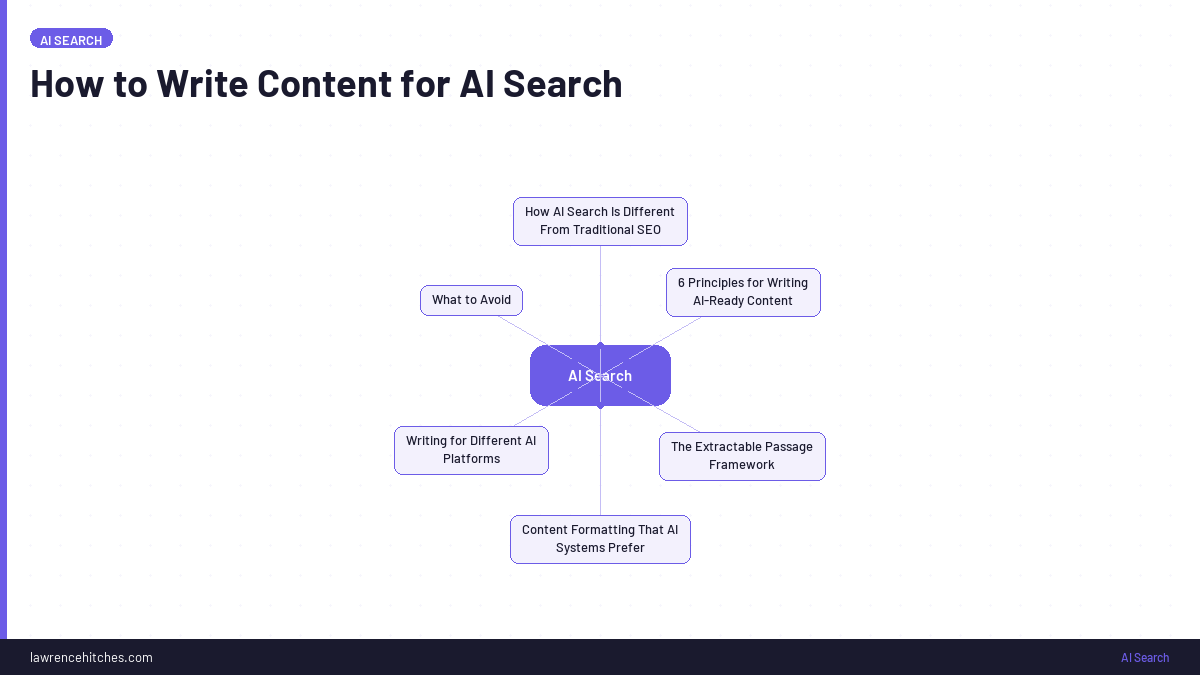
How AI Search Is Different From Traditional SEO Writing
Traditional SEO writing optimises for human readers who choose to click and scroll. AI search writing optimises for systems that extract specific information at scale. The differences that matter:
- Traditional SEO: keyword placement, engaging intro, long-form depth
- AI search: direct answer in first sentence, clear factual claims, structured sections
The good news: AI-optimised content is also better for human readers. Clearer, more direct, less padded.
The bad news: most SEO content written in the last decade was built for the old model. Long introductions designed to "hook" readers. Answers buried after three paragraphs of context. Vague claims designed to rank for keywords rather than answer questions. All of that works against you in AI search.
6 Principles for Writing AI-Ready Content
1. Answer in the First Sentence
Every page should open with a direct, quotable answer to the query it targets. Not a preamble, not a question, not "in today's landscape". The answer.
AI systems extract the first clear statement that matches the query intent. If your answer is in paragraph four, most AI systems won't find it, or they'll find a competitor's answer first.
Here's the test: can someone copy your first sentence and paste it as a complete answer to the question your page targets? If yes, you've nailed it. If no, rewrite it.
Bad: "In the ever-evolving world of digital marketing, understanding crawl budget has become increasingly important for SEO professionals."
Good: "Crawl budget is the number of pages a search engine will crawl on your site within a given timeframe."
The second version is extractable. The first is noise.
2. Use a Definition-First Structure
For any concept or term: define it first (1-2 sentences), then explain it. This mirrors how AI systems learn and reproduce information, definition, then context, then application.
I call this the "dictionary, then textbook" approach. Lead with what something is, then explain why it matters and how to use it. Every H2 section should follow this pattern.
This structure also naturally supports featured snippets and AI Overviews. Google's own systems prefer content that frontloads definitions, it's not just an AI search tactic, it's good information architecture.
3. Make Claims Specific and Verifiable
"SEO takes time" is not citable. "Most sites see meaningful organic traffic gains within 4-6 months of consistent publishing" is.
Specific, falsifiable claims are preferred by AI systems because they can be cross-referenced against other sources. Vague generalities get ignored or paraphrased into mush.
This is where practitioner experience matters. Anyone can write "link building is important." An experienced SEO can write "a single high-authority editorial link from a DR70+ domain can move a page from position 15 to position 5 within 4-8 weeks for competitive terms." That level of specificity is what AI systems want to cite.
Numbers. Timeframes. Named tools. Named platforms. Specific outcomes. That's what gets extracted.
4. Use Clear Heading Hierarchy
H2s should be answerable questions or clear topic statements. H3s should be sub-points. AI systems use heading structure to understand topic relationships, a clean hierarchy makes your content significantly more extractable.
Here's what I see constantly: sites using H2s and H3s for visual styling rather than logical structure. An H3 that isn't a sub-topic of the H2 above it confuses AI systems about the relationship between sections.
The rule is simple: every H3 should be a sub-point of its parent H2. Every H2 should be a major facet of the page topic. If you can't explain the hierarchy logically, restructure it. See how header tags affect SEO and AI search.
5. Add Structured Q&A Sections
Q&A sections are the most directly extractable content format for AI search. Three to five clear questions with direct answers at the end of every article. Use FAQ schema markup so AI systems can parse them as structured Q&A pairs.
But don't just add generic questions. Use actual questions from People Also Ask, from your search console data, from customer support queries. Real questions get real extraction. Manufactured questions get ignored.
6. Cite Your Sources
Link to authoritative external sources for factual claims. AI systems use citation patterns to assess credibility, a piece that references authoritative sources is treated as more reliable than one that doesn't.
Two to three outbound links to credible sources per article is the baseline. Think Google's own documentation, peer-reviewed research, official tool documentation, or recognised industry publications. Not random blog posts.
This also works in reverse, if other authoritative sources cite your content, AI systems treat your content as more reliable. It's the AI equivalent of backlink authority, but for citations rather than PageRank.
The Extractable Passage Framework
I use a framework I call "extractable passages" when restructuring content for AI search. Every section of your content should contain at least one passage that meets these criteria:
- Self-contained: the passage makes complete sense without reading anything before or after it
- 40-80 words: long enough to be meaningful, short enough to be extracted as a single unit
- Factual claim included: contains a specific, verifiable statement, not just opinion
- Entity-rich: mentions specific brands, tools, platforms, or concepts by name
- No pronoun dependencies: doesn't rely on "this", "it", or "they" referring to something in a previous paragraph
When you write with extractable passages in mind, your content naturally becomes more structured, more specific, and more useful, for both AI systems and human readers.
Content Formatting That AI Systems Prefer
Beyond structure, certain formatting patterns consistently perform better in AI extraction:
Comparison tables. When comparing two or more things, use an HTML table. AI systems can parse table data much more reliably than comparison paragraphs. "Tool A costs $50/month and supports 10 users. Tool B costs $70/month and supports unlimited users", that's better as a table.
Numbered lists for processes. If something has steps, number them. AI systems extract ordered lists as procedures and can cite individual steps. Bullet points work for unordered information.
Bold key terms on first use. Using <strong> on important concepts, names, and data points helps AI systems identify the most important elements in a passage. Don't bold everything, bold the parts you'd want quoted.
Short paragraphs. One to three sentences per paragraph. Long paragraphs dilute signal density. AI systems have an easier time extracting from focused, tight paragraphs than from dense blocks of text.
Writing for Different AI Platforms
Not all AI search systems work the same way. The principles above apply universally, but each platform has nuances worth understanding.
ChatGPT Search pulls from Bing's index and prioritises well-structured content with clear citations. If you're not indexed in Bing, ChatGPT's browsing mode won't find you. This is the most common blind spot I see, businesses optimising for Google while being completely invisible to ChatGPT.
Google AI Mode extracts passages of 40-60 words from pages in Google's own index. It favours content that answers sub-queries generated through its Query Fan-Out process. Your content needs to address not just the main query, but the implicit follow-up questions Google generates internally.
Perplexity is the most citation-heavy AI search tool. It always shows sources and tends to cite multiple perspectives on the same topic. Content that acknowledges nuance and presents balanced viewpoints performs especially well here.
Claude draws heavily on its training data and values content that demonstrates genuine expertise, specific examples, named tools, real data points. Generic advice gets filtered out in favour of practitioner-level detail.
The common thread: all of these systems reward clarity, specificity, and structure. If you nail those fundamentals, you perform well across all platforms.
What to Avoid
- Buried answers, if the direct answer is in paragraph four, AI systems may not find it
- Hedge language . "it depends", "there are many factors" without specifics reduces citability. If it does depend, say what it depends on specifically.
- Keyword stuffing. AI systems aren't matching keywords, they're matching concepts. Write for the concept, not the phrase.
- Generic introductions . "In today's digital landscape..." is not extractable. Cut it.
- Pronoun-heavy writing . "This is important because it helps them achieve their goals" tells AI nothing. Name the thing. Name who. Name what goals.
- Walls of text, no visual breaks, no subheadings, no lists. AI systems can technically parse this, but they strongly prefer structured content with clear section delineation.
Measuring AI Search Content Performance
You can't improve what you can't measure. Here's what to track:
- AI referral traffic: monitor GA4 for traffic from chatgpt.com, perplexity.ai, and other AI sources
- Citation monitoring: regularly query AI tools with your target questions and check if your content gets cited
- Passage extraction rate: when AI cites you, which specific passages are being extracted? This tells you what's working.
- Featured snippet wins: content that wins featured snippets is also more likely to be cited by AI systems, the same structural principles apply
For a deeper look at the technical side, see how to optimise content for LLMs and the full structured data guide for AI search.
Frequently Asked Questions
Does writing for AI search hurt readability for humans?
No, it usually improves it. Answer-first structure, clear headings, specific claims, and concise paragraphs are good writing principles regardless of who (or what) is reading. AI-optimised content tends to score better on user engagement metrics too.
How long should AI-ready content be?
Long enough to cover the topic with genuine depth, not a word longer. For definitional content, 600-900 words is usually sufficient. For how-to guides and complex topics, 1,200-2,000 words. Padding to hit a word count hurts AI visibility because it dilutes signal density.
Should every page on my site be written for AI search?
Informational and educational content, yes, prioritise AI-ready structure. Commercial and conversion pages (service pages, product pages) should prioritise human readers first, with AI-friendly structure as a secondary consideration. Don't let AI optimisation make your sales pages feel like encyclopaedia entries.
Sources & Further Reading
Soaring Above Search
Weekly AI search insights from the front line. One newsletter. Six sections. Everything that actually moved this week, with a practitioner's take.
AI SEO consultant and AI search consultant helping brands appear in AI Overviews, AI Mode and ChatGPT. Chief of Staff at StudioHawk, Australia's largest dedicated SEO agency. Runs a measured three-channel playbook: Google, Bing and AI citations. Book a free consultation →