Both Claude and ChatGPT can help with SEO. But they're fundamentally different tools - and choosing the right one depends on whether you need advice or execution.
ChatGPT is the better conversational assistant. Claude (specifically Claude Code) is the better SEO automation engine. Here's exactly why, with real examples from running both on the same site.
Quick verdict: Use Claude Code for technical SEO, automation, and anything you'll do more than once. Use ChatGPT for content ideation, creative brainstorming, and one-off research tasks. Use both together for the best results. Claude executes, ChatGPT ideates.
At a glance
ChatGPT is the better conversational assistant for ideating, writing, and explaining. Claude (specifically Claude Code) is the better SEO automation engine: file access, script execution, full GSC exports. Use ChatGPT for advice, Claude for execution.
| Category | Winner | Why |
|---|---|---|
| Content Writing | ChatGPT | More natural flow, better creative hooks |
| Technical SEO | Claude Code | File access, script execution, CMS integration |
| Data Analysis | Claude Code | Processes full GSC exports, not sandboxed |
| Keyword Research | Tie | ChatGPT ideates, Claude clusters and maps |
| Link Building | Claude Code | Prospect lists + personalised outreach at scale |
| Local SEO | Claude Code | GBP automation, citation building, schema at scale |
| Ecommerce SEO | Claude Code | Product feeds, bulk meta, category optimisation |
| Reporting | Claude Code | Automated monthly reports from raw data |
| Quick Questions | ChatGPT | Faster for ad-hoc queries, no setup needed |
| Learning SEO | ChatGPT | More conversational, better for explanations |
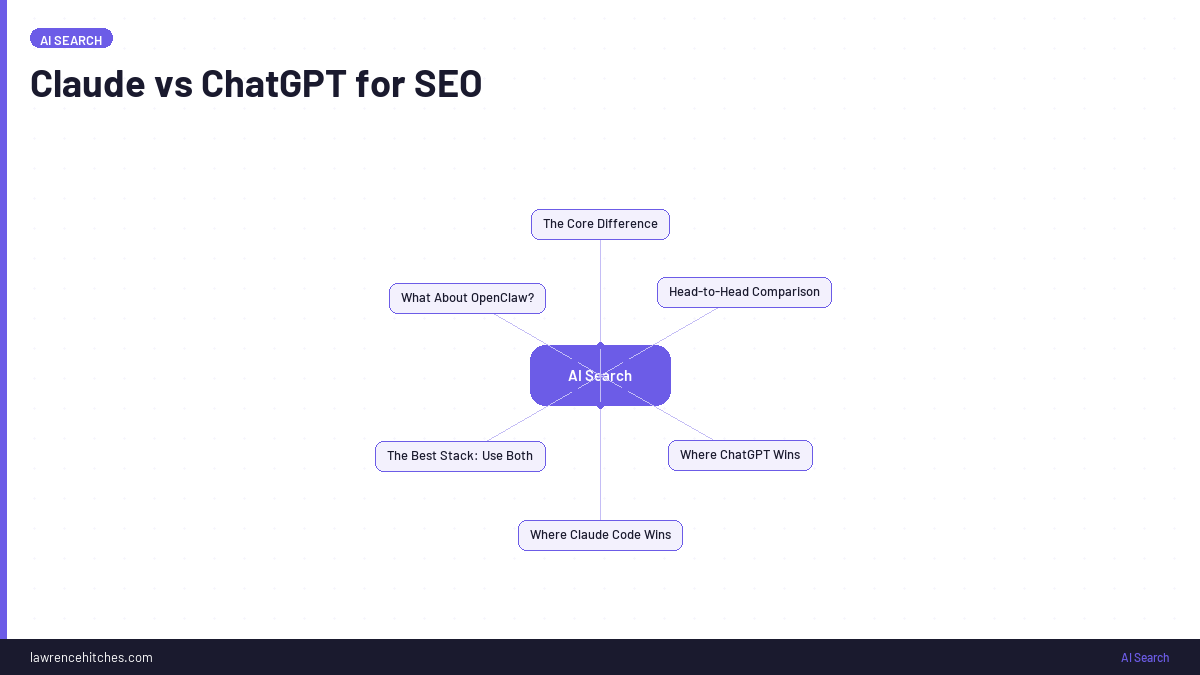
The Core Difference
The fundamental difference between Claude and ChatGPT for SEO is execution depth versus breadth. Claude Code operates as a terminal-based AI agent that can read files, run scripts, edit code, and execute multi-step SEO workflows autonomously, making it superior for technical SEO tasks, data analysis, and automation. ChatGPT excels at content generation, brainstorming, and conversational research where breadth of knowledge matters more than execution capability. In practice, most SEO practitioners get the best results using both: Claude for building and executing, ChatGPT for ideating and drafting.
ChatGPT lives in a browser tab. You type, it responds. It can't touch your website, run scripts, or make changes to your CMS.
Claude Code lives in your terminal. It reads your files, runs commands, accesses APIs, and pushes changes to your site. It's an agent, not just a chatbot.
This distinction matters enormously for SEO, where the gap between knowing what to do and actually doing it is where most strategies die.
Head-to-Head Comparison
Across the core SEO use cases we test at StudioHawk, content writing, technical audits, data analysis, keyword research, and link building outreach. Claude and ChatGPT each win in different categories. Claude outperforms on technical SEO (crawl analysis, schema generation, redirect mapping), data processing (GSC exports, log file analysis, rank tracking), and automation (building reusable workflows and scripts). ChatGPT outperforms on content drafting, creative ideation, image generation for blog posts, and conversational keyword research. Neither tool is categorically better; the right choice depends on the specific task.
| Capability | Claude Code | ChatGPT (Plus/Pro) |
| Generate SEO content | Yes - and publishes it directly to WordPress | Yes - but you copy-paste manually |
| Rewrite meta tags at scale | Yes - audits + rewrites + pushes via API | Can suggest rewrites, can't push them |
| Internal linking | Builds link graph, scores opportunities, injects links | Can suggest linking strategies only |
| Technical SEO audits | Runs scripts against your live site | Can review code you paste in |
| Browser automation | Yes (MCP) - can operate SEOtesting, GSC, etc. | No |
| File system access | Full read/write to your project | Code Interpreter sandbox only |
| WordPress API integration | Direct - create/update posts, meta, categories | Not possible |
| Persistent memory | File-based, survives across sessions | Limited memory feature |
| Scheduled tasks | Yes - cron-style recurring automation | No |
| Context window | Up to 1M tokens (Opus) | 128K tokens (GPT-4o) |
| Custom workflows (skills) | Yes - reusable, chainable, shareable | Custom GPTs (limited actions) |
| Cost | API usage or Max subscription ($100-200/mo) | Plus $20/mo, Pro $200/mo |
Where ChatGPT Wins
ChatGPT is the better choice for content creation, creative brainstorming, and tasks that benefit from its multimodal capabilities. Its image generation (DALL-E), web browsing, and plugin ecosystem give it advantages for visual content, real-time research, and integrating with third-party tools. ChatGPT’s conversational interface is also more intuitive for SEO practitioners who aren’t comfortable with terminal-based tools. For content teams producing blog posts, social media copy, or email campaigns, ChatGPT’s writing quality and creative range make it the practical first choice.
Content Ideation and Research
ChatGPT with web browsing is excellent for researching topics, finding angles, and brainstorming content ideas. Its conversational interface makes it easy to iterate on concepts quickly. For pure ideation, it's hard to beat.
Pros
- Zero setup, works in browser immediately
- Superior content ideation and creative writing
- DALL-E image generation built in
- Web browsing for real-time research
- Code Interpreter for data analysis
- Intuitive for non-technical users
Cons
- Cannot access your file system or CMS
- Manual copy-paste for every task
- No persistent project memory
- Cannot automate recurring workflows
- 128K context window (vs Claude's 1M)
- Cannot spawn parallel agents
Quick One-Off Tasks
Need to rewrite a single meta description? Want feedback on a title tag? Have a quick SEO question? ChatGPT's browser interface is faster for small, one-off tasks where you don't need to set up an environment.
Accessibility
ChatGPT requires zero setup. No terminal, no API keys, no project directory. For non-technical SEOs, the barrier to entry is much lower.
Data Analysis with Code Interpreter
ChatGPT's Code Interpreter can analyse CSV files, create charts, and process data. For one-off analysis of a keyword export or a crawl file, it works well - though it can't access your live site data.
Where Claude Code Wins
Claude Code dominates for technical SEO automation, data analysis, and any task requiring file system access or code execution. It can read your entire site structure, analyse crawl logs, generate schema markup, build internal linking maps, process Search Console exports, and execute multi-step audits, all from the terminal with no copy-pasting between tools. At StudioHawk, we use Claude Code to build reusable SEO skills (saved workflows) that standardise how we handle technical audits, content refreshes, and reporting across 300+ client sites. This kind of persistent, code-level automation isn’t possible with ChatGPT.
Pros
- Full file system and terminal access
- Direct CMS integration (WordPress, Shopify APIs)
- Reusable skills that compound over time
- 1M token context window (Opus)
- Multi-agent parallel execution
- Persistent file-based memory across sessions
- Scheduled/automated tasks
Cons
- Requires terminal comfort (basic CLI skills)
- Initial setup needed (API key, project directory)
- Less creative for content ideation than ChatGPT
- No built-in image generation
- API costs can add up at scale ($50-150/mo)
Scale
This is the decisive advantage. ChatGPT helps you optimise one page at a time. Claude Code optimises your entire site.
Real example: I needed to add internal links across 164 blog posts. With ChatGPT, I'd paste content, get suggestions, manually implement them - probably a week of work. With Claude Code, I described the linking logic, it built a scoring algorithm, generated a plan for 305 links, and executed it in 15 minutes.
CMS Integration
Claude Code connects directly to your WordPress REST API (or any CMS with an API). It doesn't just suggest changes - it makes them. Create posts, update meta tags, reassign categories, deploy sitemaps. All through conversation.
Persistent Workflows
With Claude skills, you build SEO workflows once and reuse them forever. A content refresh skill, an internal linking skill, a meta audit skill - these compound over time. ChatGPT custom GPTs are similar in concept but can't access your file system or run scripts.
Multi-Agent Execution
Claude Code can spawn sub-agents that work in parallel. Three agents exploring your codebase simultaneously while a fourth analyses competitor data. ChatGPT can't parallelise tasks.
Memory and Context
Claude Code maintains file-based memory across sessions. It remembers your site structure, writing style, category taxonomy, API credentials location, and project status. Every session starts with full context. ChatGPT's memory feature is improving but can't match this level of project awareness.
The Best Stack: Use Both
The optimal SEO AI stack in 2026 uses Claude Code for execution and automation, ChatGPT for ideation and content drafting, and a structured handoff between them. A typical workflow: use ChatGPT to brainstorm content angles and draft outlines, then use Claude Code to research competitor content, generate the article with SEO formatting, build internal links, add schema markup, and deploy it. This division of labour plays to each tool’s strengths. The practitioners seeing the biggest productivity gains aren’t choosing one tool, they’re building systems that use both in sequence.
They're not mutually exclusive. Here's how I use them together:
| Task | Tool | Why |
| Topic ideation + keyword research | ChatGPT | Better at open-ended brainstorming with web access |
| Competitor analysis | Both | ChatGPT for research, Claude Code for crawling sitemaps |
| Content writing | Claude Code | Writes in my brand voice using stored style guide, publishes directly |
| Meta optimisation at scale | Claude Code | Audits, rewrites, and pushes 100+ pages autonomously |
| Internal linking | Claude Code | Only Claude can build link graphs and inject links via API |
| Technical audit | Claude Code | Runs scripts against live site, checks headers, schema, speed |
| Quick SEO questions | ChatGPT | Faster for one-off queries and explanations |
| SEOtesting management | Claude Code | Browser automation creates tests without manual clicking |
| Site architecture changes | Claude Code | Bulk category reassignment, sitemap generation, taxonomy fixes |
What About OpenClaw?
OpenClaw is an open-source alternative that runs Claude-compatible models locally. For SEO teams that need to keep data on-premises or want to avoid API costs at scale, it's worth watching. The trade-off is setup complexity and model quality - Anthropic's hosted Claude models are significantly more capable than most open alternatives.
For most SEO practitioners, Claude Code with an API key or Max subscription is the practical choice. OpenClaw becomes relevant at enterprise scale where data sovereignty matters.
Cost Comparison for SEO Use
ChatGPT Plus costs $20/month for GPT-4 access with usage limits, while ChatGPT Pro at $200/month removes most limits. Claude Pro costs $20/month, and Claude Max (with extended context and higher usage) costs $100-200/month depending on tier. For most SEO practitioners, the $20/month tier of either tool handles 80% of daily tasks. The cost difference becomes meaningful at scale: agencies running Claude Code for automated audits across dozens of clients will hit usage limits faster than individual practitioners. Both tools offer API pricing for custom integrations, typically at $3-15 per million tokens depending on the model.
| Scenario | ChatGPT Pro | Claude Code (API) | Claude Max |
| Monthly cost | $200/mo | ~$50-150/mo (usage-based) | $100-200/mo |
| Audit 100 pages | Manual copy-paste per page | Automated in one run | Automated in one run |
| Refresh 20 posts/month | 20 separate conversations | Scripted with scheduling | Scripted with scheduling |
| Internal linking sweep | Not possible at scale | Full site in 15 minutes | Full site in 15 minutes |
| Time investment | High (manual execution) | Low (automated execution) | Low (automated execution) |
Claude Code with API usage is the most cost-effective for most SEOs. A full site audit + meta optimisation + internal linking sweep costs roughly $10-15 in API credits.
FAQ
Claude vs ChatGPT for SEO: which is better?
For SEO work, Claude and ChatGPT win at different things. Claude is stronger for long-form content, nuanced editing, and following detailed brand and style instructions. ChatGPT is stronger for quick research, broad ideation, and its larger plugin and browsing ecosystem. In my own workflow I draft and refine content with Claude and run research and data tasks through ChatGPT. There is no single winner for Claude vs ChatGPT SEO, match the tool to the job.
Is Claude better than ChatGPT for SEO in 2026?
For scale and automation, yes. Claude Code lets you build persistent SEO workflows that run across your entire site, chain multiple analysis steps, and integrate directly with your CMS. ChatGPT is better for one-off research tasks, quick content ideas, and data analysis with Code Interpreter. The best approach is using both: Claude for execution at scale, ChatGPT for exploration and ideation.
Which AI should I use for SEO: Claude or ChatGPT?
It depends on what you're doing. Use ChatGPT for content brainstorming, quick competitor research, and ad-hoc analysis. Use Claude for building reusable SEO skills, running site-wide audits, automating internal linking, and any workflow you'll repeat. At StudioHawk, we use Claude as the execution layer and ChatGPT as the research layer.
Can Claude replace SEO tools like Ahrefs or Semrush?
No. Claude doesn't crawl the web or maintain a backlink index. You still need Ahrefs, Semrush, or similar tools for keyword data, backlink analysis, and rank tracking. What Claude does is process and act on the data those tools provide. Export from Ahrefs, analyse in Claude, execute changes at scale. They're complementary, not competitive.
Is Claude's AI model better than GPT-4 for SEO content?
The models are comparable for content generation. Claude tends to produce more structured, nuanced writing. GPT-4 can be more creative with hooks and angles. The real difference isn't the model - it's the execution layer. Claude Code can do things with your content that ChatGPT physically cannot.
Can I use Claude Code without technical knowledge?
You need basic terminal comfort - opening a terminal, navigating to a directory, running a command. Claude Code handles the technical work (writing scripts, API calls, etc.). If you can use the command line at all, you can use Claude Code.
Should I switch from ChatGPT to Claude for SEO?
Don't switch - add. Keep ChatGPT for ideation and quick questions. Add Claude Code for execution and automation. They're complementary, not competitive, for SEO workflows.
Does ChatGPT have anything like Claude Code?
OpenAI has announced Codex (their agent coding tool) but as of early 2026, it doesn't offer the same local file system access, CMS integration, or persistent project memory that Claude Code provides. Custom GPTs with Actions are the closest equivalent, but they're far more limited in what they can execute.
Final Word
The question isn't "Claude or ChatGPT?" - it's "what do you need to do?"
For thinking about SEO, both work. For doing SEO at scale - auditing, optimising, linking, publishing, monitoring - Claude Code is in a different category entirely. It's the difference between having a consultant who gives advice and having a team member who executes.
Related Guides
- Claude for Technical SEO: Audits, Crawl Fixes, and Schema at Scale
- Claude for SEO Data Analysis: Combining SEOtesting, Semrush & GSC in One Conversation
- Claude for SEO Client Management: Building Databases That Scale Across 100+ Accounts
- Claude for Topical Maps: How to Build Site Architecture That Search Engines Reward
- Building Claude Skills for Niche SEO: Industry-Specific AI Workflows
- Claude for Content Optimisation: Refreshing, Expanding, and Improving Existing Pages
- Claude for Keyword Research: Clustering, Intent Mapping, and Gap Analysis
- Claude for Local SEO: Automating GBP, Citations, and Local Content
- Claude for Ecommerce SEO: Product Descriptions, Schema, and Category Pages at Scale
- Claude for Enterprise SEO: Scaling Audits, Governance, and Content Across Large Sites
- Claude Artifacts for SEO: Building Interactive Dashboards and Tools
- Claude for Competitor Analysis: Reverse-Engineering What's Working
- Claude vs ChatGPT for SEO: 15 Questions Practitioners Actually Ask
Want to run this without the manual work? The free Claude SEO skills the StudioHawk team uses on live client work package it up inside Claude Desktop.
Sources & Further Reading
Enjoying this? The 60-second versions live on Instagram.
Follow @lawrenceaiseo →Soaring Above Search
Weekly AI search insights from the front line. One newsletter. Six sections. Everything that actually moved this week, with a practitioner's take.
AI SEO consultant and AI search consultant helping brands appear in AI Overviews, AI Mode and ChatGPT. Chief of Staff at StudioHawk, Australia's largest dedicated SEO agency. Runs a measured three-channel playbook: Google, Bing and AI citations. Book a free consultation →