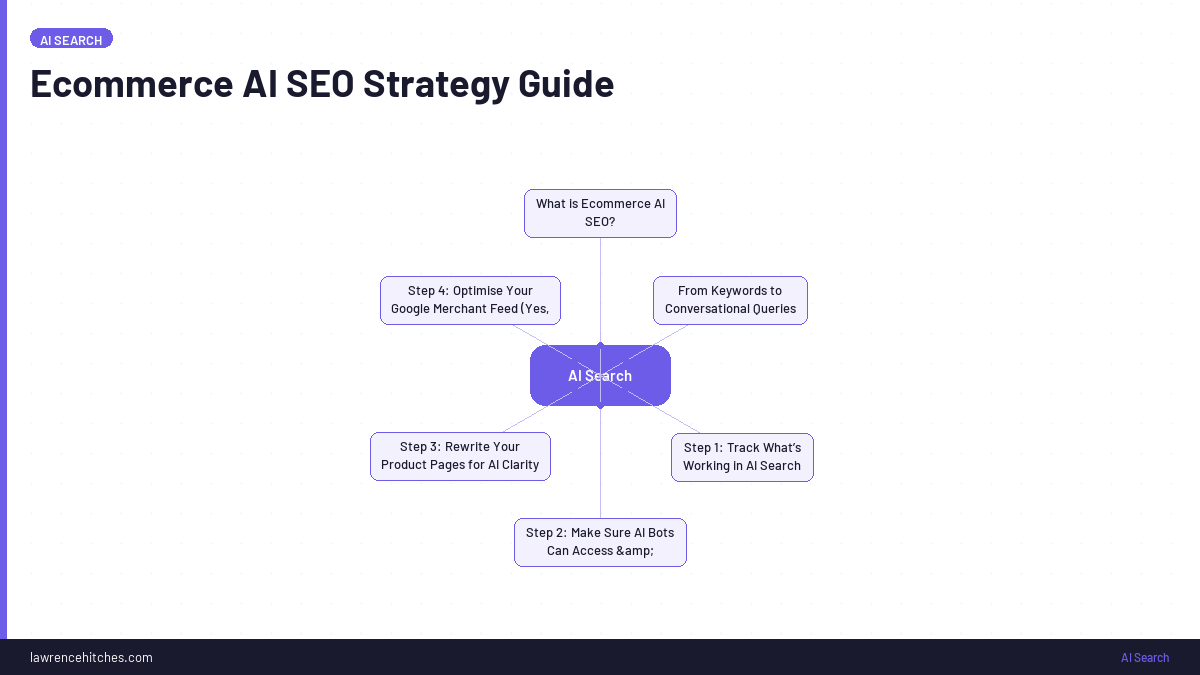
An AI SEO audit for an ecommerce store checks five things: whether you can measure AI visibility at all, whether AI crawlers can reach you, what third parties say about you, whether your feed and product pages are machine-readable, and whether your content covers the questions buyers actually ask. Everything below is the audit I run, in the order I run it.
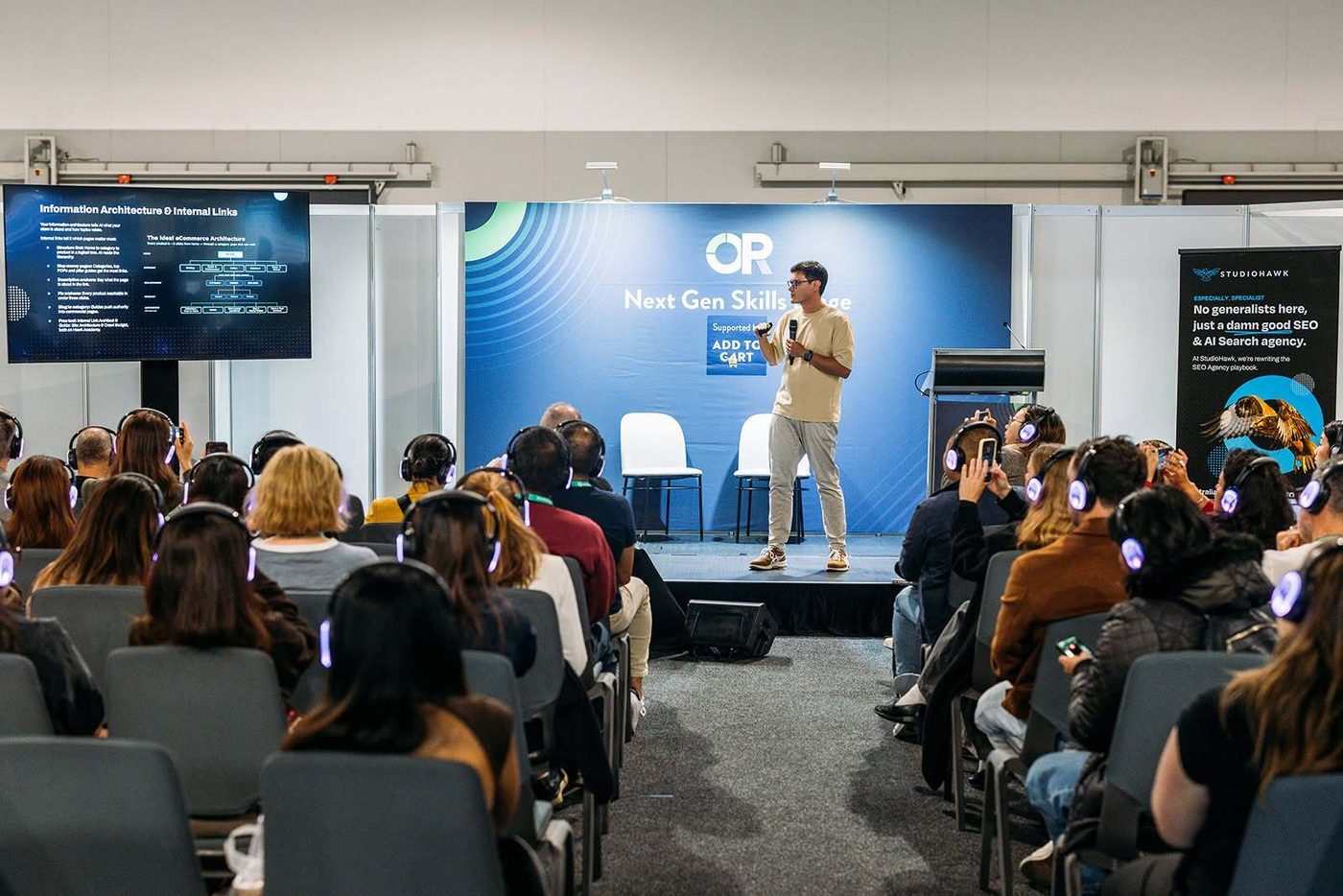
This is the workshop version, updated July 2026. I presented it on the Next Gen Skills Stage at Online Retailer in Sydney on 22 July 2026. Three things changed in the last year that broke parts of the old playbook: Shopify started reporting agentic traffic as its own channel, Google Search Console added social platform properties, and Merchant Center began surfacing AI shopping query data. If your last audit predates those, it has blind spots.
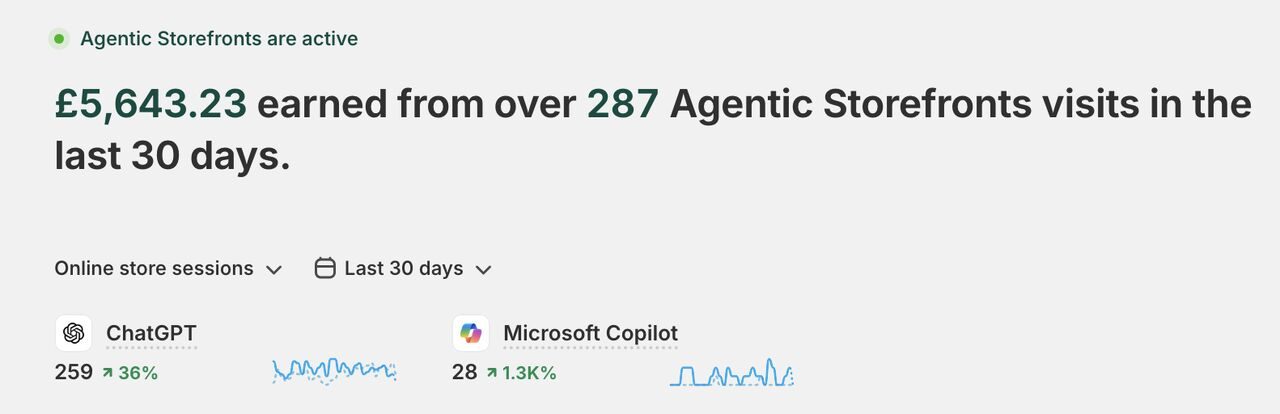
That screenshot is the single clearest argument for running this audit now. Agent-driven sessions are small in absolute terms and growing fast, and until recently they were invisible inside direct or referral traffic.
People searched → clicked → compared → decided.
Now?
They ask ChatGPT. Or browse Google’s AI Overview. Or get a ranked list in Perplexity.
You’ll ask a question, and they’ll do the curating, pulling in product images, summaries, specs, and user quotes, before anyone even visits a website.
That changes how people shop.
They’re skipping the search results entirely and getting what they need from an AI-generated response.
It’s like someone compressed the awareness and consideration stages into a single answer.
What is Ecommerce AI SEO?
AI-powered shopping is no longer a concept, it’s here.
ChatGPT’s new shopping interface now lets users browse product carousels, compare listings, and click straight through to purchase, all within a conversational flow. It’s actively recommending what to buy.
Meanwhile, Google has upgraded Search with Google’s AI Mode, combining Gemini with its massive Shopping Graph. Users can describe what they want in plain language , like “best compact stroller for travel in Europe”, and get a dynamic, visual panel of personalised results, updated in real time:
Together, these two shifts signal a new era in ecommerce.
But what’s happening, are people actually buying products through AI?
AI vs Google: 3-Month Ecommerce Traffic Snapshot
To add nuance to the conversation, we analysed a sample of ecommerce brands to understand what traffic, and ultimately revenue, is currently coming through from AI platforms compared to traditional channels.
Here’s how Google and ChatGPT stacked up against traditional channels:
Large Brand A
- Google Organic: 255,200 sessions → $1.02M
- Google Paid: 241,300 sessions → $1.17M
- ChatGPT: 134 sessions → $550
Large Brand B
- Google Organic: 192,400 sessions → $880K
- Google Paid: 174,100 sessions → $950K
- ChatGPT: 98 sessions → $230
Small Brands (C & D Combined)
- Google Organic: ~30,400 sessions → $133K
- Google Paid: ~36,000 sessions → $179K
- ChatGPT: 26 sessions → $0
Takeaway:
- Google Organic + Paid still dominate both traffic and conversions.
- ChatGPT traffic is <0.01% of sessions, but already converts for larger brands.
- The volume is small at the moment, but growing, now’s the moment to earn your place in AI results before competitors catch on.
Regardless, it’s clear that Google, the world’s biggest search engine, is shifting toward a more conversational interface, reflecting how people search today compared to the keyword-heavy habits of the past.
From Keywords to Conversational Queries
So here’s the shift in behaviour to be aware of:
Old Way:
“running shoes men”
A short keyword, basic intent.
New Way:
“What are the best men’s running shoes under $100 for marathon training?”,
A complete question, with filters baked in: price, purpose, audience.
This is how people now search in ChatGPT and Perplexity, full, multi-part queries that expect instant answers.
To show up, your product page (or blog) needs to pre-answer that kind of question directly, price, use case, top picks, comparison, reviews, all in one place.
Pages that mirror query intent at every level category, question, feature, and use case, are more likely to be visible in these search results.
If your product page doesn’t show up in those summaries with clean schema, trusted sources, and clear value?
So here’s a simple 7-step guide to winning eCommerce visibility in the AI SEO era.
Step 1: Track What’s Working in AI Search
AI search is trackable, so check out what’s working and double down.
Here’s how to find ChatGPT ecommerce metrics using standard GA4 tools:
Step 1: Navigate to the Right Report
- Go to Reports → Acquisition → Traffic acquisition
- Change the primary dimension to Session source / medium
Step 2: Filter for ChatGPT
- In the search bar above the table, type: gpt
- Press Enter
- You should see session sources like: chat.openai.com / referralchat.openai.com / (none)
Use That Data to Optimise
- UTM traffic from AI tools: Filter for session sources like chat.openai.com, perplexity.ai, you.com, etc..
- Use GA4 with regex filters:
chat\.openai\.com|perplexity\.ai|phind\.com|arc\.google\.com|gpt- Search Console impressions: Especially for long-tail product + guide terms, see what’s rising in visibility.
- Brand mentions and citations: Set up alerts with Profound, Feedly, or Google Alerts to catch off-site signals.
- Pages being paraphrased or cited: Manually check Perplexity, Bing Copilot, or Google AI Overviews. What’s being quoted? What’s missing?
Ask ChatGPT or Perplexity:
- “Best [product type] for [use case]”
- “What does [your brand] do?”
- “Is [your brand] good for X?”
What’s showing up?
What sources is it pulling from?
That’s the next battleground.
Which tools actually measure AI visibility?
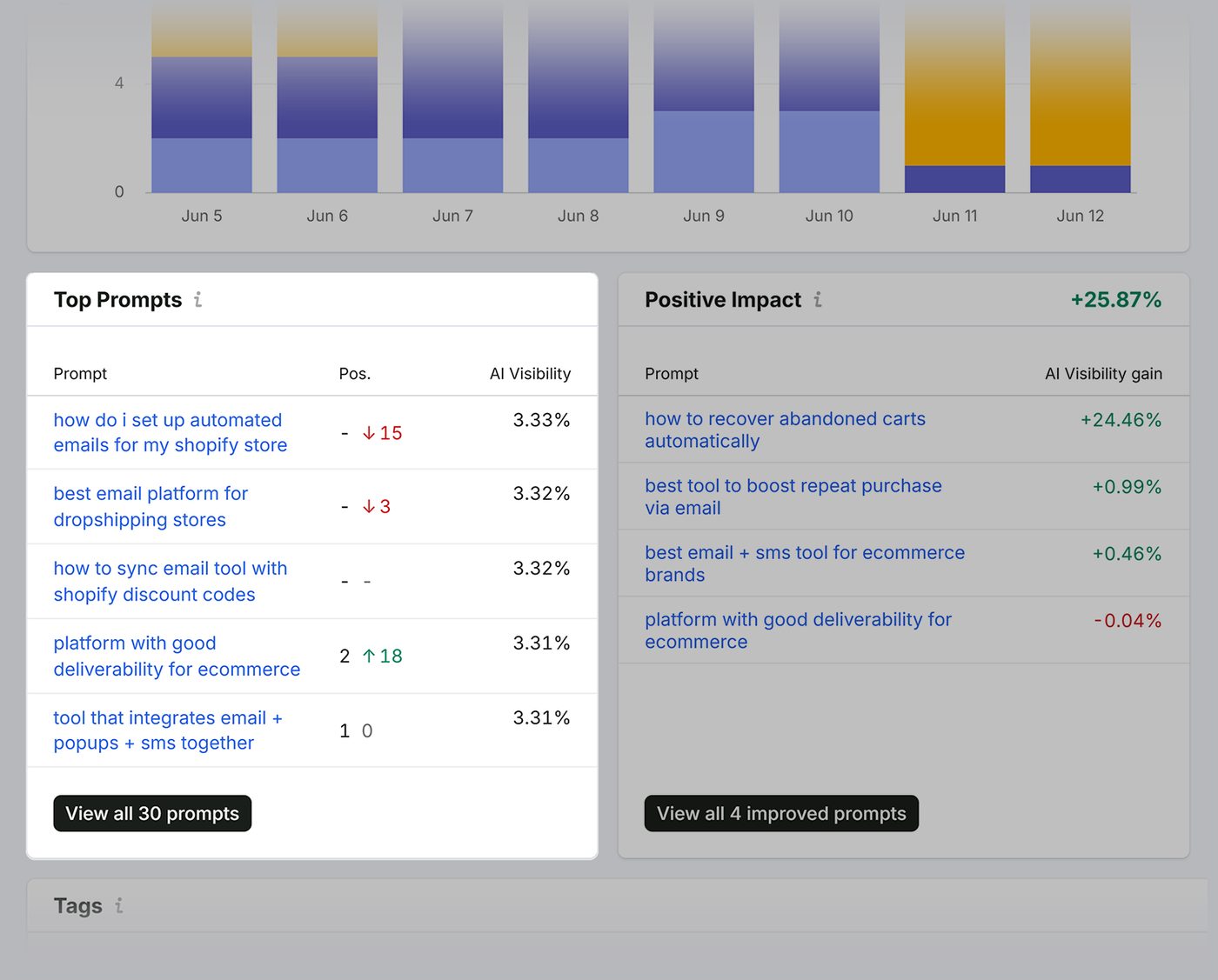
Prompt trackers sample a fixed set of questions and record whether your brand appears in the answer. Peec AI and Profound are the two I see most, and new ones launch monthly. Their consistency is questionable, because the same prompt can return different answers hour to hour, so read them as a directional signal inside a wider measurement lens rather than a source of truth.
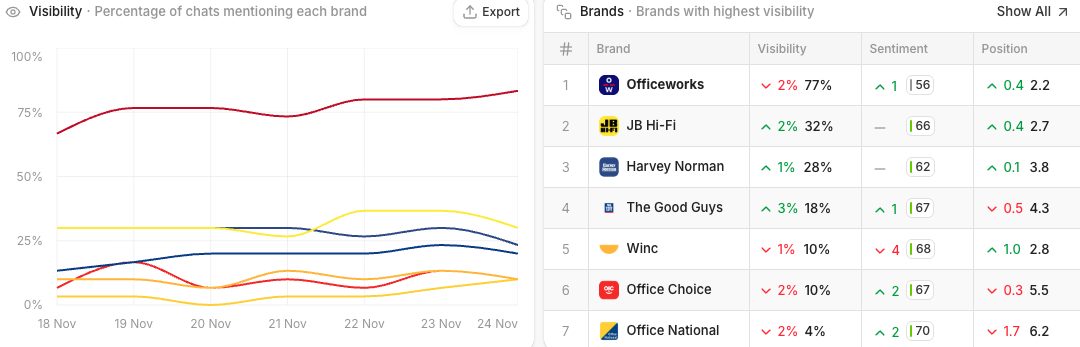
Run a fixed prompt set of 30 to 50 questions, unchanged month to month. Changing the prompts changes the result, so a moving prompt set measures nothing. Track which competitor wins the prompts you lose, because that tells you what to fix.
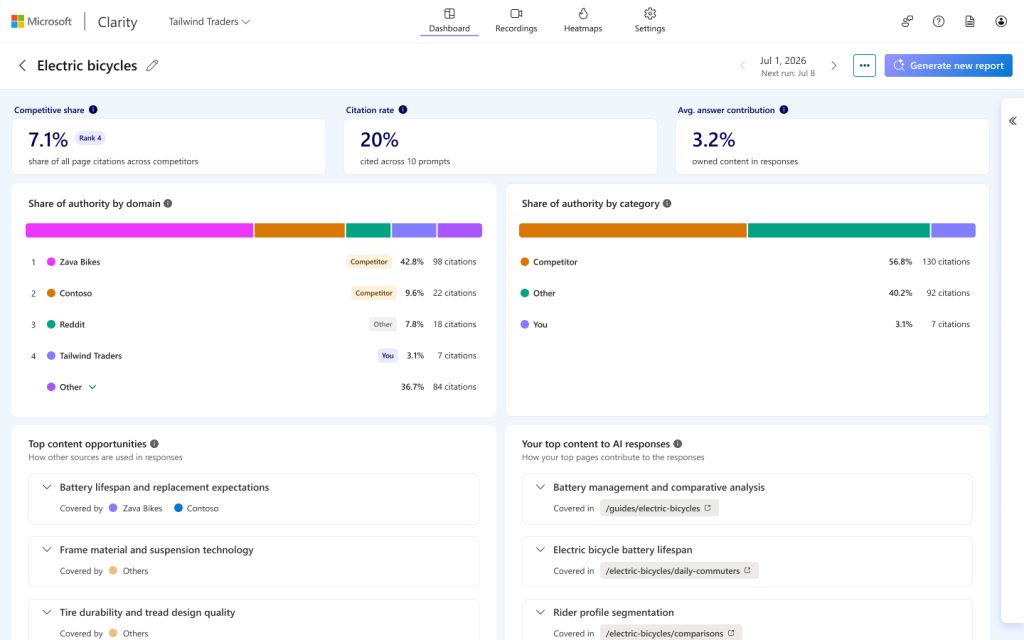
How do you track AI citations for free?
Microsoft Clarity reports AI citation data at no cost, including citation share and which sources the answer engines pull from. It is the cheapest entry point to citation measurement if a paid tracker is not justified yet.
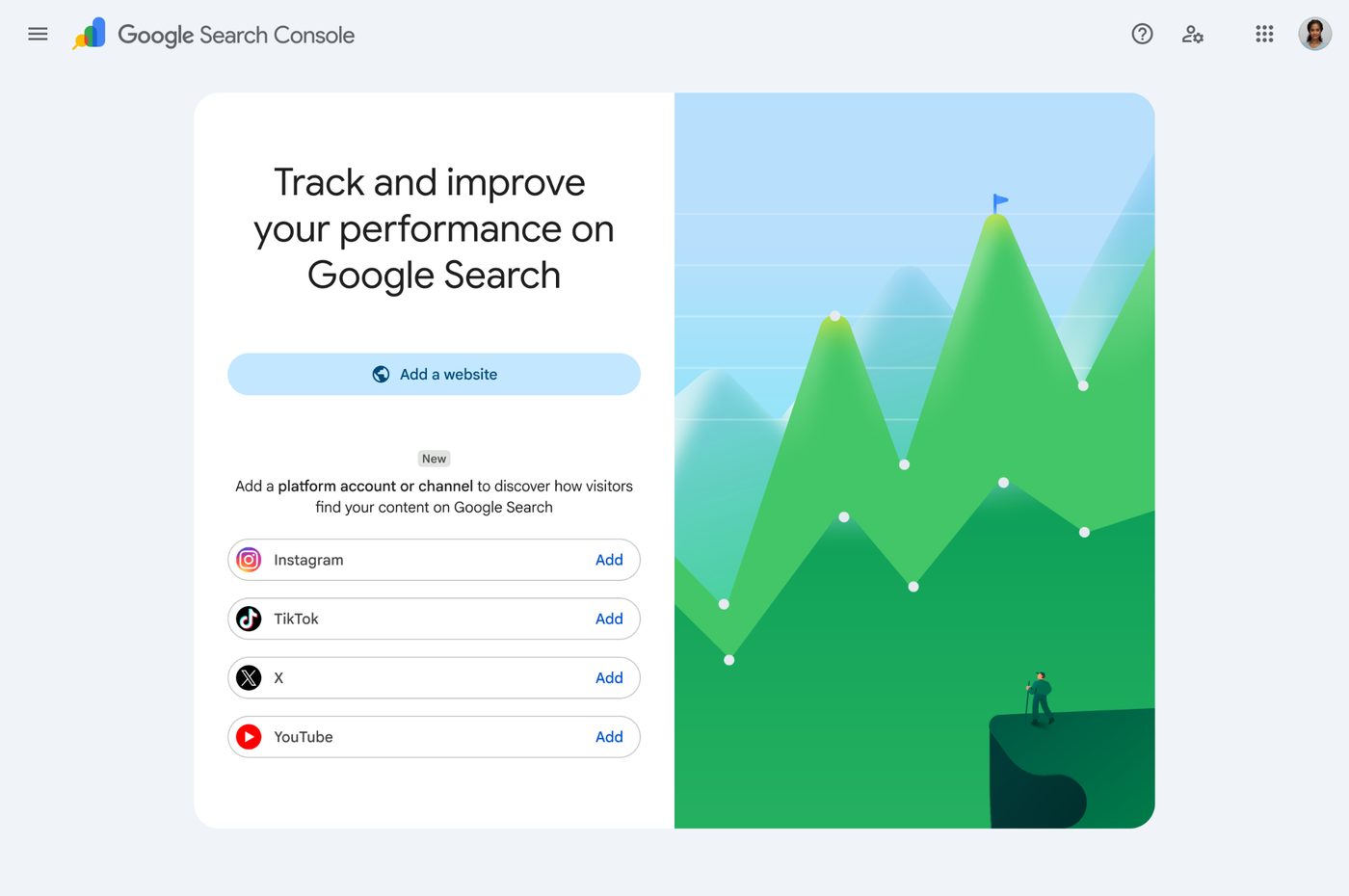
What does Search Console now show for social platforms?
Google Search Console added platform properties, so you can connect Instagram, TikTok, X and YouTube and see their performance inside Search Console itself. For an ecommerce brand this closes a long-standing measurement gap, because social surfaces increasingly rank in the same results your product pages compete in.
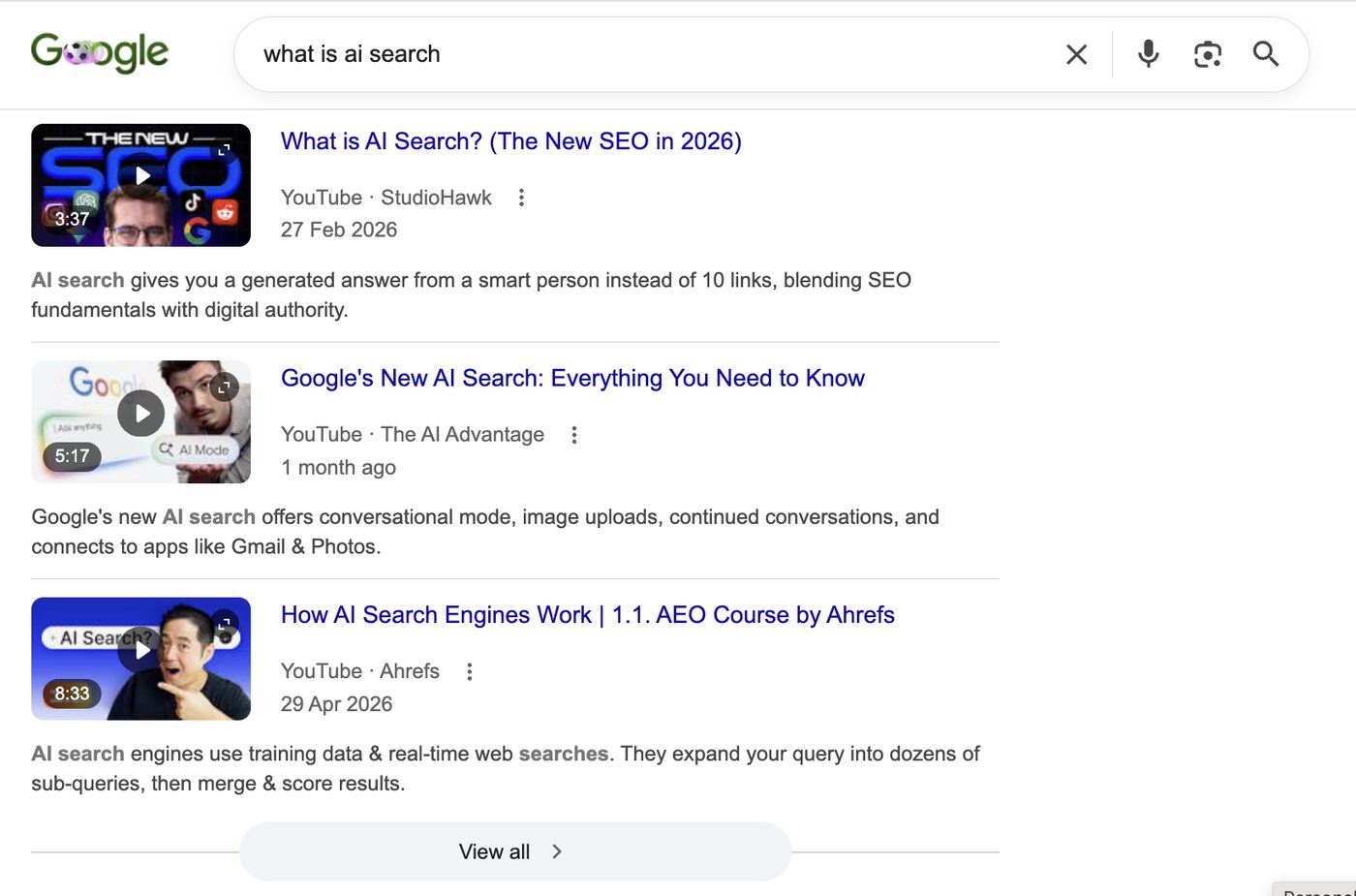
Video is the clearest example of why this matters. A well-optimised video can occupy the results page for a query your product and category pages cannot reach.
Step 2: Make Sure AI Bots Can Access & Understand Your Site
Visibility starts with access, so open up your website.
Technical AI SEO Tips:
- Ensure key product pages are included in your XML sitemap
- Don’t block AI bots like oai-searchbot or PerplexityBot in robots.txt
- Avoid hiding critical content in tabs, popups, or JavaScript-only elements
- Add structured data: Product, FAQPage, and Review schema
- Optimise for mobile and site speed (LCP < 2.5s, INP < 200ms)
The foundations of technical SEO still apply, and they’re more important than ever.
Step 3: Rewrite Your Product Pages for AI Clarity
Most product pages are designed to convert.
But AI tools like ChatGPT and Perplexity need clarity, structure, and extractable answers.
How to Optimise for Product Pages for AI SEO:
- Use a clear, specific H1: e.g. “120cm Walnut Standing Desk”, not “Adjustable Desk” (Helps AI match product to query)
- Add a tight intro (40-60 words): Answer: What is it? Who is it for? Why choose it? Think of it as your TL;DR, this often gets cited.
- Use proper H2 subheadings: Break sections into scannable answers:
- Include specs in plain HTML: Avoid hiding them in dropdowns, tabs, or JavaScript.
- Add a FAQ section with FAQPage schema: Bonus points for phrasing Qs in a conversational style.
- Include review markup with real quotes: Let customers describe use cases, it builds trust and fuels citations.
Test it: Would this page answer a Reddit thread or Quora post about the product? If not, add what’s missing.
Here’s a mock up example I made in Gemini based on this research:
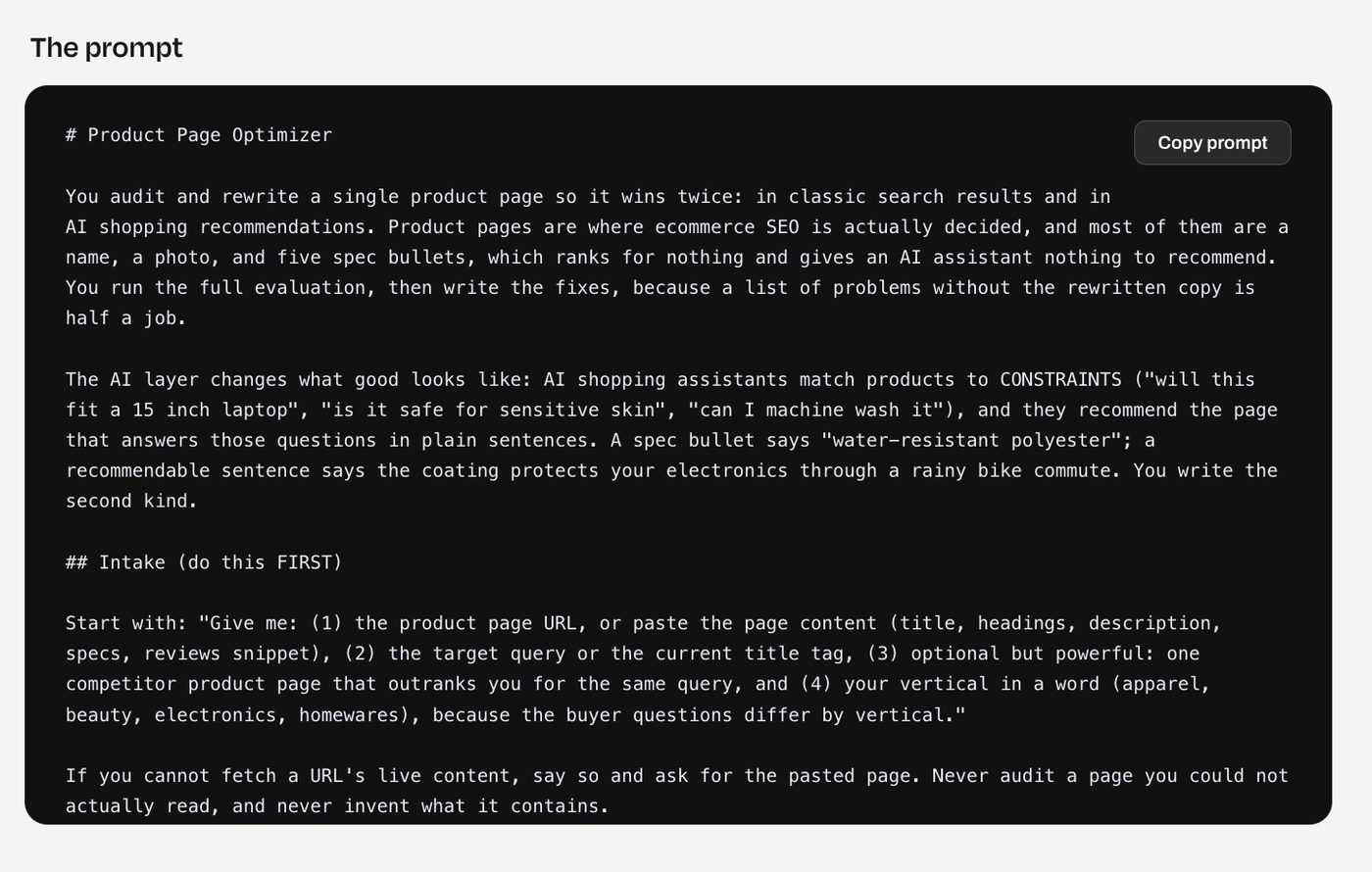
Roughly 55% of AI-referred sessions land on a product page rather than the homepage or a category, which makes the product page the front door for this channel. Five things carry most of the weight:
- A specific H1. "120cm Walnut Standing Desk" gives an AI system attributes to match against. "Walnut Standing Desk" gives it a guess.
- An opening that answers three questions in about fifty words: what this is, who it suits, why it beats the alternative.
- Real H2 subheadings rather than styled bold text, so the page segments cleanly into passages.
- Specs in plain scannable HTML, not baked into an image and not loaded by script.
- An FAQ built from real customer questions, in the words customers actually use.
The test to apply: could this page answer a stranger's question about the product without a human present? That is the standard the answer engines are holding it to.
Step 4: Optimise Your Google Merchant Feed (Yes, Even for Organic)
Your Merchant Center feed now powers Google’s AI Shopping summaries and “Shop with AI” carousels in Search.
How to Set It Google Merchant Centre for AI SEO:
- Install the Google & YouTube app in Shopify
- Connect your store to Google Merchant Center
- Ensure these fields are well-written and AI-friendly:
- Fix any disapprovals in the GMC dashboard
This is how you show up in “Shop with AI” results, often above the fold, before organic or ad results appear.
Even if your feed is perfect, AI won’t recommend your product if the on-page content is vague, generic, or missing structured data.
This is the handshake between feed and content, both need to be clean for AI visibility.

The feed is the part of an ecommerce store that most directly feeds AI shopping answers, and it is the part least often audited. Disapprovals quietly remove products from the catalogue. Generic titles lose to specific ones. Price and stock that lag the store produce answers that are wrong at the moment a buyer reads them.
Step 5: Build Topic Coverage for AI
AI doesn’t think in isolation, it connects the dots.
One great product page won’t cut it.
You need a network of content that covers the topic from every angle, so AI sees your site as the source.
Google isn’t hunting for a single perfect page anymore, it’s using query fan out to find trust worthy sources to build an answer.
How to Build a Topic Map for AI SEO:
- Create blog content that supports your products for AI search.
- Interlink pages using descriptive, natural anchor text (not just “click here”)
- Use consistent terminology across pages: e.g. “TV unit” + “entertainment console”, helps LLMs recognise entity relationships..
- Add comparison tables, image galleries, or visual guides These increase engagement and give AI more structured data to parse
More pages = more topical signals = more trust.
AI is building answer graphs and those graphs need depth.
What is query fan-out, and why does it change your content plan?
Query fan-out is when an AI system breaks one question into several sub-questions, answers each separately, then merges the results. Ask for the best Bluetooth headphones for comfort and battery life, and the system quietly runs something closer to four searches: most comfortable models, longest battery life, over-ear versus on-ear, and a battery comparison between specific brands.
The consequence for an ecommerce content plan is direct. You are no longer competing to rank for one query, you are competing to be the source that satisfies several sub-answers at once. A page covering one facet well gets beaten by a cluster covering every facet adequately, which is why hub and spoke structures outperform single long guides in this channel.
Step 6: Earn Off-Site Mentions AI Actually Trusts
AI builds a trust profile from off-site signals.
LLMs cite what they use, and what they use often lives on Reddit, YouTube, and expert blogs.
Pplatforms like Reddit and forums now carry more weight in AI answers than traditional backlinks.
How to Get Backlinks for AI SEO
- Use Digital PR to pitch stories or data that journalists actually want. Think less “we launched a product” and more “here’s something new or weird with a clear angle.
- Search for Reddit threads or Quora posts related to your product category, then earn a mention by engaging or adding value
- Pitch inclusion in curated roundups (e.g. “Best Standing Desks for Home Offices”)
- Collaborate with creators who publish long-form, indexed content, YouTube > TikTok, blogs > Instagram
- Use SparkToro, Profound, or custom brand alerts to spot when and where you’re mentioned,then amplify or respond
Backlinks still help, but off-site brand mentions are what feed the LLMs.
Think of this as semantic PR, you’re building context for AI.
Step 7: Become a Brand That Looks Real to AI
AI models judge your brand.
To get cited in ChatGPT, Perplexity, or Google AI Overviews, your brand needs to look real, credible, and experienced.
How to Build AI SEO Trust Signals:
- Add real author bios to key content, highlight founders, designers, or internal experts with relevant experience
- Publish first-hand content, think teardown posts, side-by-side comparisons, buying guides, or real usage tips.
- Show your brand is human, use real photos: team, packaging, behind-the-scenes, product in context.
- Mark it up with schema use Article, Review, VideoObject, ImageObject, so AI can extract meaning from every element
- Get mentioned off-site in trusted places even unlinked brand mentions on Reddit, Trustpilot, or forums add credibility.
AI is building a knowledge graph of who knows what and who to trust.
The Agentic Future: When Your Buyer Is a Bot
We’re entering a world where your customer has an AI agent shopping for them.
These personal agents don’t “search” the way we used to. They:
- Filter products by preference, price, and trust
- Build shortlists based on citations
- Only surface brands that make sense to a machine
- Decide what to buy or recommend on the user’s behalf
THis is an emerging space to watch as AI agents get better and smarter.
TL;DR: Your AI eCommerce SEO Checklist
- Pages structured for answers → H2s that mirror questions + 40-60 word summary blocks
- Schema fully implemented → Product, FAQPage, Review on all key pages
- Product pages are clear, semantic, and crawlable → No hidden tabs, dropdowns, or JS-only content
- Topic clusters support product discovery → Interlinked blog posts and comparison guides
- Off-site brand mentions in trusted spaces → Reddit, YouTube, expert blogs, forums
- AI tracking is set up and monitored → UTM-based traffic, citation checks, and prompt testing
Final Word: Your Product Pages Are Now Your Pitches
Every product page is a pitch to an AI model.
To be chosen, your content needs to be:
- Structured → Clear headings, direct answers
- Trusted → Real reviews, author bios, schema
- Easy to extract → Crawlable HTML, not hidden in tabs
- Backed by authority → Off-site mentions AI respects
This is the new funnel: Be part of the answer.
Sources & Further Reading
Enjoying this? The 60-second versions live on Instagram.
Follow @lawrenceaiseo →Soaring Above Search
Weekly AI search insights from the front line. One newsletter. Six sections. Everything that actually moved this week, with a practitioner's take.
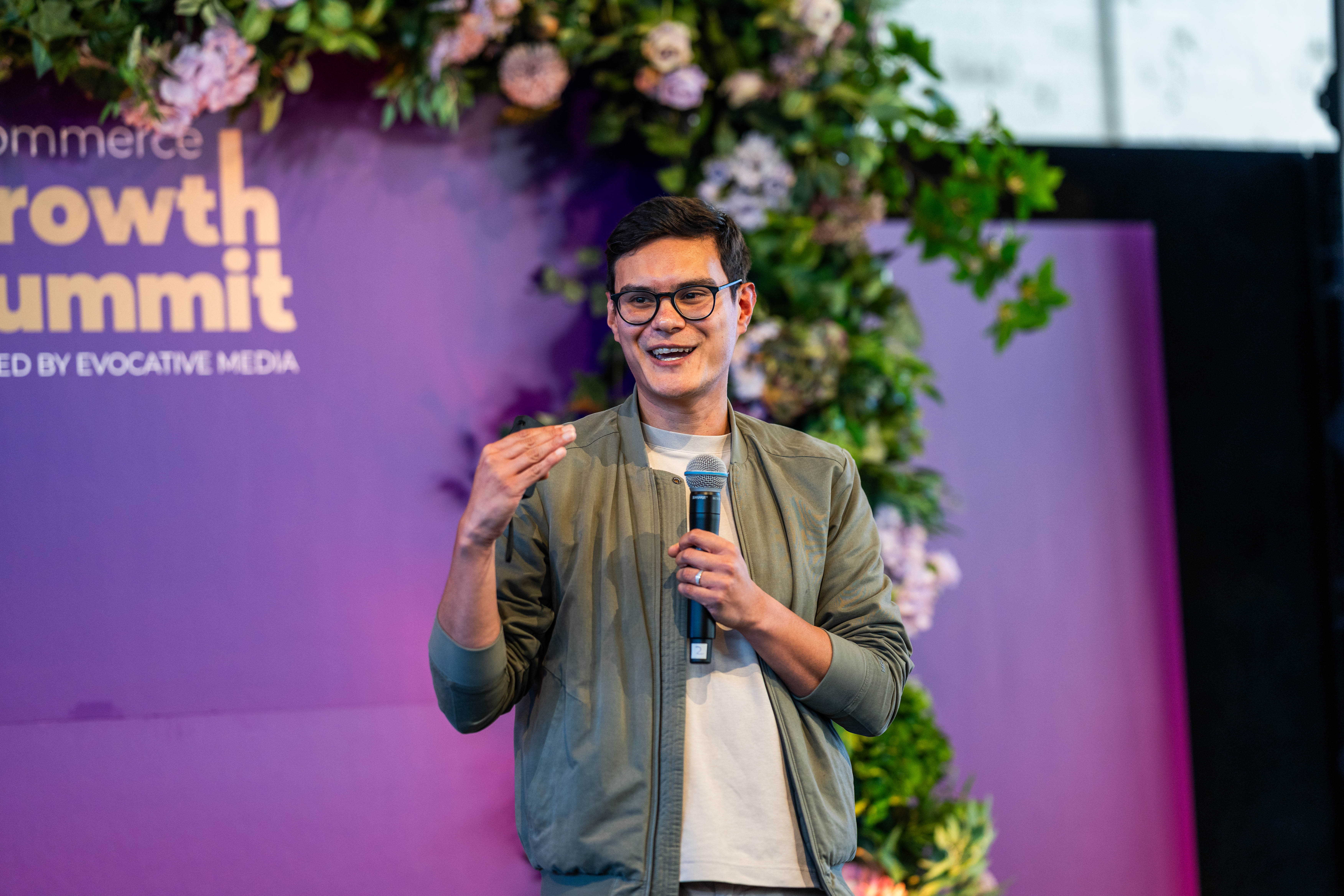
AI SEO consultant and AI search consultant helping brands appear in AI Overviews, AI Mode and ChatGPT. Chief of Staff at StudioHawk, Australia's largest dedicated SEO agency. Runs a measured three-channel playbook: Google, Bing and AI citations. Book a free consultation →